• About
  • Past Laureates
  • Blog
  • Events
  • Resources
  • Contact Us

Piedmont Laureate

~ Promoting awareness and heightened appreciation for excellence in the literary arts throughout the Piedmont Region

Piedmont Laureate

Author Archives: Tamara

This weekend: Triangle Bake-Off & FB live interview with RDU on Stage

04 Saturday Apr 2020

Posted by Tamara in Tamara Kissane

≈ Leave a comment

Tags

playwriting, triangle bake-off, upcoming events

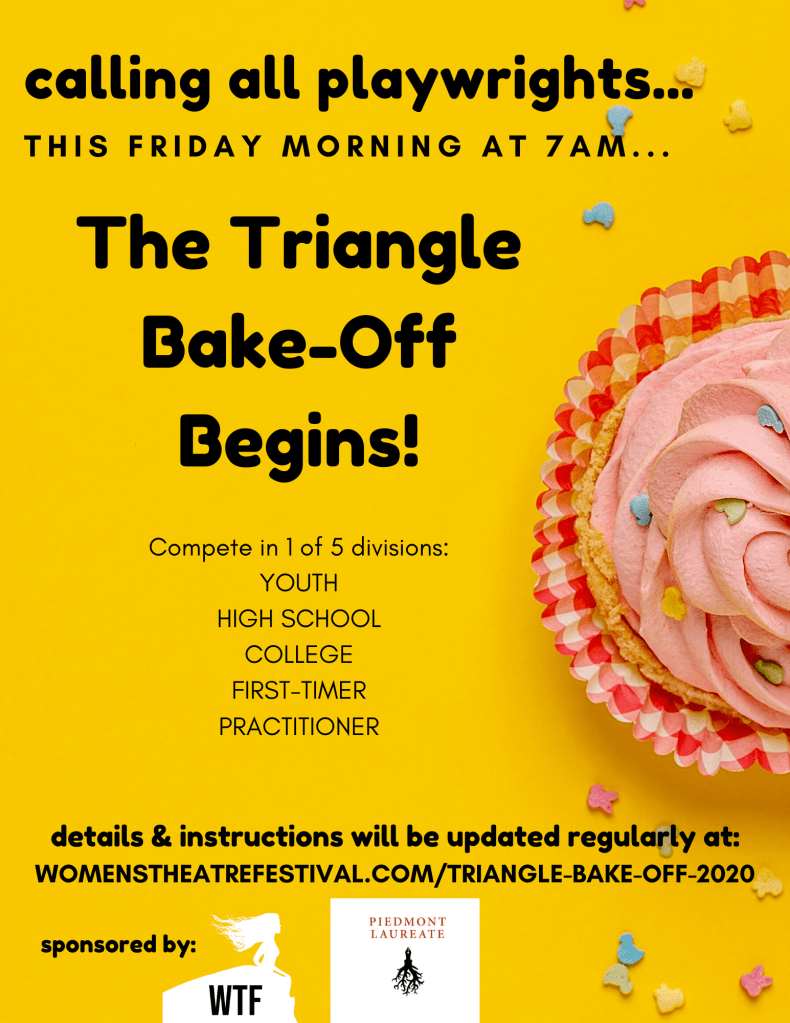
#1: WANNA WRITE A PLAY THIS WEEKEND?

THE TRIANGLE BAKE-OFF HAS BEGUN. 

This is a quick and (hopefully stress-relieving) short playwriting competition. There’s a youth category if your kids are looking for something to do – OR – perhaps this will be a way for you to blow off some steam using writing as a tool. 

On Friday, April 3 at 7:00 am, the Women’s Theatre Festival released the list of “secret ingredients” that each script must include. Submissions must be received by 7:00 pm on Sunday, April 5 to beconsidered. 

Here are the ingredients:

For more information, read this blog post: Calling All NC Playwrights! Announcing the Triangle Bake-Off!

#2: WANNA SEE/HEAR ME ON FACEBOOK LIVE? EEEP!

I’LL BE THERE, SUNDAY EVENING.

On Sunday evening after you’ve turned in your play, I’d love for you to hop online and listen to a conversation with me and Lauren Van Hemert of RDU On Stage. 

Lauren has put together an amazing series of guests over the last few weeks, and I’m feeling honored to be included in the line up. We’ll talk about the Piedmont Laureate-ing, writing audio fiction, and parenting during this bonkers time while trying to make art and get things done. (Spoiler alert: life is confetti and what is time). 

We’re scheduled for a Facebook Live event this Sunday, April 5 at 8pm EST. 

Hope to talk to you then!

Calling All Playwrights! Announcing the Triangle Bake-Off!

31 Tuesday Mar 2020

Posted by Tamara in competition, Tamara Kissane

≈ Leave a comment

Tags

bake-off, playwriting competition, writing plays

ANNOUNCEMENT:

In collaboration with Tamara Kissane, the 2020 Piedmont Laureate, and local theatre artist Hayden Tyler Moses, Women’s Theatre Festival (WTF) proudly announces the Triangle Bake-Off Competition.

This spirited playwrighting competition is open to North Carolina residents of all ages and experience levels. 

The Bake-Off will begin at 7:00 am on Friday, April 3 when WTF releases the list of “secret ingredients” that each script must include. Submissions must be received by 7:00 pm on Sunday, April 5 to be considered. See below for additional timeline and info.

The ingredients, all of the submissions guidelines, and the submissions can be found on the WTF website: https://www.womenstheatrefestival.com/triangle-bake-off-2020

Competitors will elect to compete in one of five divisions: 

● Youth (anyone under high school age) 

● High School (any current high school student) 

● College (anyone currently enrolled at an institution of higher learning) 

● First-Timer (anyone who is NOT a student and has NEVER written a play) 

● Practitioner (anyone who is a practicing writer or artist) 

Submissions will be read and scored by a team of adjudicators who will select 3-5 finalists per division. Those finalists will receive a reading of their drafts through the WTF Virtual Plays Club. Audiences will then get the chance to vote for their favorites. The play in each division that receives the most votes will receive a professional staged reading during WTF’s Occupy The Stage staged reading festival in November of this year.

Throughout the next six months, Piedmont Laureate Tamara Kissane will offer the playwrights coaching and feedback as they prepare their final drafts for performance. 

For more information, email info@womenstheatrefestival.com and stay tuned across their website and social media platforms. 

RULES & GUIDELINES: 

1. All playwrights must be North Carolina residents 

2. Playwrights may identify as any gender. 

3. Playwrights may submit a maximum of 15 pages* 

4. Playwrights must follow formatting guidelines** 

5. Playwrights must use all of the 4 ingredients in their “recipes” 

6. Plays should be written for 4 actors to perform. If your script includes more than 4 characters, please include doubling instructions. 

7. Submissions must be received via the submission form on the WTF website by 7:00 pm on 04/05/2020. 

*The spirit of the Bake-Off is not finished or perfect scripts, but an interesting and exciting  START. You may submit a draft that is fewer than 15 formatted pages. 

**Formatting guidelines may be relaxed for very young (ie 5-10 years old) playwrights. 

RESOURCES & FURTHER INFO: 

● Visit the WTF website for full info on formatting guidelines and to learn more about the history of Bake-Offs. 

● Each submission will be read and scored by 3 adjudicators chosen because of their expertise in that particular division. Submissions will be read “blind,” meaning that the adjudicators will not see the name or other identifying information of the playwright so that they may be as impartial as possible. 

● Adjudicators are NOT eligible to submit for any division in the competition. 

● A Facebook Event will be created for each Virtual Performance via WTF’s Facebook Page. All of the virtual performances will be live-streamed via Twitch.TV/wtheatrefestivalnc and will be available for viewing on our website for voters who miss the live event. 

● Listeners will be asked to make a small donation (suggested $5).

● The play from each division that receives the most votes will have a professionally produced staged reading during Occupy The Stage 2020. These playwrights will also receive a small honorarium.

Unlike most WTF sponsored events, male-identifying playwrights will receive equal consideration and will have their plays featured during a new section of Occupy called “The Ally Hour.” 

If you want to listen, here are six conversations for you.

27 Friday Mar 2020

Posted by Tamara in Tamara Kissane

≈ Leave a comment

Tags

artist soapbox, new plays, playwriting, writing for young audiences

Friends,

I am working to bring the voices of writers in our community to your ears as quickly as possible via the Artist Soapbox podcast.

May these voices and conversations be:

  • comforting or stimulating
  • thought-provoking or soothing
  • inspiring or sheltering
  • or whatever you need at this moment in time.

My needs seem to change from hour to hour, but I do find comfort in the connection I feel after a 40 minute conversation with another human being about creativity, life, writing, process, and meaning. These conversations are sustaining me in a moment when I feel very isolated and worried.

You’ll see the most recent podcast episodes listed below, in case you’ve missed them. If now is not the best time for you to listen, then they will be here when you are ready. If you have questions that you’d like me address in upcoming interviews, please let me know. Sending you love.

  • 095: What’s next? Big feelings + big love.
  • 096: Writing audio fiction for young audiences with Dania Ramos & Michael Aquino of Timestorm
  • 098: Compassion, Care, and Children’s Lit with Amber Wood, the Storylady
  • 099: Growth, impact, and accessibility with podcast critic and advocate Elena Fernández Collins
  • 100: My Geriatric Uterus with Lormarev Jones, playwright and solo performer
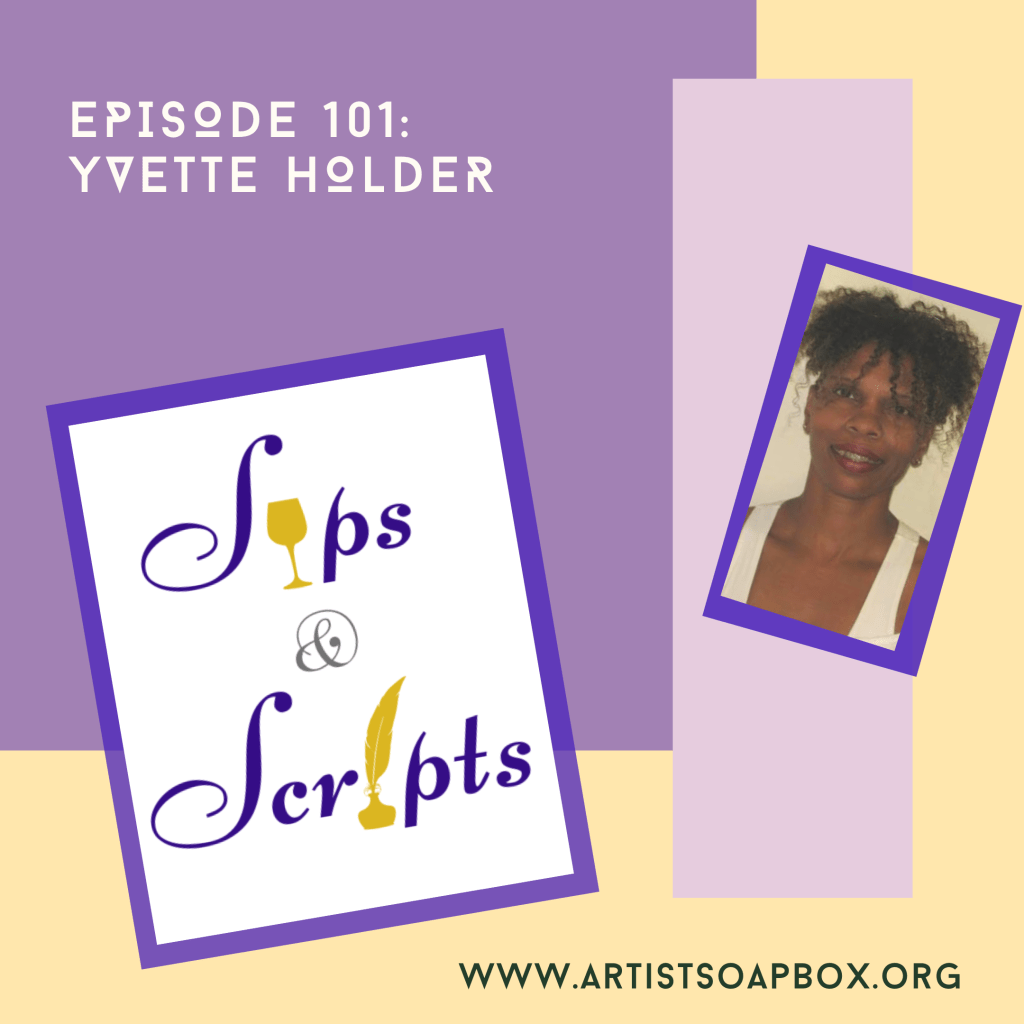
  • 101: Supporting North Carolina playwrights with Yvette Holder, the creator of Sips & Scripts

[Note: the episodes listed above are related to writing from March 13-27. There are additional episodes with other creatives at www.artistsoapbox.org. Please reach out if you need a transcript.]

What’s next? Big feelings + big love.

13 Friday Mar 2020

Posted by Tamara in Uncategorized

≈ 2 Comments

Tags

audio fiction, community, coronavirus, podcast, staying connection, Tamara Kissane

The text below is a transcript from today’s Artist Soapbox podcast episode (if you didn’t know, I am the host of the Artist Soapbox podcast). If you would like to hear my voice saying those words, then you can do so via the Artist Soapbox podcast here or via any podcast platform such as Apple Podcasts, Google Podcasts, etc.

It’s very likely that the Piedmont Laureate events that are scheduled for the next month(s) will be postponed. In the meantime I am thinking of ways to say connected. Perhaps you have ideas?

You are not alone

Transcript:

Well, Happy 2020! It’s been a few months since I released an episode on Artist Soapbox.

These are strange and uncomfortable times. I want you to know that I’m thinking of you wherever you are, I’m thinking of you and sending you love.

At this moment in time and for some undefined period into the future, many of us feel that our way of life, state of mind, health, loved ones and livelihood are under threat — by COVID-19 sure but also by the response or lack of response or lack of support in our particular communities. If you are having big feelings, as I am as a result of this, I just want to say that it’s totally understandable — big feelings are coming up because these things: our way of life, state of mind, health, loved ones, and livelihood are big deals. People are suffering. If you are feeling isolated and at sea, as I am, then I also want to say that you are not alone and I am sending you love.

To be sure, I am not an expert in anything, nor am I particularly skilled in any way that could be helpful in a time of crisis, and I don’t say that in a self-deprecating way, it’s just true. However, I’m thinking a lot — I’m thinking hard about community and what it means to build and maintain community when we cannot congregate….when we cannot be face-to-face.

I’m thinking about how we can care for each other and care for ourselves and pull together in a way that makes us feel less lonely and perhaps even momentarily soothed. If you’ve been listening to this podcast, then you’ll also know that for a long time I’ve been thinking about how we can make art and tell stories when we cannot physically show up together. That was the genesis of this podcast and the work I’m doing in audio fiction and…. All of this has been on my mind increasingly in the last few weeks.

So I want you to know that I’m going to start pushing out content as often as I can via Artist Soapbox — I’ll do as much as possible given my family and work responsibilities – thru the podcast and the website — if you have the brain, heart, life space to listen or read, then I hope that content makes you feel less alone or distracts you or reminds you that we are a community of creative kick-ass people. Because we are. And you are a part of that.

A month ago, I was planning this episode to be an update on all the cool things I’ve been doing since my last episode in 2019 and everything you have to look forward to from me in 2020. I had a long list. It was pretty exciting! The truth now is that the multitude of live events I had planned for the next 6 weeks will almost certainly be postponed and perhaps cancelled indefinitely. I’m in a place where I need to recalibrate my expectations, my priorities, and reconsider what I have to look forward to in that regard.

And I think I’m reconsidering that what I have to look forward to is this. If you are out there and you can hear my voice….I like to hear from you now. What would soothe you, distract you, entertain you? What would you like to hear about? What are your questions? I am a playwright, audio fiction writer, actor, director, producer, parent, creative coach and podcaster — those are things I can talk about. I can also connect with other people and they can talk about what I can’t.. Friends, if you share your thoughts with me, then I will share my voice and the voices of my guests with you. Email me at artistsoapbox@gmail.com.

If any of you are audio fiction fans, you might have seen a tweet from Mr. Paul Bae who’s an amazing creator associated with big audio fiction series like the Black Tapes, The Big Loop, and more recently The Marvels podcast. He’s amazing. Anyway, Paul Bae recently tweeted that “Podcasters are the cockroaches of the entertainment world during pandemics” and as much as I groaned when I read that, I also embrace the idea that this medium could be a way that our community can bridge what feels like a chasm in our usual connection and remind us that we have voices. We are here. We can make things. We are together. I’d love to hear from you.

Friends,there are many people who are providing resources and wisdom and helpful tips for weathering this crisis and the impact. Please seek out real experts and reliable sources of information. Let’s agree to care for each other, care for those who are most vulnerable, and care for ourselves.

Stay safe out there. Be in touch. Wishing you peace, sincerely.

If Lady Gaga’s boyfriend’s ex-girlfriend can do it, then we can too

28 Friday Feb 2020

Posted by Tamara in comparison

≈ 2 Comments

Tags

comparison, Tamara Kissane, Writer's Block, Writer's journey

  • How often do you compare yourself to other writers?
  • How do you compare yourself to other writers?
  • Afterwards, how do you feel? Inspired or deflated? Encouraged or shut down?

This is how I feel when I start sliding down the comparison chute:
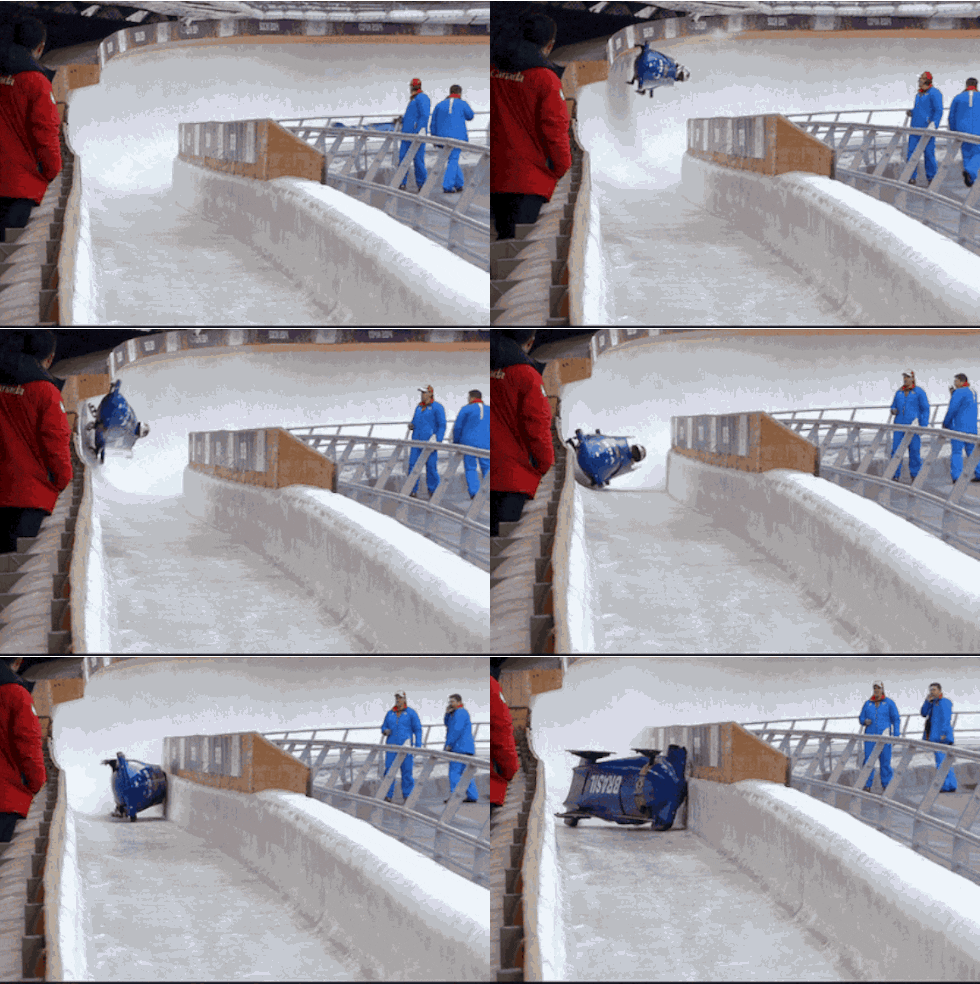
It’s almost impossible to avoid these days, right? (The comparison chute, not the luge.)

Even without the luge-like experience of scrolling through social media which can leave me cold and potentially broken on my worst days or winded and manic on my best days…even when I disconnect entirely, my day-to-day conversations are primed to invite ranking and stacking myself against others. “How’s so-and-so doing?” “Oh, I heard that so-and-so is blah blah blah.” “Whatever happened to so-and-so?” “Did you hear about so-and-so?” “What did you do today?”

That reflexive action bubbles up to measure myself against other people’s circumstances. “I don’t want to be that.” “I wish I could do that.” “I will never.…”

Friends, raise your hands if you know this is toxic. (Ok, raise your hand right now because I am telling you This. Is. Toxic.) Raise your hands if you do this sometimes.

Right. Well, that way madness lies. That way is a massive writing roadblock. That way squelches our unique voices.

To be plain, if we want to do some primo writing and lessen the suffering that accompanies it (there’s always pain, but perhaps we don’t have suffer so much?), then in my opinion, we have two options:

  1. Never compare.
  2. Use others as inspiration and encouragement.

Option number 2 works best for me. Which one works for you?

There’s a fun article in the New York Times Opinion section written by Lindsay Crouse titled My Ex-Boyfriend’s New Girlfriend Is Lady Gaga. The story is pretty self-explanatory, but the twist is that Lindsay Crouse uses this discovery as an opportunity to lift herself up. Yes!

Lady Gaga is amazing. Comparing yourself with her is incredibly motivational, and I recommend you try it, regardless of how you relate to who’s dating her.

At least, that’s what I did.

I like Lady Gaga just fine, but I actually find my comparison-turned-inspiration closer to home. I’m inspired by the artists and friends who surround me and with whom I have long and deep relationships or short and meaningful ones. Reading Crouse’s positively framed opinion piece brought to mind a conversation that turned into a blog post written in 2017. You’ll see it below. I was excited to dust it off and remind myself that time is best spent in high-frequency mode.

How about you? (And, let me know if this is useful.)

*******

High-Frequency Comparison is Part II of a blogversation on the Artist Soapbox website about comparing ourselves to other artists. Read Part I, by Mara Thomas first. (Part I and Part II were originally posted in November 2017.)
**
Over churros at Cocoa Cinnamon, Mara and I spent some time talking about what she termed “low-frequency comparison.”  Low-frequency comparison is the kind of comparison you use to make yourself feel bad – a self-flagellating tool. “High-frequency comparison” on the other hand is the kind of comparison you use to encourage yourself – an inspirational tool. Low-frequency’s easy to slide into. It’s familiar, simple and doesn’t require us to make any changes in behavior or thought patterns. Low-frequency comparison allows more of the same…and more of the same is easier, the path of least resistance.


So, if comparison sling-shots you directly into low-frequency territory, then I totally agree with Mara, just don’t go there. Don’t do that to yourself. Stop comparing immediately. If you consistently race towards low-frequency, that’s a signal to investigate your own awesomeness for awhile and learn to embrace your self-worth. That’s a signal that you need to fill up your self-love bucket. Do that, please. Focus on reframing your vision of yourself because that internal re-tooling will pay you dividends over and over. You have worth. You deserve to believe that.


If however, you’re feeling pretty solid about your value as a human and artist, and if you’d like to make positive changes, then open yourself to some high-frequency comparison. Look around at people you admire (you don’t need to start with the superstars, there are likely fabulous peeps right in your local orbit) and see what those you admire are doing. Is anyone living a life closer to the one you want to live? Is anyone making art that’s closer to the art you want to make? Is there anyone you can use as an example or model for whatever changes you want to make?


Re-orientating to high-frequency comparison has helped me enormously and in significant ways. It’s my go-to fixit. I think, “What would this person do right now? How would that person solve this problem/approach this mess/respond/decide/etc? What would the person-I-admire say right now?” And the ideas start flowing because people are doing MANY THINGS better than I am — good for them! —  and their examples teach me, inspire me, encourage me to try.


Ultimately, I’m still me being me, and I’ll do it my way, but I feel like I have more fuel in the tank. Because to be honest, in several areas of my life, I’ve run out of ideas. Over the last few decades, I solved problems ‘my own way’ and that didn’t work or the outcome was subpar. I have blindspots and tangles that I can’t work out. I’m ready for new ways of doing and being and I’m surrounded by inspirational people who are doing and being those things. It’s thrilling to see others thriving, living with integrity and purpose, aligning their inner compass and their outward actions, eating vegetables, and quitting nasty habits like biting their nails. I want to do that too.


Although low-frequency comparison flickers on the edge of my perception more frequently than I’d like, I have many wonderful high-frequency days when I compare myself to the Patti Smiths of the world and think, “Wow, I’m gonna infuse my life with a little of her creative bad-assery…..so…WWPD (what would Patti do)?”


What do you think? What would you do?
First drafts stink

16 Sunday Feb 2020

Posted by Tamara in Revision, Writer's journey, Writing Advice

≈ Leave a comment

Tags

first draft, Ian Finley, Revision, Tamara Kissane

How are your stinky first drafts doing? 

This week I completed a stinky first draft of a new play. I felt victorious. I felt defeated. I felt nauseous. 

This is always the case for me.

My brain understands that the stink is part of the process. (I assure you that the stink is part of the process.)

And yet, I’m always surprised and a little disappointed when the first draft does actually stink. 

This is always the case for me. 

Despite a multitude of examples to the contrary, I thought maybe this time it would be different. Maybe this time my play would spring from my mind in fully-formed perfection. Maybe this time I wouldn’t have to grind out five gazillion drafts just to get it to an acceptable shape for a reading around my kitchen table with my three kindest friends.

Oh well, not this time. (This is always the case for me. Is this the case for you?)

Friends, I don’t have a problem with a blank page. I have a problem with what I write on it. 

Anyone else feel that way?

This is what helped me accept the reality of writing the despicable first draft:

  • Pep-talks from my friends
  • A spirited sixty minute walk
  • Advice from Ian Finley (more on that below)

Ian and Tamara look happy because they are talking about writing and not actually writing.

I accept that writing is work. Writing is revision. And more work. And more revision. 

I accept.

And I turn to one of my favorite podcast conversations with playwright and 2012 Piedmont Laureate, Ian Finley. Ian tells it like it is, and I find a lot of comfort in that. 

I find comfort in knowing that we all go through this.

Solidarity, writers! Make a stink! Carry on! 

When you have 50 minutes, listen to Ian tell it here: 043: What good is a bad first draft? Playwright and arts educator Ian Finley extols the power of revision.

For now, take a look at the transcript below and revel in his wisdom about revision. 

TRANSCRIPT OF PODCAST EXCERPT:

Timestamp: 10:00

TAMARA:

Let’s talk a little bit about revision because I know this is something else that you have strong opinions about. And I’m in agreement. Your assertion is that revision is 75% of the work in writing a new play. 

IAN:

Yeah. So I hate Lord Byron.  I love his poetry. What I hate about him and all the Romantics was this belief that they put forward that is still so prevalent – that art is just given to you. Like the muse reaches down and you’ve got this great idea and you’re inspired and you go off and you write it and it’s done. And it’s a lie. It’s a gigantic lie. And it’s a destructive lie because it makes people feel that when they don’t get inspired that way, that they can’t write, that they can’t create.

Timestamp: 10:53

IAN:

And it’s a lie because that’s not how Byron wrote. Byron wrote and then he revised, he put the work in. Again, it’s a craft, not an art. The art comes out of the craft, right? The working of the pieces….

Timestamp: 11:38

IAN:

The first draft really ought to be quite horrible. Because if it’s not, you’re not trying anything, You’re doing the safe, easy thing if it’s any good in that first draft. Greatness is next door to awful. It’s like 10 miles away from good. Right? if you’re ever going to be really great, you’ve got to allow it to be just miserable in that first draft. And then you can fix it later on. Anything can be fixed once it’s done. And it’s an iterative process, right? You learn about the work by writing it. You don’t learn about it by researching. You don’t learn about it by outlining. Those are important things. And you do need to do some degree of them.

Timestamp: 12:27

IAN:

But you learn about the characters. You get to know the characters, you get to know the world by spending time in that world, which means piling up pages, and writing. And then once you’ve written it, you realize that 80% of it is crap and has to be thrown away, but it’s not wasted time. It’s how you got to know what you are actually writing. So the first draft is what is really your outline, right? The second draft is like your deeper outline and then maybe by the third draft you get something that’s sort of your first draft. Right? The process of revision, I would say is 75% of the work, that first draft maybe outlining all that is 25%. Revision is 75% because anything can be fixed if you’re willing to do that.

← Older posts
Newer posts →

About our laureates

  • Past Laureates

Join Us on Facebook

Join Us on Facebook

Enter your email address to subscribe to this blog and receive notifications of new posts by email.

Join 174 other subscribers

Piedmont Laureate Sponsors

Raleigh Artsuac-logo

Search

Website Powered by WordPress.com.

  • Subscribe Subscribed
    • Piedmont Laureate
    • Join 174 other subscribers
    • Already have a WordPress.com account? Log in now.
    • Piedmont Laureate
    • Subscribe Subscribed
    • Sign up
    • Log in
    • Report this content
    • View site in Reader
    • Manage subscriptions
    • Collapse this bar
 

Loading Comments...