• About
  • Past Laureates
  • Blog
  • Events
  • Resources
  • Contact Us

Piedmont Laureate

~ Promoting awareness and heightened appreciation for excellence in the literary arts throughout the Piedmont Region

Piedmont Laureate

Category Archives: Genres

Thanksgiving Gratitude

21 Tuesday Nov 2017

Posted by Mimi Herman in Mimi Herman, Poetry

≈ 2 Comments

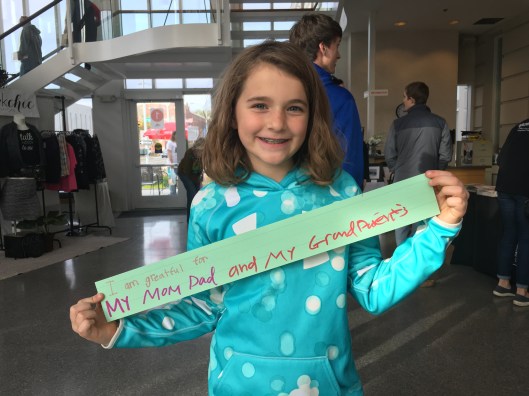
Sadie with her Gratitude Poem Line

Last Saturday, I got to spend part of the afternoon at the Durham Art Walk, inviting passersby to share the things for which they’re grateful. Little did I know what a moving and delightful afternoon it would turn out to be, as several dozen people, aged 2 to 70-something, stopped by to add their sentence strip gratitudes to our list poem, which you’ll find below. (I played a little with the order, to make sure everyone’s lines would shine.) Thanks to everyone who participated and wishing you all a wonderful season of gratitude.
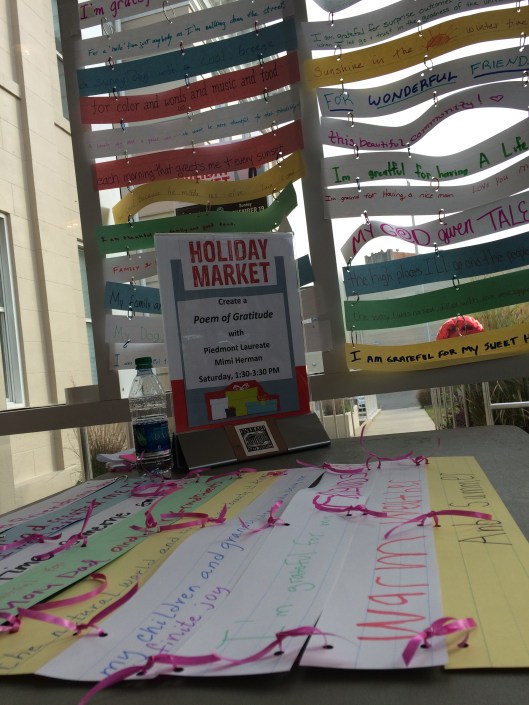
Gratitude Poem

Gratitude

I’m grateful for a “hello” from just anybody as I’m walking down the street,
a sunny day with a cool breeze,
for color and words and music and food.
A lonely dog met a quiet cat—she cannot be more thankful for their friendship.
I am thankful for family and good food,
each morning that greets me & every sunset,
for God because he made us alive (Tara, 6 years).
my dog (Rocket), he gets me,
my family and friends, they are always there for me,
meeting wonderful strangers who inspire me to embrace my imperfections,
find beauty in all interactions and remind me that this moment is perfect,
because it just is.
I am grateful for surprise outcomes that can arise
when I let go and trust in the goodness of the universe,
sunshine in the wintertime,
for wonderful friends,
this beautiful community,
my God-given talents,
the high places I’ll go and the people I’ll meet.
I’m grateful for having a life,
the way I was raised, filled with love and support
I’m grateful for having a nice mom. Love you, Mom.
I am grateful for my sweet husband.
I am thankful for my family and my dog,
family and friends who love me through thick and thin.
I’m grateful for my mom, dad and my grandparents,
the natural world and the peace and beauty it brings,
my children and grandchildren who bring me infinite joy.
I’m grateful God created me in his image.
I’m grateful for my friends,
my home, son, old friends, my dog
warm weather and summer,
every time someone smiles.

I hope you’ll all come back to meet me at the Durham Arts Council from 5:00 to 8:00 pm on December 15th to make poetry holiday cards and New Year’s (re)solutions (our ideas for ways to make the world a better place). I hear there will be ballet dancers and cookie-decorating that evening, too, so there will be something for everyone!Mimi Herman and Gratitude group poem


Photo of Sadie, age 9, by her mom.
Photo of gratitude poem by Susan Tierney, Durham Arts Council
Photo of Mimi Herman, Piedmont Laureate by Helen Wu

 

Pond and River

08 Wednesday Nov 2017

Posted by Mimi Herman in Mimi Herman, Poetry, Reading, Writing Advice

≈ Leave a comment

River
The bare (brindled) word of it word enough; brim-rhyming as it runs                              alongside reverie-bank (all rindled roots) and order.

                                                                                     by Atsuro Riley

Magnolia and Irises, designed by Louis Comfort Tiffany

This Saturday marks the first Piedmont Laureate/North Carolina Museum of Natural Sciences collaboration, “Find Your Muse on the Millpond.”

Pardon the pun, but it’s a natural connection. Everything about the sciences seems to lend itself to poetry: the wonders you find beneath a microscope lens or at the far end of a telescope; the ways nature constructs, deconstructs and reconstructs itself; the miracles of human bodies and bodies of water.

So on Saturday, we’ll take our human bodies (via kayaks) onto a body of water, a pond that looks less like a flat reflective pan beneath the sky and more like a meandering cypress stream. In the November afternoon sun, bundled up against the cold, we’ll create poems on the pond. We’ll stop periodically to collect names of trees and natural history, to magnify bark and leaf, to listen. And as the words and sounds accumulate, we’ll borrow from the flow of the water to create currents on the page, pausing toward the end to let our words settle onto the page like sediment, before releasing them to float on the waters we’ve paddled.

We aren’t the first to compose poems on the wonders of water, and we won’t be the last. In honor of the poems we’ll be writing, I offer you some that have come before us.

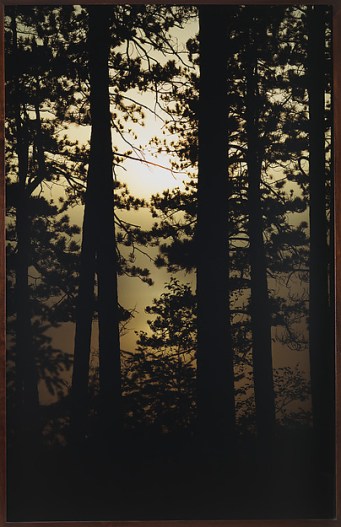
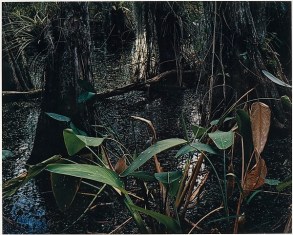
Cypress Swamp, Eliot Porter


The Pond
Cold, wet leaves
Floating on moss-coloured water
And the croaking of frogs—
Cracked bell-notes in the twilight.

by Amy Lowell


2015.300.227a


A Walk in the River
A few companions had been doing too much talking beside the purple water. The troupe, panic-stricken, ran away, and I found I was incapable of following them. I stepped into the water and the depths turned luminous; faraway ferns could just be seen. The reflections of other dark plants stopped them rising to the surface. Red threads took on all sorts of shapes, caught in the invisible and doubtless powerful currents. A plaster-cast woman advancing caused me to make a gesture which was to take me far.

by René Magritte
Translated from the French by Jo Levy

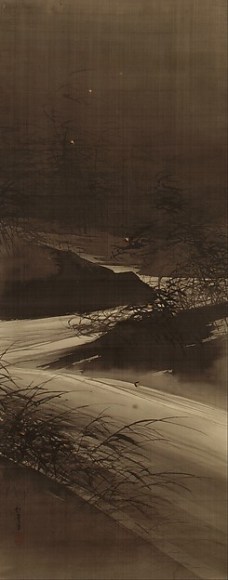
Fireflies Over the Uji River by Moonlight, Suzuki ShonenBlack River – by Joe Hutchison
You believe you must be beginning again.
The river opens to accept your first step,
and you’re into it up to your knees—
the water’s wrestle brotherly, bracing.
You start across, shouldering goods
you believe you’ll need on the far side.
Waist-deep now. Feeling for rooted stones
through sopping boots. Surely this is where
you crossed before; there are no unknown
channels, no abysses, though the current
does seem swifter than you remember,
and darker (of course, it’s only dusk
coming on, staining the air and water;
and the river—you believe—only seems
to be growing wider). Chest-deep now.
Icy water races past your racing heart,
under raised arms that ache to balance
whatever you carry, what you must (you
suddenly understand) be willing to let go.
Chin-deep. Perched on a slippery stone
that shifts with each shivering breath.
No choice but to take the next step—
deeper into the black river, farther
toward the shore of ink-black pines
over which the feverish stars have risen
and the cold comfort of a bone-white moon.

New York Water (Osgood Pond), Roe Ethridge


River Rhyme
The rumpled river
takes its course
lashed by rain

This is that now
that tortures
skeletons of weeds

and muddy waters
eat their
banks the drain

of swamps a bulk
that writhes and fat-
tens as it speeds.

by William Carlos Williams


Elk River Falls, Jasper Nance, flickr

Elk River Falls
is where the Elk River falls
from a rocky and considerable height,
turning pale with trepidation at the lip
(it seemed from where I stood below)
before it is unbuckled from itself
and plummets, shredded, through the air
into the shadows of a frigid pool,
so calm around the edges, a place
for water to recover from the shock
of falling apart and coming back together
before it picks up its song again,
goes sliding around the massive rocks
and past some islands overgrown with weeds
then flattens out and slips around a bend
and continues on its winding course,Clearwater, Michael B
according to this camper’s guide,
then joins the Clearwater at its northern fork,
which must in time find the sea
where this and every other stream
mistakes the monster for itself,
sings its name one final time
then feels the sudden sting of salt.
by Billy Collins

[IDAHO-B-0003] Clearwater River - Ahsahka, photographer unknown

Credits:

Poems
River, by Atsuro Riley
The Pond, by Amy Lowell
A Walk in the River, by René Magritte
Black River, by Joe Hutchison
River Rhyme, by William Carlos Williams
Elk River Falls, by Billy Collins

Art
Magnolias and Irises, designed by Louis Comfort Tiffany, Metropolitan Museum of Art
Cypress Swamp, Florida, by Eliot Porter, Metropolitan Museum of Art
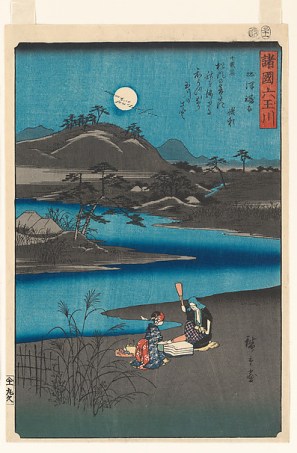
Six Tamagawa Rivers from Various Provinces, by Utagawa Hiroshige, Metropolitan Museum of Art
Fireflies Over the Uji River by Moonlight, by Suzuki Shonen, Metropolitan Museum of Art
New York Water (Osgood Pond), by Roe Ethridge, Metropolitan Museum of Art
Elk River Falls, by Jasper Nance, flickr
Clearwater, by Michael B, flickr
Clearwater River – Ahsahka, by photographer unknown, flickr


How to Break through Your Writer’s Block

13 Wednesday Sep 2017

Posted by Mimi Herman in Mimi Herman, Poetry, Writing Advice

≈ 2 Comments

Tags

Writer's Block

Locked-Phong6698-flickr-creative commons

Getting Rid of Your Internal Critic

So you’ve got this voice in your head. The voice says, “You’re stupid. Nobody wants to read anything you write. You can’t write. You have nothing to say, and even if you think you do, you’ll say it badly. Plus you’re fat and your breath stinks.”

Sound familiar?

Relax. Most of us have a voice like this. I call it The Critic. It’s uncanny how these voices know how to say exactly the right thing to make us so hopelessly miserable that we don’t even want to attempt anything because, of course, we’ll fail.

Here’s what I want you to do:

Imagine that you’re walking down a long hall with your critic. Really picture your critic, who may look a lot like someone from your life or may be some monster fabricated out of spare parts from your subconscious. See your critic. Smell your critic. Hear your critic’s footsteps in the hallway.

As you walk, distract your critic.Find something innocuous to discuss. Talk naturally—or as naturally as you can. Try not to get overwhelmed by the disturbing smell of your critic or the clomp of footsteps.

At the end of the hall is a big door.

Open the door, push your critic inside, slam the door and lock it. Bolt it. Take that big metal bar from the floor next to the wall and slide it into the slots on the door.

Now that your critic is locked away, you can do one of several things:

  • Walk away and leave the critic there. Let someone else be in charge of the feeding and exercising of your critic. It’s not your job.
  • Slide a one-way ticket to a Greek island under the door. Perhaps your critic just needs to spend some time in a relaxing environment to get over being so cranky and mean. Have the customs inspector check for cell phones and computers before letting the critic out of airport. Your critic should have no way to reach you. Change your phone number, if you must.
  • Create a comfortable room for your critic, with all the things that will make her or him feel appreciated and cared for. Clearly your critic is acting out of some deep childhood insecurity and needs a more nurturing environment to recover.
  • Write a letter to your critic, detailing all the ways your critic is wrong about you.
  • Leave your critic locked up until she or he agrees to be helpful, and then only on second or third drafts. A first draft is hard enough to create, without someone looming over your shoulder, telling you everything you write is dreck. In later drafts, your critic can say things like, “That looks really good. Do you mind if I make a few suggestions?” or “Great work. I could check it for typos, if you like.”
  • Decide that the critic came into your life in the first place to help you. Figure out what the critic was supposed to do, and whether you need that help any more. If not, thank the critic graciously and walk away. If your critic’s help is still useful, write down all the things you’d like the critic to do in a job description. In your own job description, write down all the things you’re going to take care of yourself.

So now that you’ve taken care of your critic, it should be easy enough to write, right?

Wrong.

Vintage Memo Notebook-Calsidyrose-flickr-creative commons

If you’re like most of us, you suffer from the Blank Page Disease.

There’s a blank page sitting in front of you. A number of people—loggers, papermakers, stationers—worked overtime to get that page to you. And you have absolutely no idea what to do with it. If you write on a computer, it’s even worse. Do you know how many people it took to build your computer and get it to you? And how hard they had to work? Go ahead, feel guilty.

You done yet? Good. Then let’s begin.

So here’s what you do. Just start writing. Whatever enters your head, let it flow down your neck, over your shoulder, through your arm, into your hand, and down onto the paper or keyboard. If you really have gut-stabbing doubts about your ability to write anything of value, you have a couple of choices: find a really good therapist and work on your self-esteem, or use recycled paper for your first drafts. If you’re using a computer, let your monitor get dusty so you don’t feel like the words have to be so sharp and precise. Do not, I repeat, do not take this time to clean your screen. Or worse yet, to go to the nearest office supply store and purchase that special stuff intended only for the polishing of computer monitors. We’ll discuss creative procrastination later.

Hey, wait a minute. I’m doing all this talking and you’re doing all this listening. Enough already. Start writing.


Credits:
“Locked,” Phong6698, flicker, Creative Commons, 2016
“Vintage Memo Notebook,” Calsidyrose, flicker, Creative Commons, 2009


Planners and Wingers

29 Tuesday Aug 2017

Posted by Mimi Herman in Mimi Herman, Poetry, Writing Advice

≈ Leave a comment


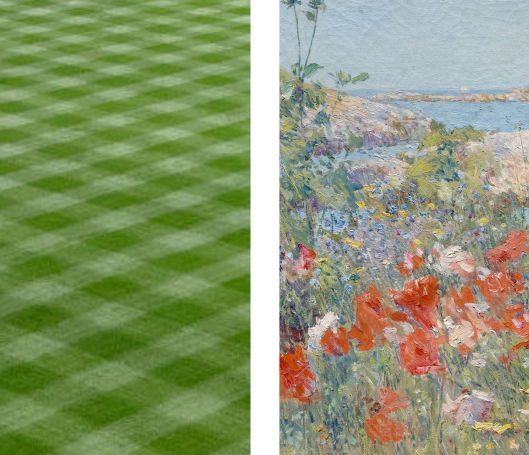
Planners and Wingers graphic

I love dichotomies. I don’t completely believe in them, of course, but they’re fun to play with.

So here’s one for you.

There are two kinds of people in the world: planners and wingers. The minute I say this to a group of people, everyone starts nodding. They may not be precisely sure of what I mean, but they have a pretty good idea.

A planner, I tell them, knows what she’s going to wear the next day before she goes to bed the night before. More nods. The motto of a winger, on the other hand, is, “How can I know what I mean until I see what I say?” Laughter and more nods.

I ask for a show of hands from the people who think they’re planners. Their friends tend to look pointedly at them if their hands don’t shoot up quickly enough. Everyone knows who the planners are. They’re the ones who sit around tapping their fingers at 3:00 pm when you said you’d be ready. The planners are a little embarrassed to be called out like this, and say things like “I know I’m a bit anal, but I just like to do things right.” On the inside, though, they’re pretty proud that everyone actually recognizes how organized they are.

Planners like lists. They’re irresistibly drawn to outlines. They want to know the rules in advance so they can be sure to follow them. Neatness counts for planners, and they’re likely to be as hard on themselves for lack of neatness as they are for less than stellar content.

Then I ask the wingers to raise their hands. A number of slow hands go up, accompanied by sheepish smiles. In our world, it’s not thought of too highly to be a winger, even though many of us are. We may secretly prefer to be planners, but we’re just not built that way.

The minute wingers sit down to write, the gates are up and they’re sprinting for the finish line—wherever and whatever that might happen to be. The best wingers know they’re wingers and are willing to make improvements using a very handy process we call revision. But often wingers feel that whatever they’ve created in a moment of passion can’t be changed, because they can never reconstruct that precise recipe of emotions and environmental factors. That moment was that moment and shall never return.

Most of us tend to land on one side of the fence or the other. The well-seeded and watered, neatly mowed side of the planners, or the wingers’ side, which is a bit overgrown but has all sorts of unexpected wildflowers popping up in it, and a lot of birds diving down to nibble on the tall grasses. Planners can wear white all day without smudging. Wingers could stain a clean shirt in a sterile operating room—before the patient is brought in. Wingers are prone to run-on sentences. Planners could probably diagram theirs.

But the truth is that most of us have are both planners and wingers, depending on the situation and what we need to accomplish. Planners can venture into the unknown; wingers can organize their thoughts. This is why dichotomies are tricky. We’re rarely all one thing or another.

And a good writer is usually both.


Photo Credits:

Grass: https://alpineservices.com

Wildflowers: Detail from “Celia Thaxter’s Garden, Isles of Shoals, Maine,” Childe Hassam
http://www.metmuseum.org/art/collection/search/14930?sortBy=Relevance&ao=on&ft=wildflowers&offset=0&rpp=20&pos=2

Flirting with Your Reader

15 Tuesday Aug 2017

Posted by Mimi Herman in Mimi Herman, Poetry, Writing Advice

≈ 1 Comment

“Flirtation, attention without intention.” Max O’Rell

Mimi and Spoon-cropped, lightened 1500

Fill Her Up

You fill me up like a Pop-tart fills the toaster,
Sweet and hot.
You’re every recipe my grandmother made
And I forgot.
You’re all my lost relatives
Come home again.
You’re my old address, my old dress—the one I wore
To the ninth grade prom.
You’re my virginity come back to haunt me.
You’re new rains, old pains, cinquains I wrote
In the fourth grade. You’re every note
I ever passed.

You are a branch bank opening in my neighborhood
With free lifetime incomes to the first 100 customers.
You’re a high like exercise (if exercise behaved as advertised).
Like hitting butter halfway down the popcorn bucket,
Like staying in the movie for a double feature
I didn’t even pay for.

You’re a microscope that sees through my skin,
A telescope that lets me keep my distance.

You fill me up like premium gas at Costco
Caught before the cost goes up,
All that power in my tank—and at such a savings.
You fill me up like the first snow
Fills the junkyards clean again.
A million flakes to cover one defunct Caddy
And suddenly it’s young again,
It runs again.

Mimi Herman

Princess Leia copies Mimi
As a child, I was so shy and self-conscious that when the school photographer said, “Smile,” tears leapt to my eyes. So in every elementary school photo, I look like I’m about to cry.

As writers, we’re often stuck with those glossy-eyed photos in our albums—and a sense that we’ve never been socially “ept,” as opposed to inept. A lot of us grew up thinking we weren’t attractive or suave or charming enough to flirt. We say to ourselves, “Right, as soon as I get my self-esteem whipped into shape, I’ll be able to flirt.”

So here’s the secret. You don’t have to be perfect to flirt. You don’t have to be good-looking, though, of course, you happen to be stunningly gorgeous. You don’t need a perfectly healthy well-balanced self-esteem. You don’t need zenlike ease, a rapier wit, a stockpile of clever rejoinders. That stuff, by the way, will come with time and practice, as a useful byproduct of flirting. All you need is situational confidence, which is something you can put on at whenever you choose to do so.

Now what does all this have to do with writing? Well, I think we run the risk as writers of serious poetry and fiction, work meant to do more than “just entertain,” of leaving our best selves off the page—our witty, charming, devious, delightful, intriguing, entrancing, and enticing selves—when we write. These are the selves you play with, the ones that are available to you when you have a little extra ease and comfort, and you trust your reader to want to get to know you.

Flirting is always about balancing opposites in delicious tension:

  • generosity and reserve
  • mystery and openness
  • rapid-fire and lingering
  • desire and self-sufficiency
  • intimacy and distance
  • inviting and holding back
  • secrets and surprise revelations

Flirting is a gift, a way of sharing your best self, your most delicious and delightful self, with someone whose attention you desire. And isn’t that exactly what writing is?


Sonnetize Yourself

01 Tuesday Aug 2017

Posted by Mimi Herman in Mimi Herman, Poetry, Writing Advice

≈ Leave a comment

CC-043-William-Shakespeare-The-Cobbe-Portrait-c.-1610-Cobbe-Collection-high-res-2-550x550

All right, fearless readers and writers. We’ve now explored sound and meter in poetry, so we’re ready to put them together to start creating formal poems. If you create something you really like, please share it with the rest of us. We’d love to see what you’re writing.

With every kind of formal poetry, you can follow the rules precisely and create strictly formal poems, or you can relax a little, put on those jeans with the holes in the knees, and create a looser version. Either way, it’s not about proving how good a rule-follower you are. It’s about using these forms and techniques to write the poems that matter to you and your readers.

Let’s start with that classic: sonnets. If it’s good enough for Shakespeare, it’s good enough for us. And besides, it’s only fourteen lines long.

There are two types of sonnets, each with two names, the Elizabethan/Shakespearean sonnet and the Italian/Petrarchan sonnet. English is, unfortunately, a very rhyme-impoverished language, particularly as opposed to Italian, so the Italian sonnet has a lot more words that rhyme with each other. We’re going to go for the Elizabethan version, since if you’re reading this, I’m guessing your command of English is fairly strong.

All sonnets are written in iambic pentameter: ten syllables that alternate light and heavy stresses like this: ta-TUM-ta-TUM-ta-TUM-ta-TUM-ta-TUM. If you want to know what this feels like, try limping around the room, coming down heavily every second step.

An Elizabethan/Shakespearean sonnet has three quatrains (four-line stanzas) often without a break in between, with alternating rhyme, followed by a rhyming couplet (two-line stanza). So the rhyme scheme for this sonnet looks like this:

a220px-Millay_magn
b
a
b
c
d
c
d
e
f
e
f
g
g

To learn more about rhyme, go to Playing with Sound in Poetry, Part 1. To learn more about rhythm, go to Playing with Sound in Poetry, Part 2.

Here’s one of my favorite Elizabethan/Shakespearean sonnets:

If I Should Learn      

by Edna St. Vincent Millay

If I should learn, in some quite casual way,
That you were gone, not to return again –
Read from the back-page of a paper, say,
Held by a neighbor in a subway train,
How at the corner of this avenue
And such a street (so are the papers filled)
A hurrying man, who happened to be you,
At noon today had happened to be killed –
I should not cry aloud – I could not cry
Aloud, or wring my hands in such a place –
I should but watch the station lights rush by
With a more careful interest on my face;
Or raise my eyes and read with greater care
Where to store furs and how to treat the hair.

Try reading it while you limp around the room.* Maybe do it several times to get the rhythm in your body.  Now try writing one, just as an experiment. About anything. I wrote one about yeast once and another about apnea, so you can see the world of sonnet subjects is vast.

Remember, you can follow the rules strictly, or play with the form. If you’re just starting out, I recommend aiming for about 10 syllables per line (allowing yourself to have 9 or 11, as needed), in 14 lines, rhyming ababcdcdefefgg as above, and giving yourself the freedom to use as many slant rhymes as you want. The form is not nearly as important as taking the chance to play with different techniques, so you’ll have new ways to write the poems you want to write.

*If you want a real treat, go here to hear a Youtube version of Edna reading another of her famous poems, “Recuerdo.” I can’t get enough of her voice!

Shakespeare Portrait from http://www.cobbecollection.co.uk/art/william-shakespeare/
Edna St. Vincent Millay photograph by Arnold Genthe, Mamaroneck, NY, 1914
https://en.wikipedia.org/wiki/Edna_St._Vincent_Millay
← Older posts
Newer posts →

About our laureates

  • Past Laureates

Join Us on Facebook

Join Us on Facebook

Enter your email address to subscribe to this blog and receive notifications of new posts by email.

Join 174 other subscribers

Piedmont Laureate Sponsors

Raleigh Artsuac-logo

Search

Website Powered by WordPress.com.

  • Subscribe Subscribed
    • Piedmont Laureate
    • Join 174 other subscribers
    • Already have a WordPress.com account? Log in now.
    • Piedmont Laureate
    • Subscribe Subscribed
    • Sign up
    • Log in
    • Report this content
    • View site in Reader
    • Manage subscriptions
    • Collapse this bar
 

Loading Comments...