• About
  • Past Laureates
  • Blog
  • Events
  • Resources
  • Contact Us

Piedmont Laureate

~ Promoting awareness and heightened appreciation for excellence in the literary arts throughout the Piedmont Region

Piedmont Laureate

Category Archives: Writing Advice

On Getting Lost

04 Sunday Feb 2018

Posted by nancystoryflow in Attention, Fiction, Process, Writing Advice

≈ Leave a comment

Tags

Attention, characters, Process

Peacock


Not everyone has a natural area to visit in their daily lives. I count myself blessed to be able to step into nature regularly. My studio is located on land that has been in the same family since the 1700s. They work hard to hold on to this land, but who lived here before this family arrived? I’ve never found arrowheads here, although I have found several along the Eno River, close to my home. Those arrowheads were surely made by the Occaneechi Tribe who occupied the area before the British colonized it. I am sure there were native people living and hunting the land my studio occupies too.

On that land there are many trails through the woods. The trails loop and connect to other trails, and backtrack on themselves and spiral within each other, or so it seems to me. When I first started walking these trails I tried to orient myself to the pond and know where I was, but I ended up places without really knowing how I got there. Whenever I am in the woods, I make sure to pay attention to landmarks as I walk. When I got lost, I would finally stumble across something familiar. The big rocks. A familiar fallen tree. Another tree with its bark stripped off. The stream flowing into the pond. A deer stand. I found my way by getting lost. And so it is with fiction.

A story is not a series of disconnected events. A story is a series of events that play off each other. If this happens to this character then what happens because of that? Every scene has a reason for being there, and ends with either conflict or a consequence. That’s a tough row to hoe if you ask me. I know, because I’ve done it.

But doing it, or having done it, doesn’t mean I know what I’m doing when I start out. Often, in the beginning, I have only a glimmer of a character, or an opening line, or a snippet of dialogue. Something that intrigues me that I’m willing to follow, like a path into the forest. I get lost often. Sometimes I thrash my way out and leave a trail of massacred scenes in my wake. Sometimes there’s a guiding hand. Always, I am looking for those landmarks, noticing points in the story that seem similar to other points in the story. For instance, I really don’t want to forget that a character does not eat meat, and then have her date a butcher. If I forget that she’s a vegetarian, then I have forgotten something major. A driving force for her, and a potential conflict or compromise between the two of them.

What I am saying here is pay attention. Get to know your characters the same as you get to know strange paths through the woods. Entering lightly is probably not a good idea, but neither is hanging back and not entering at all. Enter respectfully. Know you can get lost, and probably will. The great thing about writing is you won’t die of hypothermia (unless you can’t pay your heating bill) and you won’t starve (unless – well, you get the picture).

A walk in the woods, in my opinion is always worth it. I don’t always come out of it with an arrowhead, or a story, but I do come out closer to myself, and closer the bone of something deep and primal. And so it is with fiction.

A Poet and a Novelist

17 Wednesday Jan 2018

Posted by nancystoryflow in Fiction, Mimi Herman, Nancy Peacock, Poetry, Writing Advice, Writing Workshops

≈ 4 Comments

Here’s your chance to see two laureates in one post – 2017 Piedmont Laureate Mimi Herman, and 2018 Piedmont Laureate Nancy Peacock– in Mimi’s final post and Nancy’s first.

Welcome Nancy! We’re all wishing you a fabulous year of sharing your gifts with the writers and readers of the Piedmont.

Mimi Herman in Yosemite Headshot
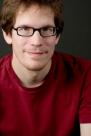
NancyPeacock_0076-1

How would describe yourself?

Mimi Herman: I’m a writer who brings out the writer in others, an inventor of ways for people to learn, and someone who can’t resist finding useful solutions to problems.

Nancy Peacock: When I think of how to describe myself, pairs of words come to mind. Reverent and irreverent. Serious and funny. A hard worker and lazy. I don’t see these paired words as opposite of each other. Irreverence is bred of knowing what to be reverent about. Humor is spawned by seriousness. A writer must be a hard worker, and, in order to avoid burnout, enjoy a fair amount of “moodling” time as Brenda Uhland called it in If You Want to Write.

What matters to you in your own writing?

Mimi Herman: I want my writing to be as evocative and engaging as possible – and to be of use to readers. I hope my writing will help see people through difficult times and give them ways to understand the world in which we live. I would love for people to say, “That’s how I’ve always felt, but I’ve never been able to say it.”

Nancy Peacock: Telling a story that wants to be told. Working with a character in a way that honors his or her voice, and his or her needs. This means that with each draft, I, the author, disappear more and more, and give over to the character.

How do you think poetry and fiction are connected?

Mimi Herman: I’ve always thought that poetry and novels – both of which I write – are somehow linked. Maybe poetry is condensed, freeze-dried fiction; maybe novels are what happen when you add the water of extended time to poems. In both, paying attention to how the world works is essential.

Nancy Peacock: When I was younger I wanted to be a poet. Not having any real knowledge of what it means to make a living or pay rent, I imagined what I thought would be a poet’s life: living in a big yellow house with my loving partner and a cat. Not having a job. Spending every day, writing and then taking care of cozy domestic things, like baking bread (which in my imagination was always warm, fresh out of the oven, and the dishes were cleaned), producing wonderful meals (ditto the appearance of food and absence of clean up) shared with a plethora of brilliant friends (never mind that I was very shy and had only a few friends). As I matured, I maintained this fantasy but transferred it to writing novels. And as I matured even more, I recognized that it would never pan out this way (exactly), and that this is okay. Good even.

While my desire to write poetry may have been more driven by fantasy than anything else, I did write poems. I like poetry for its succinctness and punch. I think my early efforts as a writer of poems helped me a great deal in learning to say a lot with only a few words, and in being precise in my use of words when telling a story. It also helped me learn to notice many small things in life that now feed my fiction. Poetry helped me appreciate the world I live in. This is a practice I think is very important to anyone who wants to write anything.

What are some ways you tempt people to become writers?

Mimi Herman: I like to get people thinking about the experiences and ideas that matter to them, and help them find the words to describe these things. We all share our five senses. When these are translated into images through writing, the words come alive on the page.

Sometimes, when people are struggling to write anything at all, I ask them to tell me what they want to say. Then I write it down for them until they’re speaking too quickly for me to write—at which point I hand them the paper and pencil and tell them to keep going. This ends up being pretty much irresistible for even the people who consider themselves complete non-writers.

Nancy Peacock: Writing from prompts in a group is one of my favorite things to do. I offer a free prompts class the second Saturday (10 to 12) of every month at Flyleaf Books in Chapel Hill. I’ve been doing this for fifteen years, starting at the old Borders Bookshop, and migrating around different meeting places until the group landed such a great home in Flyleaf Books. I witness a lot of magic in this process of writing from prompts in groups. It’s wonderful to sit with a group of people telling stories. How often do we get to create something and immediately share it, without criticism? This temptation I offer is not so much about “becoming a writer” as it is about tapping into the subconscious and finding unknown stories inside, which we all have. It’s a lot of fun. Y’all come and join in.

What do you do when you can’t write?

Mimi Herman: I read. What I really like to do is to read someone else’s poetry until I get interested – then use the energy and fascination evoked by another writer to launch into my own poems.

Nancy Peacock: For me writing is a little dance. I have to make myself walk across the room and ask the partner I think I’m interested in to dance with me. That’s the going forward part, the making myself sit down at the desk even when I don’t know what I’m doing, or have a full plot or character in mind. Once the partner and I get out on the dance floor, I sometimes find that this person didn’t want to dance with me after all, in which case I drop the project. Or sometimes I find that this person isn’t so sure about me, in which case I try to prove my interest in her by showing up every day. Sometimes though the partner and I enter into a difficult relationship where we’re stepping on each other’s toes. When that happens, I back off from that particular material. Maybe it will hold something for me at some future date, and maybe it won’t. I move on. I ask someone else to dance. If this difficulty continues with other characters and projects, I know it’s time to just take a break from writing. I read. I take walks. I weave (I have a small tapestry loom). I clean the house (or plan to). I try to replenish the well by just being. I’m happiest when I have a writing project though, and feel a little bereft during this time of not writing. That’s the hardest part.

How can writing help people through challenges – both internal and external?

Mimi Herman: One of my favorite phrases is E. M. Forster’s “How can I know what I mean until I see what I say?” I think when we’re struggling with something, the process of writing it out helps us understand it – and perhaps even solve it.

Nancy Peacock: Writing in my journal always helps my state of mind, and helps me process what is going on around me. My journal is the place where I get to have an uncensored voice. If I’m grumpy or pressed for time, it helps to just write that I’m feeling grumpy and pressed for time. It allows it to be, and I don’t feel like I’m faced with fighting against it. The page holds my grumpiness and busyness for me, and allows me to move through it. Yet it remains a place that will also hold the spaciousness needed for art. Writing in my journal has been a way for me to learn to trust my own voice, and trust my own thoughts. I know artists in other mediums who also keep journals as a way of working through the daily onslaught of events and energy, and as a way to work out thoughts and insights on particular pieces of art they are producing.

And then there’s reading. Reading is so important. Stories help us become more empathetic to other people. Period. This is the most important life skill you can ever have, and you can hone it by reading fiction.

Why do we need laureates?

Mimi Herman: I think the job of a laureate is to open a door for writing and invite the community we represent to the party. We are ambassadors, helping people not only understand the country of poetry and prose, but inviting them to visit and even become citizens. Citizenship in the country of writing is open to anyone who has something to express. All are welcome.

Nancy Peacock: I think we need laureates now more than ever, to remind people of the written word and of storytelling, and to celebrate the work that has come before us, the work that writers do now, and the work that is not yet written. We need laureates to encourage people to read books other than those on the bestseller lists, and books that are not written by celebrities or about celebrities. Novels and stories reach deep into the human condition, the human experience and human nature that we all share. A laureate’s role is to spread this magic about as widely as possible. We need that.
A Gathering of Laureates

06 Wednesday Dec 2017

Posted by Mimi Herman in Ian Finley, James Maxey, Katy Munger, Mimi Herman, Poetry, Reading, Scott Huler, Writing Advice, Writing Workshops

≈ 3 Comments

23915508_1976582055895529_2258818442474702301_n

Exactly one year ago today, I was initiated into my reign as 2017 North Carolina Piedmont Laureate. This wasn’t my official coronation, complete with tiara, but it had a lot to do with setting the stage for a fabulous year. On this night, Katy Munger, the 2016 Piedmont Laureate in Mystery and Crime Fiction, invited me to drink and dine with the Laureates Emeritus, so they could share with me the secrets to Laureate success.

“Don’t beat yourself up if you don’t write anything all year,” they told me, and although at the time I had grand plans of writing a poem a day (I was, after all, the Piedmont Laureate in Poetry. Who better to set an example as a poet by composing 365 new poems by the end of the year?) I found by the end of January that I’d been unduly ambitious. I will say however, that I’ve written a number of new poems this year, and spent the early autumn creating a new poetry collection.

“Being Piedmont Laureate is great”, the Emeriti told me, “but the really spectacular time will come after your year ended, when you’ll get to be one of us, a Laureate Emeritus. In the meantime, they said revel in the fact that you have been chosen, you have received the literary stamp of approval.”

It felt a little bit like being 11 years old, and hanging out with your big sister and her friends while they tell you what it’s like to be a teenager. Writers are notoriously nerdy, but on that night, I felt pretty cool.

So it seems timely that this Saturday, December 9th, I have the chance to rejoin a number of my compatriots for a Gathering of Laureates at Mordecai Historic Park, where they’ll get to share their writerly brilliance with you once again.

katy_mungerKaty Munger, 2016 Piedmont Laureate
Mystery and Crime Fiction


james-maxeyJames Maxey, 2015 Piedmont Laureate
Speculative Fiction


ian_finleyIan Finley, 2012 Piedmont Laureate
Playwriting


scott_hulerScott Huler, 2011 Piedmont Laureate
Nonfiction


The day promises to be splendid, with Mordecai holding its official Holiday Open House, and four Laureates Emeritus and myself teaching bite-sized workshops (20 minutes to an hour) in the historic buildings of the park—the old post office, Andrew Johnson’s birthplace and the Badger-Iredell Law office—and the accessible classroom in the Visitors’ Center, starting at 10:00 am. We’ll follow this up with a reading in beautiful St. Mark’s Chapel at 4 pm. Come to one workshop or try out all five, and stay for the reading.

Five Laureates in one place, free workshops and reading, a chance to tour the stunning Mordecai house, and festive seasonal food and drinks—what more could you desire on a Saturday in December?

Sign up soon at https://raleigharts.wufoo.com/forms/a-gathering-of-laureates/. Spaces are limited.

We look forward to seeing you this Saturday!

Pond and River

08 Wednesday Nov 2017

Posted by Mimi Herman in Mimi Herman, Poetry, Reading, Writing Advice

≈ Leave a comment

River
The bare (brindled) word of it word enough; brim-rhyming as it runs                              alongside reverie-bank (all rindled roots) and order.

                                                                                     by Atsuro Riley

Magnolia and Irises, designed by Louis Comfort Tiffany

This Saturday marks the first Piedmont Laureate/North Carolina Museum of Natural Sciences collaboration, “Find Your Muse on the Millpond.”

Pardon the pun, but it’s a natural connection. Everything about the sciences seems to lend itself to poetry: the wonders you find beneath a microscope lens or at the far end of a telescope; the ways nature constructs, deconstructs and reconstructs itself; the miracles of human bodies and bodies of water.

So on Saturday, we’ll take our human bodies (via kayaks) onto a body of water, a pond that looks less like a flat reflective pan beneath the sky and more like a meandering cypress stream. In the November afternoon sun, bundled up against the cold, we’ll create poems on the pond. We’ll stop periodically to collect names of trees and natural history, to magnify bark and leaf, to listen. And as the words and sounds accumulate, we’ll borrow from the flow of the water to create currents on the page, pausing toward the end to let our words settle onto the page like sediment, before releasing them to float on the waters we’ve paddled.

We aren’t the first to compose poems on the wonders of water, and we won’t be the last. In honor of the poems we’ll be writing, I offer you some that have come before us.

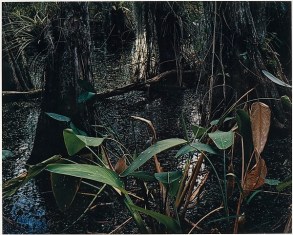
Cypress Swamp, Eliot Porter


The Pond
Cold, wet leaves
Floating on moss-coloured water
And the croaking of frogs—
Cracked bell-notes in the twilight.

by Amy Lowell


2015.300.227a


A Walk in the River
A few companions had been doing too much talking beside the purple water. The troupe, panic-stricken, ran away, and I found I was incapable of following them. I stepped into the water and the depths turned luminous; faraway ferns could just be seen. The reflections of other dark plants stopped them rising to the surface. Red threads took on all sorts of shapes, caught in the invisible and doubtless powerful currents. A plaster-cast woman advancing caused me to make a gesture which was to take me far.

by René Magritte
Translated from the French by Jo Levy

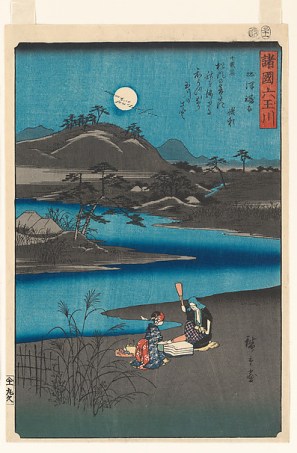
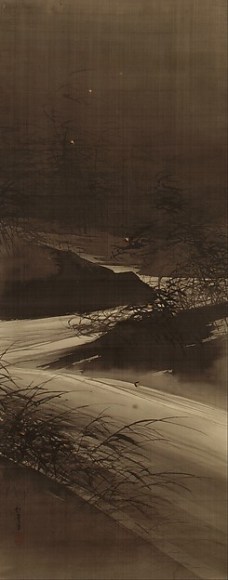
Fireflies Over the Uji River by Moonlight, Suzuki ShonenBlack River – by Joe Hutchison
You believe you must be beginning again.
The river opens to accept your first step,
and you’re into it up to your knees—
the water’s wrestle brotherly, bracing.
You start across, shouldering goods
you believe you’ll need on the far side.
Waist-deep now. Feeling for rooted stones
through sopping boots. Surely this is where
you crossed before; there are no unknown
channels, no abysses, though the current
does seem swifter than you remember,
and darker (of course, it’s only dusk
coming on, staining the air and water;
and the river—you believe—only seems
to be growing wider). Chest-deep now.
Icy water races past your racing heart,
under raised arms that ache to balance
whatever you carry, what you must (you
suddenly understand) be willing to let go.
Chin-deep. Perched on a slippery stone
that shifts with each shivering breath.
No choice but to take the next step—
deeper into the black river, farther
toward the shore of ink-black pines
over which the feverish stars have risen
and the cold comfort of a bone-white moon.

New York Water (Osgood Pond), Roe Ethridge


River Rhyme
The rumpled river
takes its course
lashed by rain

This is that now
that tortures
skeletons of weeds

and muddy waters
eat their
banks the drain

of swamps a bulk
that writhes and fat-
tens as it speeds.

by William Carlos Williams


Elk River Falls, Jasper Nance, flickr

Elk River Falls
is where the Elk River falls
from a rocky and considerable height,
turning pale with trepidation at the lip
(it seemed from where I stood below)
before it is unbuckled from itself
and plummets, shredded, through the air
into the shadows of a frigid pool,
so calm around the edges, a place
for water to recover from the shock
of falling apart and coming back together
before it picks up its song again,
goes sliding around the massive rocks
and past some islands overgrown with weeds
then flattens out and slips around a bend
and continues on its winding course,Clearwater, Michael B
according to this camper’s guide,
then joins the Clearwater at its northern fork,
which must in time find the sea
where this and every other stream
mistakes the monster for itself,
sings its name one final time
then feels the sudden sting of salt.
by Billy Collins

[IDAHO-B-0003] Clearwater River - Ahsahka, photographer unknown

Credits:

Poems
River, by Atsuro Riley
The Pond, by Amy Lowell
A Walk in the River, by René Magritte
Black River, by Joe Hutchison
River Rhyme, by William Carlos Williams
Elk River Falls, by Billy Collins

Art
Magnolias and Irises, designed by Louis Comfort Tiffany, Metropolitan Museum of Art
Cypress Swamp, Florida, by Eliot Porter, Metropolitan Museum of Art
Six Tamagawa Rivers from Various Provinces, by Utagawa Hiroshige, Metropolitan Museum of Art
Fireflies Over the Uji River by Moonlight, by Suzuki Shonen, Metropolitan Museum of Art
New York Water (Osgood Pond), by Roe Ethridge, Metropolitan Museum of Art
Elk River Falls, by Jasper Nance, flickr
Clearwater, by Michael B, flickr
Clearwater River – Ahsahka, by photographer unknown, flickr


Upcoming Laureate Events

25 Wednesday Oct 2017

Posted by Mimi Herman in Ian Finley, Jaki Shelton Green, James Maxey, Katy Munger, Reading, Scott Huler, Writing Advice

≈ 1 Comment

Jerry and Pat Donaho-North Carolina-Blue Ridge Mountains

I’ve always thought of the calendar as a square, with autumn on the right side, sliding down into winter. Now that I’m back from our Writeaways in France and Italy, I’m very aware that we’re sliding toward the end of my wonderful year as Piedmont Laureate. I’ve had ten months of creating the workshops and readings and events of my dreams, with the support of the four marvelous directors of the Piedmont Laureate program: Eleanor Oakley, Belva Parker, Margaret DeMott and Katie Murray.

The good news is that between now and December 31st when I hang up my tiara, we have a glorious fall and early winter bouquet of upcoming Laureate events, which I’ll describe here in the hopes that you’ll join me for some of them.


SertomaExterior
The Geography of Your Life – Sertoma Arts Center
1400 W Millbrook Road, Raleigh, NC 27612

Saturday, November 4, 2017
10:00 am-12:00 pm
Free and Open to the Public (ages 6 and up)

This is a workshop for kids and grownups—and families composed of both kids and grownups. You’ll delve into the important events, people and places from your history through art and poetry by making a map of the journey of your life. Discover your own personal history in a whole new way, by making a map of your life. You’ll find intersections between important people, landmark events, and detours you’ve taken along the way as you use art and poetry to create a three-dimensional map. You’ll explore, create and discover in this journey into what really matters to you. Bring your friends, your family and your memories. 
To register, go to https://reclink.raleighnc.gov/Activities/ActivitiesAdvSearch.asp and enter 219231 in the barcode search.

By the way, I’ve just been invited to teach a weeklong version of this workshop–including writing, visual art, dance, theatre and music–this summer for Family Week at Ghost Ranch, Georgia O’Keefe’s home and inspiration in New Mexico. I hope some of you will be able to join me there!

22310591_1729188354056574_2123370825626705223_n

The Laureate’s Thanksgiving
Orange County Public Library
137 West Margaret Lane, Hillsborough, North Carolina 27278
Wednesday, November 8, 2017
7:00 pm
Free and Open to the Public

We have so much for which to be thankful. Piedmont Poets Laureate Emeritus James Maxey, Katy Munger, Scott Huler and 2017 Piedmont Laureate Mimi Herman invite you to a reading in which we’ll express our gratitude for the things, people and events that have changed our lives.

22496255_1960929147458045_3232997092348498960_o

Educator Trek: Find Your Muse on the Millpond –  NC Museum of Natural Sciences
Robertson’s Millpond
Saturday, November 11, 2017
12:30-5:00 pm
Open to Educators of All Kinds

Join Museum Educators and Piedmont Poet Laureate Mimi Herman in an exploration of the connections between nature and writing. Discover an amazing swamp ecosystem as we paddle on beautiful Robertson Millpond in eastern Wake County, and use the beauty of nature and the wonder of science as a means to express yourself through poetry. This workshop is generously supported by the United Arts Council of Raleigh, the Raleigh Arts Commission, the Durham Arts Council and the Orange County Arts Commission.
To register, go to http://naturalsciences.org/calendar/event/millpond/

unnamed-1Hands-on Poems of Gratitude – Durham Art Walk Holiday Market
Durham Arts Council, 120 Morris Street, Durham, NC 27701

Saturday, November 18, 2017
1:30-3:30 pm
Free and Open to All Ages

In this hands-on poetry-writing workshop, I’ll be carrying on the theme of gratitude from our Laureate’s Thanksgiving at the Orange County Library, as you learn to write poems to share your own various gratitudes. You’ll learn a few simple techniques for writing poetry and then create a poem suitable for sharing at Thanksgiving Dinner.

Chapel3-edited.jpg

A Gathering of Laureates
Workshops and Reading with Piedmont Laureates Past and Present
Mordecai Holiday Open House
1 Mimosa Street, Raleigh, NC 27604

Saturday, December 9, 2017

Scott Huler, 2011 Piedmont Laureate in Nonfiction
Ian Finley, 2012 Piedmont Laureate in Playwriting
James Maxey, 2015 Piedmont Laureate in Speculative Fiction
Katy Munger, 2016 Piedmont Laureate in Mystery and Crime Fiction
Mimi Herman, 2017 Piedmont Laureate in Poetry

Visit the Mordecai Holiday Open House on Saturday, December 9th to experience five Piedmont Laureates in one place. Mimi Herman, the current Piedmont Laureate, will offer a morning workshop in poetry, “This is My Letter to the World: Epistle Poems for the New Year” for ages 8-adult. In the afternoon, visit the historic buildings for 20-minute workshops with the Laureates. Finish out your day with a reading by all the Laureates and a chance to chat with them over seasonal treats.


CHPL-Logo_300Author’s Tea – Friends of the Chapel Hill Public Library
Chapel Hill Public Library, 100 Library Drive, Chapel Hill, NC 27514

Thursday, December 14, 2017
3:30-5:00 pm
Free and Open to the Public

Possibly my final reading of the year as your 2017 Piedmont Laureate. The Friends of the Chapel Hill Public Library invite you to join us for a reading and refreshments. I’ll try to remember to keep my pinky up, and limit my petits fours consumption to three!

dac_logo2

Holiday Card Making – Third Friday Art Walk
Durham Arts Council, 120 Morris St, Durham, NC 27701
Friday, December 15, 2017
5:00-8:00 pm
Free and Open to the Public

Bring your kids, family and friends to create handmade art and poetry cards for the holidays. This is your chance to take the time to remember the people who matter to you, and custom-design cards so they’ll always know how much they mean to you.


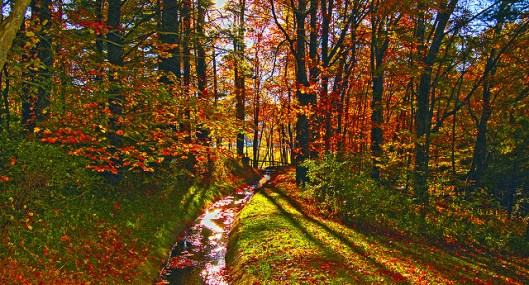
“Autumnal Beauty,” Valerie, flickr, Creative Commons, 2012
“Blue Ridge Parkway,” Jerry and Pat Donoho, flickr, Creative Commons, 2008
“Chapel,” Belva Parker, 2017

Absence Makes the Writer Stronger

11 Wednesday Oct 2017

Posted by Mimi Herman in Mimi Herman, Publication, Writing Advice

≈ 1 Comment

IMG_5922

It’s the last night of my Writeaways adventures in France and Italy, and after walking five or six miles throughout Rome, I’m ready to curl up in my armchair and rest my feet on my own footstool at home, pen in hand, and write.

Absence may make the heart grow fonder; it also makes a writer stronger. I’m returning home a better writer and teacher, more knowledgeable not only about the world, but also about how writing works. There’s something about getting away from the familiar that allows you to see everything you thought you knew more clearly – and there’s something about taking risks abroad that makes it possible to take risks in your own writing.

I saw that adventurousness in each of the writers who joined us at Chateau du Pin for our Writeaway in France, and at Villa Cini for our Writeaway in Italy. Some arrived with no idea of what they’d write about. Others found themselves on unfamiliar journeys through places and experiences they’d thought they knew well.

David and Liz.jpg

A Texas writer put away 20 chapters of a murder mystery he’d written to start again from a different angle. A writer from Florida discovered a depth of feeling in her writing that she didn’t know she had, a depth that fueled the delightful characters she’d created over the past year, and gave balance not only to her writing but to the way she saw herself. A writer from Singapore wrote a complete short story – her first since graduating college – and stayed up until 1 a.m. on our last night in Italy, submitting her story to some of the most respected literary journals around. Another, from Victoria, British Columbia, invented an older brother and created for him such a vivid picture of a family that I kept expecting to hear their dog scratching at the door of our villa to come inside (along with the cat who lived there, who seemed mysteriously able to enter the villa through locked doors and closed windows).

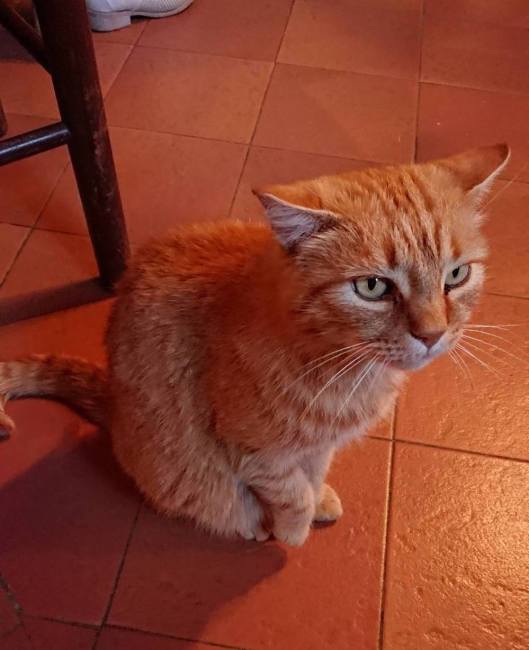
Aranciata-kitten on arancia copy

A Pennsylvania writer in France found herself recalling previously unreachable memories about her family as she worked on her memoir. A returning writer from Texas used writing and revision of a long poem to deal with a deep and longstanding pain—weaving imagery with a new understanding. A North Carolina writer finished the children’s book about Manfred (a very vain and valiant mouse) that she’d begun five years previously at her first Writeaway while another North Carolina writer began a children’s book about a cloud named Miranda and her friend Sirocco the osprey, a book which deftly wove scientific facts with fiction to make weather concepts accessible to children and the parents who might someday read her book.

Cointreau-Jean O'Neill copy

Our workshops each day were astonishing journeys, too. All the writers, both in France and in Italy, were able to help each other’s writing be—as we often say—“what it wants to be when it grows up.” We talked about imagery and plot, about “speed bumps” that wake the reader from “the fictional dream” described by John Gardner in his book The Art of Fiction, and about crafting characters and ideas that would remain with readers long after they finished reading. After each workshop, our writers delved again into their work, discovering anew what they wanted to say in this journey not only to the countries of our chateau and villa but to the countries created in their imaginations, each with its own customs and language.

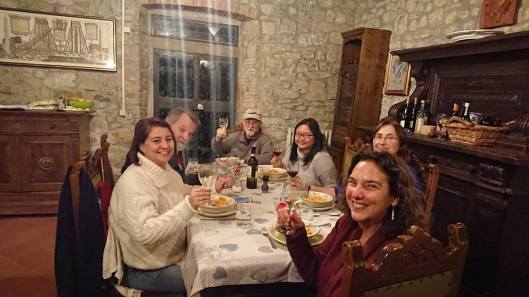
Villa Cini Dinner-Gayle Goh

And me, I wrote too, and revised, not my usual practice when we hold our Writeaways. But I had a book of poetry to complete, and a deadline by which it needed to be finished. I found myself looking at my own poems, some written several years ago, to see what they “wanted to be when they grew up.”

The distance from home allowed me to become closer to my own writing, as it does. This is something I wish for all writers, the chance to leave the home where you live to discover the home you create.

Photographs by John Yewell, Gayle Goh and Jean O’Neill, with permission by the photographers.
← Older posts
Newer posts →

About our laureates

  • Past Laureates

Join Us on Facebook

Join Us on Facebook

Enter your email address to subscribe to this blog and receive notifications of new posts by email.

Join 174 other subscribers

Piedmont Laureate Sponsors

Raleigh Artsuac-logo

Search

Website Powered by WordPress.com.

  • Subscribe Subscribed
    • Piedmont Laureate
    • Join 174 other subscribers
    • Already have a WordPress.com account? Log in now.
    • Piedmont Laureate
    • Subscribe Subscribed
    • Sign up
    • Log in
    • Report this content
    • View site in Reader
    • Manage subscriptions
    • Collapse this bar
 

Loading Comments...