On Becoming a Poet

grandpop-and-mim-reading

My life as a poet began with a love of words. A year before I took my first step, I was already speaking in full sentences, though only in the company of my own family. I was a shy kid who felt safest alone or in the company of one other person.

For the first several years of elementary school, I did my best to remain invisible. Then, in fourth grade, someone outside my family finally saw me: my Language Arts teacher, Miss Stephens. In Miss Stephen’s eyes, I became a person. In her class I became a poet. I started to let my cloak of invisibility slip to the classroom floor.

I’m sure Miss Stephens taught us many things about parts of speech and punctuation, but it’s the poetry I remember. She showed us how write haiku, where every syllable counts. Because of her, I think about the sounds and meanings of words every time I write or speak.

mim-with-fur-coat-and-dictionary

The young poet, contemplating her next meal

In sixth grade, I was mortified by a note passed around my class asking people to sign if they believed that “Mimi eats encyclopedias for breakfast.” Everyone in class signed that note.

As you can imagine, a child who eats encyclopedias for breakfast might find school a little boring. So Mrs. Williams, my highly perceptive teacher, invited me to create a project of my choice, which turned out to be a book of animal poems.

Like so many poets, I spent the next decade writing the tortured (and often cryptic) poems of adolescence. What I lacked in joie de vivre, I appear to have gained in courage, since I summoned the guts to enter a poetry contest run by the Chapel Hill branch of the American Association of University Women. In sixth grade I won second place with “Thoughts of a Child in a Concentration Camp.” In seventh grade, I earned first prize with my poem “Southern Belle.”

I wrote throughout high school and college, sometimes for school, but more often as a way to figure out how the world worked. Mostly I kept my volumes of journals (which now fill several bookshelves) separate from my poems. My journals were bowls to catch the overflow of adolescent emotions. I wrote the poems to craft something that might be useful to my future self and maybe, if I were lucky and diligent, to others.

I’ve always liked William Wordsworth’s definition, “Poetry is the spontaneous overflow of powerful feelings: it takes its origin from emotion recollected in tranquility.” As I grew older, I started to understand the “tranquility,” a state of mind not usually available to adolescents.

When I was accepted to the Warren Wilson MFA Program in Creative Writing, my father gave me three gifts. First he asked if it would be okay for him to pay my tuition, a gift I’d never expected.I accepted with astonishment, and, I hope, a certain amount of grace. Next, he gave me Eudora Welty’s book, One Writer’s Beginnings. And finally, he told me, “I know writers often write about the people in their families. I want you to know that you can write anything you want about me. Just tell me what to read and what not to read.”

In the 26 years since Warren Wilson, I’ve made my way as a writer and as a teacher of writing. I’ve struck a balance between Wordsworth’s “powerful feelings” and his “tranquility.” I’ve helped over 25,000 students and teachers—many of whom would rather scrub a bathtub than write a poem—discover the poets within themselves. And I’ve kept exploring the world through poetry.

This week, I’m teaching poetry to fourth graders at my old school, E.C. Brooks Elementary. It’s another gift in a series of gifts, the chance to share with kids what Miss Stephens helped me discover when I was in fourth grade: that you can be seen and heard, and that paying attention to the sounds and meanings of words is one way to become visible in the world.
Have Tiara, Will Travel

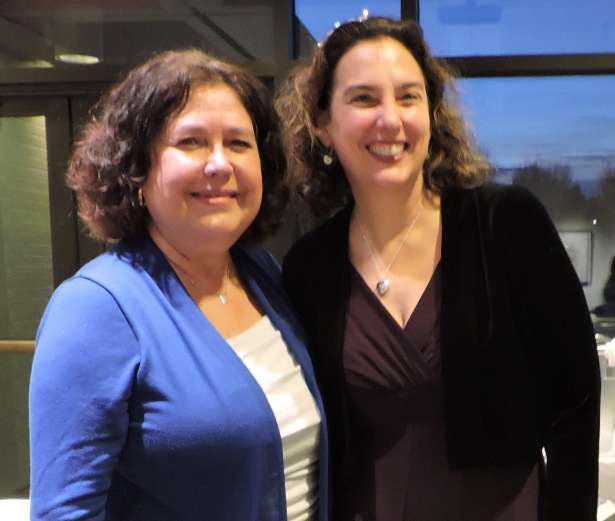
munger-herman-coronation-cropped

I’m delighted to launch into my year as the 2017 North Carolina Piedmont Laureate. The year began for me on New Year’s Eve, with this great article by David Menconi in The News & Observer.

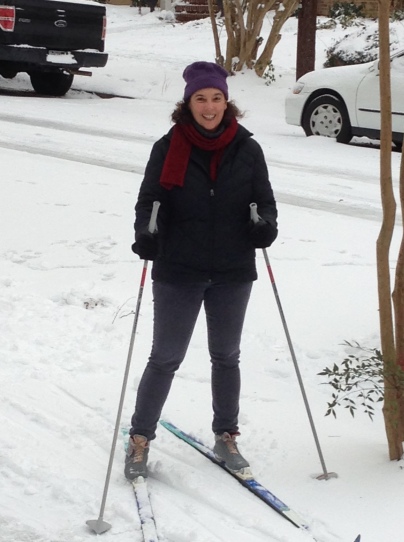
A week later, we were graced here in the Piedmont with a snowfall, so I took advantage of the snow days to write some poetry and do a little skiing around my neighborhood—always an inspiration.

mimi-on-skis-3-january-7-2017

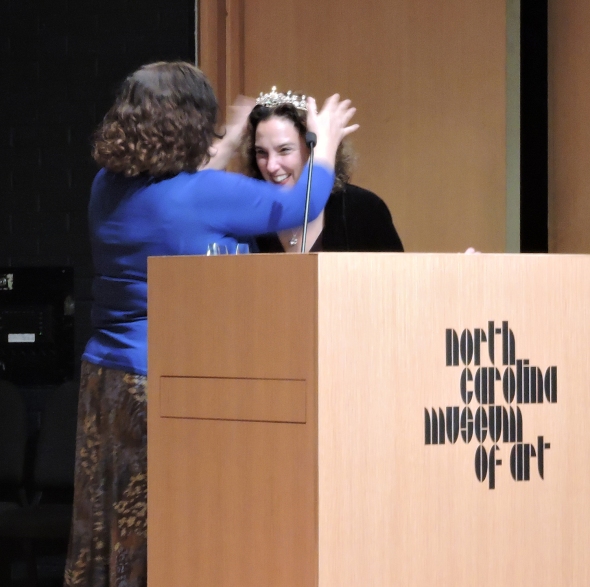
On Tuesday, January 10th, with snow still on the ground, Katy Munger, the 2016 Piedmont Laureate in Mystery Writing officially crowned me the 2017 Piedmont Laureate at the North Carolina Museum of Art.

I know a few of you weren’t able to slog through the snow, so I thought I’d share with you some of the remarks I composed for the occasion, so you can get a sense of me and what I’m planning for the year.

I appreciate the great work done by the City of Raleigh Arts Commission, the Durham Arts Council, the Orange County Arts Commission and the United Arts Council in creating and sustaining the Piedmont Laureateship.

I was born in Orange County—Orange County California, that is. But my family moved to Raleigh when I was eight months old, then later to Chapel Hill, and for the last 28 years I’ve lived in Durham. My father was born and raised in Winston-Salem, and was a pediatrician in Raleigh for many years. I went to Carolina with Michael Jordan, earned my degree in creative writing from there, and got my Masters in Fine Arts from Warren Wilson. I have called the Piedmont home for all of my talking, walking and poetry-writing life. This is the landscape I know. These are the people I cherish.

“How can I know what I mean until I see what I say?” E. M. Forster once said. I believe we can do this best by writing poetry. Write a draft. See what you’re trying to say to yourself. Play with the sound and language of it. Say it better, so it’s not just you talking to yourself, but you sharing what’s in your head and heart with other people in a way that inspires them to say, “That’s exactly what I felt. I just hadn’t figured out how to say it.

In the animated film, Ratatouille, the great chef Auguste Gusteau says, “Anyone can cook.” I believe anyone can write. My goal this year as Piedmont Laureate is to create opportunities for people to do that: for experienced poets to hone and share their craft, and for new writers to discover their voices. I plan to provide occasions for older people to share the stories of their lives and for younger people to imagine theirs—all through poetry. And for those of us in the middle (and my father used to say, “Middle age is ten years older than whatever you happen to be right now,” so I think I can safely say that most of us are in the middle!), maybe we can use poetry to help us understand our own lives a little better.

In the interest of time [and to leave you with something to look forward to in future blog posts], I won’t tell you about all I have planned for the year, but I did want to mention one of my favorites: poetry nap workshops in stressful workplaces.

Each of us has a distinctive voice. This year, I invite you to discover yours.

I’ll be offering all sorts of poetry events throughout Wake, Durham and Orange Counties, from workshops to readings to surprises I’ll reveal as the year progresses. I hope you’ll join me at one—or many—of these great events.

munger-herman-cropped

The Only 2017 Resolutions You Need

by Katy Munger, 2016 Piedmont Laureate

This is my last blog post as the 2016 Piedmont Laureate and I am using it to bring you the most important message I have to share: the world has never needed the arts more than it does now. The arts inject genuine emotion into a superficial, staged, commercially-driven world. The arts can cross borders and boundaries and generations. The arts illuminate the human dreams and emotions that unite us rather than creating issues to divide us. The arts can win over hearts and minds, counteracting the political negativity that turns us against one another.

Music… theater… books… art…. dance… museums: these are your weapons in 2017, the tools that you can use to increase peace, love, understanding and joy in the world. Are you with me? If so, forget losing 40 pounds or organizing your closet. Choose from among these suggestions for your New Year’s resolutions for 2017. And if you have an idea for more, or want to commit to some of these resolutions with me, please post in the Comment section below!

Join museums. Continue reading

Twice the Advice: Out with the Old and In with New!

by Katy Munger, 2016 Piedmont Laureate

In this very special, and close-to-final blog post of mine as the 2016 Piedmont Laureate, I asked the 2017 Piedmont Laureate — the ever fabulous poet Mimi Herman — to join me in answering some of the more interesting questions we writers get. We each answered without knowing what the other had to say. It’s a pretty interesting read, if I do say so myself. If you grab a beer or glass of wine before reading this post, it will almost be like you are sitting at the quiet end of the bar with me and Mim on a cold winter’s night. Enjoy!

Where do you think creativity comes from? What is it made of? 

Herman: I find creativity in the mysterious merging of a problem that needs to be solved with the time and space (and willingness) to take risks. For me, creativity is composed of time, urgency and indulgence in ideas, plus a passion for pursuing them.

Munger: I think creativity is a combination of hopes, dreams, past experience, past lives, the collective unconscious, and random electrical impulses of the brain — all mixed up in a stew that we attempt to make sense of. It’s a beautiful, chaotic expression of our individuality as well as our connections to the world around us. I like to think of it as a holding pen for our brains, where all that has gone before us and all that might be lives. I’d wander through that space forever if I could. Continue reading

Where I’m coming from

by Katy Munger, 2016 Piedmont Laureate

All writers owe thanks to the writers who came before them and left their literary footprints to follow. There’s not an author on the planet who didn’t start at, at some point, as a reader. I think of every page I turned as a child as somehow leaving a trace of longing on my fingertips, a feeling that sank deeper into my heart and, eventually, grew into a belief that I, too, could have my name on the cover of my book. That I, too, could be an author.

I thought about that a lot this Thanksgiving, in part because I stumbled across the wonderful quote above from Kurt Vonnegut. Yes, I found, and still find, humanity and humor in books, along with so much more—including lessons my teachers did not intend when they steered me toward these writers:

  • Joseph Wambaughtaught me that every character, no matter how minor, was worthy of love and care and respect. They make your books come alive. I will always love him for that.
  • Flannery O’Connershowed me that the darkness within us is universal and indecipherable—and, oh, so interesting to examine.
  • G. Wodehouse and Eudora Weltysteered me toward the joys of gentle, dry humor—an approach that inspired my first mystery series.
  • Ernest Hemingwaymade me realize I wasn’t a man and did not particularly want to be one or write like one, a more valuable lesson than you’d think.
  • Shirley Jacksonscared the crap out of me and made me realize that the need to acknowledge our fears is a powerful and fundamental human drive that can anchor a book.
  • Scott Fitzgeraldconvinced me I never wanted to squander my gifts and be known as someone who could have done so much more.
  • Robert Craisshowed me that you can write contemporary crime fiction without sounding like a bad imitation of a 50’s noir movie.
  • Ray Bradburystretched my imagination and showed me that, actually, you don’t have to write about what you know.
  • Erma Bombeck,of all people, opened my eyes to the humor lurking in the most ordinary of actions and events-–an appreciation that found its way into all of my series, even the serious one.
  • Both James Lee Burke and Tony Hillermanproved to me that an evocative sense of place was critical to creating a book that feels real enough for a reader to live in.
  • John Irvingmade me appreciate huge, sweeping plots and the joy of an ending where all the threads come together. I still pray for Owen Meany.
  • Stephen Ambrosemade me realize that the world needs real heroes and that it’s easy to overlook the best among us.

All of these writers influenced me because of the literary legacy they left for me to discover. Indeed, if you took bits of them all and whirred them up in a blender and poured them out over blank pages… you’d probably end up with a Katy Munger book. It’s always good to know where you come from.

What authors have influenced you and how? I’d love to know your own literary equation.

The Joy of Unspoiled Voices

by Katy Munger, 2016 Piedmont Laureate

One of the great joys of working with young authors is that their voices have yet to be shaped by disappointment, cynicism, or the expectations of strangers. Their imaginations are still on overdrive, unsquelched by the weight of everyday responsibilities, and they give voice to their imaginations with a delightful and unadorned boldness.

I was reminded of this over the past month as I read through the submissions of a young writers contest the Piedmont Laureate program sponsored at www.summersleuths.org. The assignment was to write a mystery or crime fiction short story and a few prompts were provided to get kids thinking. But most of the authors opted to submit stories based on their ideas. I was blown away by their creativity as well as the quality of their writing.

Sometimes the subjects were familiar: being late for school, moving to a new town, or the usual fears of childhood like fitting in or losing a pet. But they approached these topics with such elan and a cheerful enthusiasm for catching the bad guys that real law enforcement can only hope to emulate. Bus drivers, little old ladies, jealous friends, and others became villains, but many of the authors pointed out that, at heart, these villains still had good in them. Just as often, they would write about a situation where they were afraid of something, only to reveal later that they had simply misinterpreted what was going on. I love this view of the world: that no one is all bad and that we all have the resilience to overcome our fears. We just have to adjust the way we look at them.

Nearly all of the young writers excelled at creating a mood in their stories. One atmospheric submission spoke of monsters outside the window, describing a gradual increase of fear with a sparse, moody elegance I greatly admired. Other stories captured the loneliness that comes with being new to a classroom or town, or the loving interplay between child and parent. Are you wondering whether kids really hear what you say to them? Wonder no more: their ear for dialogue is astonishing.

These are kids who are paying attention to the world. These are young authors who are learning from what they see. ­­I would take nine billion of them.

Some stories were concise, others ran on and on -– leaping into different time periods and new worlds with endless energy and unpredictable creativity. May every page I write have that much joie de vivre. We could all use a little excess.

One young man even wrote a beautiful homage to British police procedurals; I wanted to call up his parents and salute them on their television watching policies. He captured the loneliness of responsibility that comes with being a senior detective who makes the decisions, the aching fear of making the wrong decision, and the price that comes with making a mistake. Somehow, this young man conveyed the essence of many a PBS series and he’s just 11 years old. Well done. He’s not just observing the world, he is absorbing it.

And unlike adults, faced with a crime, these young writers were not so concerned with dispensing justice. Bad guys might be captured, but they weren’t necessarily punished. There was little need for retribution. I rather liked this relaxed approach to good and evil. It signified a belief in the universe and its own ability to balance good and evil that I would like to embrace.

Most of all, I came away impressed with the power that stories have on our lives. These are young people raised on narratives everywhere they look, from the television commercials they see to the subjects they are taught in school, to the endless parade of books, movies, and shows that have shaped their lives. This consumption of stories has clearly made them storytellers — the advanced structures of these stories show this clearly. That gave me hope and underscored my belief that, going forward, in a world of sound bites, it will be shared stories that bind us.