Something I always tell people: Don’t go into writing books for the money, because there’s a lot less of it than you’d think. Sure, books are worth writing and publishing, enough so that I put a lot of effort into both writing and editing them. But for those of us who aren’t J.K. Rowling, say, you’d be amazed at just how little money can change hands over it.
Case in point is the annual royalty statement from University of Texas Press that hits my mailbox every year around this time. I have a small back-end interest in the books I’ve brought in to the American Music Series at UT Press, and a few of them have “earned out” — sold enough to recoup their advances and generate back-end royalties. Valhalla!

It comes to a few hundred dollars every year, which is good to have and I’m happy to get it. No, it’s not a living or much of a contribution to the retirement account, but every drop in the bucket helps here on Planet Freelance. The work is still fun to do, and it’s satisfying to feel like I’m involved in putting good things out into the world. That’s still more important to me than money.
But yeah, this is the time of year I pay attention to the money, especially since I have an even more direct rooting interest in one of those UT Press titles — because it’s a book I wrote, “Ryan Adams: Losering, A Story of Whiskeytown.” It was published way back in 2012 and did pretty well; sold decently by university-press standards while picking up mostly (but not unanimously) positive reviews and even winning an award.
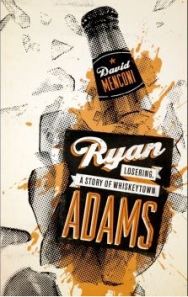 Naturally, I still feel like it could have done multiples more in sales if I’d caught a break or two — a review in the right place, the right person tweeting something about it at the right time — but that was not to be. All of which is to say that, while I’m still proud of “Losering,” it has yet to earn out and get to the promised land of back-end royalties.
But man, it’s close. By my back-of-the-envelope calculations based on this statement, it needs to sell only around 40 more copies to get there.
Seems like a sure thing, right? Guess again.
In the wake of that bombshell New York Times feature back in February, which accused Mr. Adams of various #MeToo misdeeds, his career pretty much came to a full stop. He was to have released three albums this year while touring the world, but that was all canceled.
It’s hard to tell if this is going to be a temporary lull or a permanent ban for Ryan, or if he has it within him to do what needs to be done for him to resume his career. I’ve not been able to bring myself to listen to his music since the news broke, which leaves me with profoundly mixed feelings. But in the grand scheme of things, the fate of my little university-press book on Ryan is an insignificant little blip. This time next year, I kind of expect it will still be in “Unrecouped” purgatory. So it goes.
Meanwhile, I’m just about done with my next book — this one for UNC Press, a history of North Carolina music — which has been my main side-hustle project for close to three years. There have been times when it’s felt like a sanity-keeping labor of love, others when it’s felt like an anchor I’m lugging around. But it should be done and dusted by the end of this month, with publication to follow in fall 2020.
The advance is just about the same amount I was paid to write “Losering.” Maybe this one will take less time to earn out.
 It’s coming up on seven months since I
  All the same, the place the festival once occupied in my professional life was very much on my mind, never moreso than Saturday morning — when I was actually all the way on the other side of the Triangle. Piedmont Laureate emeritus
  Several times during
  It’s hard for me to believe, but my
 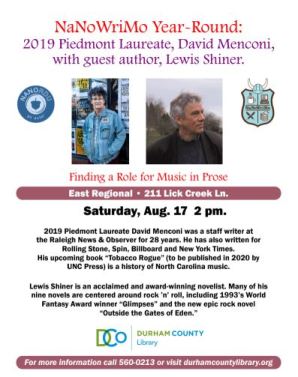 There is an application and interview process, and it’s open to all qualified writers who are at least 18 years old and have resided in Wake, Durham or Orange counties for at least one year. Application deadline is Oct. 7. You can check all the relevant details on the
  (1) Coffeehouses — Coffee joint as de facto office has become kind of a cliche for those hoofing it in The Gig Economy (TGE), and yet I must admit: There’s something about the smell of coffee brewing that makes me feel like I should be writing. It’s a Pavlovian response similar to the smell of popcorn giving you a sudden urge to go watch a movie.
 (2) Libraries — The public library remains one of the few truly egalitarian communal gathering spots because, as long as you behave, you can hang around pretty much as long as you want without spending any money (a big plus for those of us on the semi-employed budget). The bad part is, that often makes for an environment that might not be terribly conducive to thinking, reading and writing. I’ve been in some libraries that felt more like daycare centers, which feels churlish to complain about. It’s great to get kids interested in books at an early age, of course, but concentration can be difficult when the young folks are bouncing off the walls.
 (3) Shopping malls — Malls get a bad rap for being soul-sapping theme-park monuments to mindless consumerism, temples of banality and environmental catastrophes. In a world where you can get anything delivered to your door via Amazon, they don’t even really make economic sense anymore. Raleigh’s
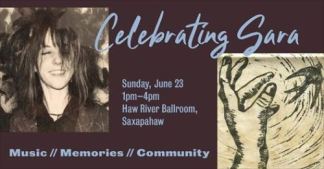
 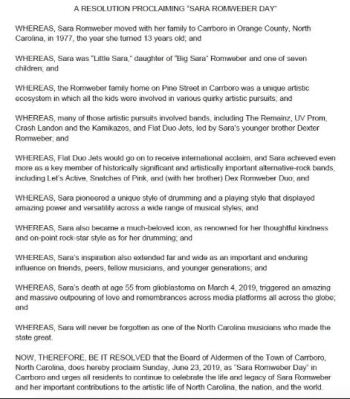 One of my duties as Piedmont Laureate this year is to be on call for occasionally composing a few words for various occasions. One such task I was honored to perform recently was writing a proclamation in honor of
  WHEREAS, the Romweber family home on Pine Street in Carrboro was a unique artistic ecosystem in which all the kids were involved in various quirky artistic pursuits; and
 WHEREAS, her inspiration also extended far and wide as an important and enduring influence on friends, peers, fellow musicians and younger generations; and
 WHEREAS, her memory will never be forgotten as one of the North Carolina musicians who made the state great.
 Piedmont Laureate