• About
  • Past Laureates
  • Blog
  • Events
  • Resources
  • Contact Us

Piedmont Laureate

~ Promoting awareness and heightened appreciation for excellence in the literary arts throughout the Piedmont Region

Piedmont Laureate

Tag Archives: Reading

The Piedmont Laureate Recommends: Buy Books As Gifts From Your Local Independent Bookstore

05 Thursday Dec 2024

Posted by Steven Petrow in Uncategorized

≈ Leave a comment

Tags

author, bookstore, holiday shopping, holidays, piedmont laureate, Reading

With the holidays already upon us, I hope you’ll consider giving books as gifts to those in your family and among your friends. And while you’re doing your shopping, please patronize your local bookstores, which make a lot of their annual income during the holiday season. If you still want the convenience of online shopping, check out Bookshop.org, a website that allows you to designate your local independent book seller. Click here to choose your favorite bookstore, which will receive the full profit from any Bookshop.org purchase you make.

To help you find the right book for the right person, here are some categories on Bookshop.org: Bestsellers, Fiction, Nonfiction, Teen/Young Adult,  Kids, and Games/Puzzles.

Piedmont Laureate Talks: Wake County Libraries Celebrate Local Authors With Special Series

04 Friday Oct 2024

Posted by Steven Petrow in Uncategorized

≈ Leave a comment

Tags

author talk, book signing, books, events, Fiction, hillsbrough, mental health, piedmont laureate, Reading, writing

I was overjoyed to join Wake County Public Libraries’ Read Local 2024, a celebration of local authors and the craft of writing. Open to residents of all ages who are invited to discover the creative voices within their community through a series of virtual and in-person programs. Bridget Booher (pictured with me above), a non-fiction writer based in Hillsborough, kindly served as my “conversation partner” at this event.

###

“We’re thrilled to bring together our community’s talented authors and provide a platform for them to share their stories and insights,” said Wake County Commissioner Cheryl Stallings. “Read Local is all about celebrating the creativity that exists right here in Wake County. Whether you’re an aspiring writer or simply love a good book, we encourage everyone to explore the opportunities available.”

Read Local 2024 offers a unique opportunity to connect with local authors, learn about the writing process and find inspiration. With a wide range of events tailored for families, kids, teens and adults, there’s something for everyone to enjoy.

Highlights include:

Write Here, Write Now: Crafting Your Story
Wednesdays, Sept. 11–Oct. 16
6:30 p.m.
Virtual
Join bestselling North Carolina authors for this six-part series that dives deep into the craft of writing a successful novel. Get insider tips and practical guidance on everything from plot development to character creation. Participating authors include Heather Frese, John Kessel, Evelyn Goldman, Meagan Church, Mazey Eddings and Daniel Wallace. Learn more and register at guides.wake.gov/write.

Read Local Celebration
Sunday, Oct. 6
1–4 p.m.
Downtown Cary Park
Enjoy an afternoon of authors at the park! Bring books or purchase them on-site to be signed.

  • 1 p.m.: Kwame Mbalia, award-winning and best-selling author of the Tristan Strong trilogy and editor of New York Times best-seller “Black Boy Joy: 17 Stories Celebrating Black Boyhood,” takes us on a fantastical journey with his newly released book “Jax Freeman and the Phantom Shriek.”
     
  • 2:30 p.m.: North Carolina Piedmont Laureate Steven Petrow, award-winning journalist and author, reads from and discusses his newly released book “The Joy You Make: Find the Silver Linings – Even on Your Darkest Days.”
     
  • 4 p.m.: Vanessa Miller, best-selling Christian fiction author, playwright and motivational speaker, will read from and discuss “The American Queen,” a historical novel featuring a strong Black woman who became queen in the post-bellum South.

The Piedmont Laureate Interview: Daniel (Big Fish) Wallace talks about the perils of secrets, advice for new writers, and why he wrote a memoir

24 Friday May 2024

Posted by Steven Petrow in Uncategorized

≈ Leave a comment

Tags

book review, books, Reading, writing, writing-tips

Whenever Daniel Wallace comes to my house, I’m left searching. I don’t mean for anything meta but for the tiniest rubber ducks acclaimed Chapel Hill writer leaves in his wake. I’ve found them on a book shelf, in my bathroom, even in my car (how did he manage to do that?). No matter, they quack delight. Daniel doesn’t quack himself, but his work exudes delight and by that I trust in the Merriam-Webster definition– “extreme pleasure or satisfaction.” Even his most recent book, This Isn’t Going to End Well, which is threaded with darkness, is such a satisfying experience. It’s also quite a departure for Wallace, best known for his novels like Big Fish and The Kings and Queens of Roam. Recently, Daniel agreed to answer my questions. Here are his answers.

Photo credit: Kate Medley

Q: You’re best known as a novelist and as the author of Big Fish, a novel of mythic proportions (as you wrote). This Isn’t Going to End Well is quite the departure. Why did you leave the fictional realm?

A: This book found me. In 2011, my sister died, and as we were sifting through the remnants of her life, I found a box of journals in the back of a closet. They belong to her husband, William Nealy, my brother-in-law. He was my mentor, a great man who stored vast amounts of knowledge and expertise in an unbelievably capacious mind, an artist and an adventurer – who, in 2001, had died by suicide. When I read these journals – after years of soul-searching – I discovered the presence of another man within the one we knew. This story of a self and its shadow self is what compelled me to write this book.

Q: How was it different—as a writer, in terms of process—to pen this book?

A: I faced a lot of perils writing this book. Writing intimately about my family. Sharing secrets that weren’t necessarily mine to tell, and sharing parts of myself too. These were challenges. But in the end all stories are the same. It’s all about telling a story sentence to sentence, page to page, something that keeps a reader reading. Finding out what happens next.

Caption: A Daniel Wallace original drawing, 2024

Q: What do you hope readers will take away from This Isn’t Going to End Well?

A: I don’t know, really. Every reader will find ways in which their own story or stories about someone close might overlap with this one. But exactly how and why I could never know unless they told me, and sometimes they do. My goal is always to make the experience of reading powerful, charged, consuming, and what happens after that is individual, personal, unknown to me.

Q: What do you love most about being a writer? What do you hate?

A: I love the writing, day-to-day. I love seeing what happens next. When I sit down to write I have no idea what’s about to happen so it’s as much a surprise to me as it is to my readers. The actual publishing process can be time-consuming, tedious, and arduous, especially when I just want to get started on another book. But it’s all good!

Q: I know you also teach creative writing at UNC Chapel Hill. What advice do you have for those who want to write, regardless of genre?

A: It’s the same for all of us, isn’t it? Read what you love, write what you love. If it sustains you, brings you joy, do it no matter what.
The Morning After Our Program on ‘Writers and Social Change’ the Durham County Library Received A Bomb Threat. Here’s What Happened.

16 Tuesday Apr 2024

Posted by Steven Petrow in Uncategorized

≈ Leave a comment

Tags

bomb threat, book reading, books, community, libraries, library, piedmont laureate, rainbow story hour, Reading

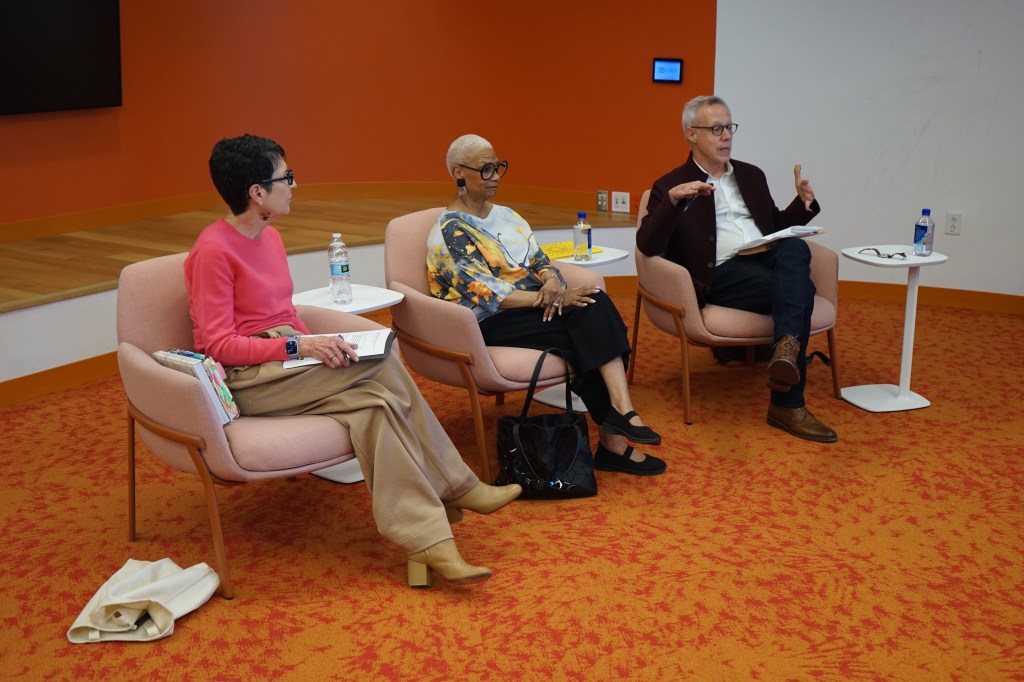
(From left to right: Marcie Cohen Ferris, Jaki Shelton Green, and Steven Petrow)

Breaking news: “Durham County Main Library was evacuated as a precaution Saturday morning because of a bomb threat. It happened just before a story hour hosted by an LGBTQ organization began.”

A scant day before I’d been overjoyed to share the stage at the Durham County Public Library at its fourth annual Library Fest. With me were Jaki Shelton Green, North Carolina’s Poet Laureate, and Marcie Cohen Ferris, one of our most important food writers. Together, we talked about the role of writers and social change, and the importance of libraries as safe spaces. 

For those who don’t know, Library Fest is in celebration of National Library Week, and all the good work that libraries do. Early on in the conversation the three of us talked about the role of libraries in our upbringing. I spoke about my grandmother, “Marian the Librarian,” who ruled the roost at my local library in Forest Hills, N.Y. I recalled that as a teen I went to the card catalogue (obviously, this was long before everything had been digitized) to seek information about “homosexuality” (obviously, this was long before I came out). I was terrified that Grandma Marian might stop by at the wrong moment—and discover my truth—so I came up with a clever excuse for being at that particular drawer. If questioned, I’d reply, “I’m actually looking up ‘homo sapiens,’ Grandma.” Nothing of the kind happened, and I came away secure with the notion that libraries are safe spaces for all. 

Jaki and Marcie concurred, with Jaki telling us how, as a child, she became the first Black girl to integrate her segregated library. We talked about a good deal more, including those who had influenced us to become writers and agents of change (a lot of credit went to family), various role models, how we found our voices, and the challenges we’ve encountered in speaking our truths. I could not have asked for a more engaged panel—or audience.

Before the evening ended, a bit overtime, each of us had thanked library staff for all they do, praising the library building itself, which is open, inviting, full of light, a true community center.

The Durham County Main Library.

I wish I could end my story right here. 

_____

On tap the next morning was a program called “Rainbow Story Time” hosted by  Rainbow Collective for Chance. According to news reports, about half an hour before the program was to begin, the library was informed of a bomb threat, specifically mentioning Maya Christina Gonzalez, whose book was to be read during the story hour.

In its statement, Rainbow Collective for Change said:

“RCC has been hosting monthly Rainbow Story Times and other events for 2 years now and this is our first experience with a serious threat…We will continue to advocate for LGBTQIA+ and gender-affirming schools and build community spaces where our children can be who they are and celebrate that love makes a family. We – together with RCC families and partner organizations — will not let hate win and will continue advocating for a safe and affirming community that all our children deserve.”

As for the library, it closed for the rest of the weekend. By Monday morning, its doors re-opened—to everyone.

As one staffer told me, “We will not be deterred or intimidated.”

No, we won’t.

Measurements

30 Friday Nov 2018

Posted by nancystoryflow in Advancing the story, art, Attention, character, communication, continuing, creating, frustration, heart, Process, Publication, Reading, slowing down, Story, Uncategorized

≈ 8 Comments

Tags

art, Attention, characters, Guidance, Process, Reading, Story, work

I live in a culture that loves measurements. Resumes, job descriptions, salaries, developments – America loves to count. When I cleaned houses for a living my work was measured not just room by room and task by task, but in bathtubs leaned over and showers leaned into. Rags dirtied and washed and folded and dirtied again. Sponges falling apart, their yellow bits washed down suburban drains. Work was measure in blown out, leaking rubber gloves, and shredding mop heads, and the nubs of feather dusters. In backaches and sore knees and Epsom Salt baths and Tylenol and hours spent on the heating pad, on the couch.

Now my work is measured in how many books I’ve published, in awards received or not, in Tweets and blog posts and movie deals (present or lacking). It’s measured by Oprah and the New York Times Bestseller List, and Youtube channels. These are big, public measurements and there’s not much a writer can do or not do to achieve them. These sorts of measurements are the work of the Gods and Goddesses, and Fate with a capital F. All I can do is show up and write.

I don’t take daily measurements of my writing. I don’t count words or even pages. The daily question I ask myself during each writing session is: Have I moved the story forward? Yes could mean a paragraph or three pages. No could mean ten or more pages, pages that do nothing for the story, pages that stall it out and go nowhere.

I work with writers and many of them study writing in a way that I do not and never have. They study trends. They know the industry standard of word count for a YA book, or a literary novel, or a sci-fi book, and they write to meet those standards.

But asking how long a novel must be is like asking how long a piece of string must be. The answer of course is that it depends on many things – mainly what is the string to be used for. A string to tie one’s shoes will be shorter than a string to tie up one’s tomatoes. A string to tie a 10″ box will be different from a string to tie a 2′ box. A string to wrap around a story will depend on the story, and if the story is dependent on the string, then that string better be cut to fit. And so it is with page count and word count.

The publishing world is a place where you can find a definitive answer to whatever question you ask, but I don’t believe it’s good to look for definitive answers. Nor do I believe the book world should be a place for industry standards. The book world, the world of story should be a place of exploration. But writers just starting out are scared of all the nebulousness. They yearn for information, anything to help get started and keep going. I’m not trying to keep information from anyone, and I understand the urge to search for answers. It’s frightening to me too when I face a story I don’t yet understand, and haven’t yet written.

In answer to my own question of measurement: Have I moved the story forward? there’s an easy answer. Has something happened that is significant? If not have I written something that contributes to the character’s development, or to setting? Am I building a believable fictional world? Does this section contribute or is it just there.

I know the answers to these questions when I ask them, which isn’t to say I know the solution. But it does mean I can recognize a problem and not write into it, not dig post holes and build a wall around it. Acknowledging that the story is stalling is the first step to moving it forward.

Readers want stories that move forward and so do editors. Editors dare not say so though, because they work in an industry, an industry that has gone awry with measurements and bean counting and shiny objects. Pay no attention. Do your work and do it well. The most important measurement of all is how you feel about it, and how your character feels about you. In the end, do you and your character respect each other? If so, you’ve done well, and you’ll be in a better place to defend your work against random suggestions having to do with fattening a book for market.

Reading Books in the Age of Madness

02 Tuesday Oct 2018

Posted by nancystoryflow in art, Attention, competition, frustration, Reading, Uncategorized, Writer's journey

≈ 1 Comment

Tags

Attention, Money, Reading, safety, Story, stress, work

A few years ago, I sat on a public bench, waiting for a friend and reading a book. A woman interrupted me. (Please note: Do not interrupt a person reading a book!) The woman wanted to know what I was reading. I showed her the cover, and then the woman said she couldn’t read anymore. She used to read. She used to read a lot, but now she can’t. She can’t concentrate. Things have become so unstable lately, so volatile that she can’t concentrate on reading.

“Read,” I told her. “Go read a book. You’ll thank me later.”

After she left I muttered under my breath, “You think it’s hard to read in this environment? You should try writing.”

I know a lot of writers. We plug along. We ride the waves of self doubt and the waves of cultural madness. We have no choice. Being a writer, or an artist, requires a little unplugging. So we unplug. And then we plug back in. And our blood pressure goes through the roof and we unplug again. We write. It’s incredibly selfish of us. It’s incredibly hopeless. And it’s incredibly depressing as we watch the celebrity-titled books fly off the shelves while ours, and those of many authors I know, linger and gather dust.

You want to help the world be less crazy? Support the arts. Support a writer. Buy a book that does not have a flashy familiar face on the cover. And be seen reading it. And then buy another.


← Older posts

About our laureates

  • Past Laureates

Join Us on Facebook

Join Us on Facebook

Enter your email address to subscribe to this blog and receive notifications of new posts by email.

Join 174 other subscribers

Piedmont Laureate Sponsors

Raleigh Artsuac-logo

Search

Website Powered by WordPress.com.

  • Subscribe Subscribed
    • Piedmont Laureate
    • Join 174 other subscribers
    • Already have a WordPress.com account? Log in now.
    • Piedmont Laureate
    • Subscribe Subscribed
    • Sign up
    • Log in
    • Report this content
    • View site in Reader
    • Manage subscriptions
    • Collapse this bar
 

Loading Comments...