• About
  • Past Laureates
  • Blog
  • Events
  • Resources
  • Contact Us

Piedmont Laureate

~ Promoting awareness and heightened appreciation for excellence in the literary arts throughout the Piedmont Region

Piedmont Laureate

Tag Archives: Fiction

Piedmont Laureate Talks: Wake County Libraries Celebrate Local Authors With Special Series

04 Friday Oct 2024

Posted by Steven Petrow in Uncategorized

≈ Leave a comment

Tags

author talk, book signing, books, events, Fiction, hillsbrough, mental health, piedmont laureate, Reading, writing

I was overjoyed to join Wake County Public Libraries’ Read Local 2024, a celebration of local authors and the craft of writing. Open to residents of all ages who are invited to discover the creative voices within their community through a series of virtual and in-person programs. Bridget Booher (pictured with me above), a non-fiction writer based in Hillsborough, kindly served as my “conversation partner” at this event.

###

“We’re thrilled to bring together our community’s talented authors and provide a platform for them to share their stories and insights,” said Wake County Commissioner Cheryl Stallings. “Read Local is all about celebrating the creativity that exists right here in Wake County. Whether you’re an aspiring writer or simply love a good book, we encourage everyone to explore the opportunities available.”

Read Local 2024 offers a unique opportunity to connect with local authors, learn about the writing process and find inspiration. With a wide range of events tailored for families, kids, teens and adults, there’s something for everyone to enjoy.

Highlights include:

Write Here, Write Now: Crafting Your Story
Wednesdays, Sept. 11–Oct. 16
6:30 p.m.
Virtual
Join bestselling North Carolina authors for this six-part series that dives deep into the craft of writing a successful novel. Get insider tips and practical guidance on everything from plot development to character creation. Participating authors include Heather Frese, John Kessel, Evelyn Goldman, Meagan Church, Mazey Eddings and Daniel Wallace. Learn more and register at guides.wake.gov/write.

Read Local Celebration
Sunday, Oct. 6
1–4 p.m.
Downtown Cary Park
Enjoy an afternoon of authors at the park! Bring books or purchase them on-site to be signed.

  • 1 p.m.: Kwame Mbalia, award-winning and best-selling author of the Tristan Strong trilogy and editor of New York Times best-seller “Black Boy Joy: 17 Stories Celebrating Black Boyhood,” takes us on a fantastical journey with his newly released book “Jax Freeman and the Phantom Shriek.”
     
  • 2:30 p.m.: North Carolina Piedmont Laureate Steven Petrow, award-winning journalist and author, reads from and discusses his newly released book “The Joy You Make: Find the Silver Linings – Even on Your Darkest Days.”
     
  • 4 p.m.: Vanessa Miller, best-selling Christian fiction author, playwright and motivational speaker, will read from and discuss “The American Queen,” a historical novel featuring a strong Black woman who became queen in the post-bellum South.

The Piedmont Laureate Interviews New York Times Bestselling novelist, Jill McCorkle, about her new book, “Old Crimes: and Other Stories” 

06 Monday May 2024

Posted by Steven Petrow in Uncategorized

≈ Leave a comment

Tags

author, bestseller, books, Fiction, interview, Jill McCorkle, Old Crimes, writing, writing-tips

When I bump into neighbor and bestselling novelist, Jill McCorkle, on one of Hillsborough’s tree-lined streets, I know it’s going to be a good day. There’s her smile for starters, and her Southern accent, which she says befuddles even Siri, and a big heart that embraces friend and stranger alike. Earlier this year her latest collection of stories, Old Crimes, was published to rave reviews. “Dazzling,” “splendid,” and “extraordinary” are just a few of her recent accolades. 

Q: You’ve been quite busy the past several years and now you have this new collection of stories. What was the impetus?

A: I always have a story idea or two in progress but find that when fully involved in a novel, I put the stories aside and just continue to add details and thoughts along the way as I store up for time post novel to give attention. Several of the stories had been published earlier, but the bulk of them were ideas left to simmer. I find that when this happens, there is often a thematic connection that begins to take shape, the same as it would if they were parts of a novel.  

Q: The promotional copy for Old Crimes says that you take “us deep into these conflicted and sympathetic characters, puzzling to figure out the meaning of their own lives.” Did writing these stories help you figure out more about the meaning of your own life?

A: I think that it is impossible to fully immerse yourself in a project and the lives of others, and not learn something about yourself, or experience a kind of resurrection—for better or worse–of a particular time or place or memory. I think the real beauty of aging is the ability to look back and see connections and meanings that you never saw before. For me—and I suspect for most of us—this is an endless process

Q: Would you characterize yourself as a Southern writer? If not, why not?

A: I am definitely a Southern writer in that I was born and raised in the south with all of my earliest memories firmly rooted in the microcosm of my hometown. I have an accent that Siri can’t decipher even after living in New England for 20 years. I share that complicated love/hate of the south that so many do. You love the foliage and language and much you associate with the notion of home and you despise a history steeped in racism and hatred and rigid judgments of all kinds.  I think that the danger of being labeled as a “southern” writer would be if it implies that your work is only of interest to others of the same region. In this collection, my characters move back and forth, sometimes in the south and sometimes in New England. After years of teaching in both places, I have come to think that on the page, the biggest divide is rural/ urban.  Students from small towns in New Hampshire or Maine often were very similar to those of the Carolinas. Different language and weather, but thematically kin.  

Q: When you are writing, what does a “typical” day look like for you?

A: I’m always writing and it was a great realization when I discovered that there was no on/off switch but a constant return/ revisit/ recognize all along the way. As a result, I am a compulsive note taker for fear of losing those fragments that blow in and out all day.  Then, when I sit down, I have a beginning of some sort and start typing. I love early morning and that is the time for collecting the ideas and thoughts and revisiting what is in place. I never come to the keyboard empty handed. I like that writing is so portable and so my day is pretty flexible as I go here and there, storing up for a big block of time that allows me to dive in. After almost 40 years, I am only now not teaching on a formal schedule and so I am coming into a place that offers more time than I have had since I was in college.  

Q: Do you have any suggestions for people who want to become writers, whether fiction, non-fiction or any other genre?

A: To borrow from Nike, the best advice really is Just Do It–get something on the page.  The best advice I got as a young writer was that I NOT censor or edit myself prematurely, that I get rid of whoever it was standing behind me with judgment and criticism, so that the first draft offered no concerns except to the characters and situation on the page. I begin each project telling myself that no one will ever have to see it, so let it fly.  It’s liberating to give yourself total freedom and THEN, in revision, you can think about other aspects, problem solve, etc. But there’s no way to get to step two without step one. You cannot sculpt something without first producing a big messy chunk of clay.  

Piedmont Laureate Steven Petrow In Conversation With Bestselling Author, Damon Tweedy, MD

12 Friday Apr 2024

Posted by Steven Petrow in Uncategorized

≈ Leave a comment

Tags

book review, Fiction, historical-fiction, knitting, medicine, music, piedmont laureate, self help, writing

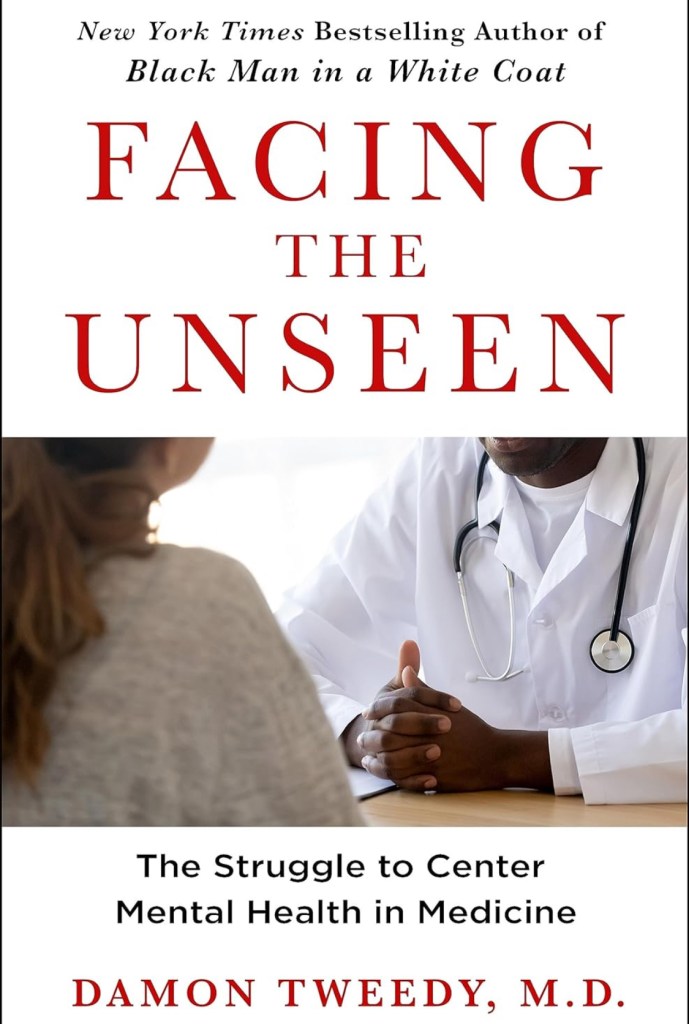
At Quail Ridge Books, The Two Writers Talk About Tweedy’s New Book, Facing The Unseen: The Struggle to Center Mental Health in Medicine

I was thrilled to be Dr. Damon Tweedy’s “conversation partner” at Quail Ridge Books in Raleigh this week. Together we were taking about his new book, Facing the Unseen, which is about the mental health crisis in this country, in our hospitals, and within our families. Tweedy, the bestselling author of Black Man in a White Coat and a professor of psychiatry at the Duke School of Medicine, has written another powerful volume, one that combines expert interviews, personal experience, and policy analysis to examine how the medical system fails people with mental illness. As he writes, “When a system marginalizes mental health … patients pay the price.”

Clearly, Dr. Tweedy was on his home turf at Quail Ridge Books, as he engaged the audience for close to 45 minutes with stories from his world—personal and professional—and then took at least a dozen questions from the audience. By 8 p.m., the program had ended and the good doctor took out his pen, signing his name in the books of a great many individuals who waited in a long line to greet and thank him.

To purchase Dr. Tweedy’s books from Quail Ridge, please click here. Or buy them from your local book store, Bookshop.org, or Amazon.com.

#

Here’s an excerpt from the BookPage review of Dr. Tweedy’s new book:

“Mostly, though, Facing the Unseen is about his patients. Tweedy is an excellent storyteller, making the people whom he treats unforgettably visible in all their complexities. Their stories embody why recognizing the mind-body connection is critical. There’s Natalie (all patients’ names are pseudonyms), an Iraq war veteran with PTSD, who came to the ER desperate for help. But treating her drug withdrawal was not considered a medical priority, and she was left to seek outpatient psychiatric care elsewhere. A passionate advocate for integrated medical and psychiatric care, Tweedy cites statistics that tally addiction and opioid abuse, PTSD, depression and anxiety, and the prevalent use of prescription pills. Throughout, he uses powerful descriptions that yield keen insights, showing us how the health care system sets doctors up to fail their patients, and offering solutions that will help.”

About our laureates

  • Past Laureates

Join Us on Facebook

Join Us on Facebook

Enter your email address to subscribe to this blog and receive notifications of new posts by email.

Join 174 other subscribers

Piedmont Laureate Sponsors

Raleigh Artsuac-logo

Search

Website Powered by WordPress.com.

  • Subscribe Subscribed
    • Piedmont Laureate
    • Join 174 other subscribers
    • Already have a WordPress.com account? Log in now.
    • Piedmont Laureate
    • Subscribe Subscribed
    • Sign up
    • Log in
    • Report this content
    • View site in Reader
    • Manage subscriptions
    • Collapse this bar
 

Loading Comments...