• About
  • Past Laureates
  • Blog
  • Events
  • Resources
  • Contact Us

Piedmont Laureate

~ Promoting awareness and heightened appreciation for excellence in the literary arts throughout the Piedmont Region

Piedmont Laureate

Tag Archives: book review

The Piedmont Laureate Is Reading: “The Fine Art of Literary Fist-Fighting,” by Lee Gutkind

01 Thursday Aug 2024

Posted by Steven Petrow in Uncategorized

≈ Leave a comment

Tags

author, book review, Joan Didion, nonfiction, piedmont laureate, Washington Post

[This review by Lucas Mann is excerpted from The Washington Post. It especially caught my eye as I consider myself a “creative nonfiction writer,” not to mention that I’m the 2024 N.C. Piedmont in Creative Nonfiction. Read on!]

Joan Didion stands in San Francisco’s Golden Gate Park in April 1967 with a group of hippies, during her reporting for her article “Slouching Towards Bethlehem.” (Ted Streshinsky/Corbis/Getty Images)

In the first paragraph of “The Fine Art of Literary Fist-Fighting,” Lee Gutkind, the “Godfather” of the creative-nonfiction genre (a title used once to describe him in Vanity Fair in 1997 and since taken up repeatedly over the years, mostly by Gutkind himself, including in the bio on this book jacket), begins with a question he often receives: “‘What is creative nonfiction?’ Or, in some cases, ‘What the hell is creative nonfiction?’”

It’s a fitting sentiment for the genre, and for its longtime champion. This term, which others forgo in favor of “literary nonfiction” or “narrative nonfiction,” or simply “the essay,” as Gutkind writes, is a blanket that seeks to cover works from Joan Didion’s stylized journalistic chronicles of the ’60s to Mary Karr and the memoir boom of the ’90s to Annie Dillard’s nature writing, and everything in between that isn’t made up but also probably wouldn’t run in the newspaper. To practice or teach creative nonfiction (or whatever else you might want to call it) has been to operate from a defensive position. As Gutkind shows, this is a genre whose inception and growth were met with uncertainty, skepticism and in many cases disdain.

In trying to name, categorize, legitimize creative nonfiction, it’s hard not to feel that you’re being defined by what you are failing to do — it’s not creative in the eyes of fiction writers, or rigorously factual in the eyes of journalists, or properly literary in the eyes of academics. Here, Gutkind attempts to narrate the history of the genre, and that story is inevitably one of contestation and conflict — about what “creative nonfiction” even is, above all else, and just how “creative” writers can be before they’re no longer writing nonfiction. Those are familiar debates for some of us, and they haven’t stopped. I was in graduate school more than a decade ago, at one of the creative-nonfiction programs that Gutkind describes, and I was constantly getting into “Literary Fist-Fights,” though I imagine most of the people around me wanted to punch me for real.

To read more of this review, please click here.

The Piedmont Laureate Interview: Daniel (Big Fish) Wallace talks about the perils of secrets, advice for new writers, and why he wrote a memoir

24 Friday May 2024

Posted by Steven Petrow in Uncategorized

≈ Leave a comment

Tags

book review, books, Reading, writing, writing-tips

Whenever Daniel Wallace comes to my house, I’m left searching. I don’t mean for anything meta but for the tiniest rubber ducks acclaimed Chapel Hill writer leaves in his wake. I’ve found them on a book shelf, in my bathroom, even in my car (how did he manage to do that?). No matter, they quack delight. Daniel doesn’t quack himself, but his work exudes delight and by that I trust in the Merriam-Webster definition– “extreme pleasure or satisfaction.” Even his most recent book, This Isn’t Going to End Well, which is threaded with darkness, is such a satisfying experience. It’s also quite a departure for Wallace, best known for his novels like Big Fish and The Kings and Queens of Roam. Recently, Daniel agreed to answer my questions. Here are his answers.

Photo credit: Kate Medley

Q: You’re best known as a novelist and as the author of Big Fish, a novel of mythic proportions (as you wrote). This Isn’t Going to End Well is quite the departure. Why did you leave the fictional realm?

A: This book found me. In 2011, my sister died, and as we were sifting through the remnants of her life, I found a box of journals in the back of a closet. They belong to her husband, William Nealy, my brother-in-law. He was my mentor, a great man who stored vast amounts of knowledge and expertise in an unbelievably capacious mind, an artist and an adventurer – who, in 2001, had died by suicide. When I read these journals – after years of soul-searching – I discovered the presence of another man within the one we knew. This story of a self and its shadow self is what compelled me to write this book.

Q: How was it different—as a writer, in terms of process—to pen this book?

A: I faced a lot of perils writing this book. Writing intimately about my family. Sharing secrets that weren’t necessarily mine to tell, and sharing parts of myself too. These were challenges. But in the end all stories are the same. It’s all about telling a story sentence to sentence, page to page, something that keeps a reader reading. Finding out what happens next.

Caption: A Daniel Wallace original drawing, 2024

Q: What do you hope readers will take away from This Isn’t Going to End Well?

A: I don’t know, really. Every reader will find ways in which their own story or stories about someone close might overlap with this one. But exactly how and why I could never know unless they told me, and sometimes they do. My goal is always to make the experience of reading powerful, charged, consuming, and what happens after that is individual, personal, unknown to me.

Q: What do you love most about being a writer? What do you hate?

A: I love the writing, day-to-day. I love seeing what happens next. When I sit down to write I have no idea what’s about to happen so it’s as much a surprise to me as it is to my readers. The actual publishing process can be time-consuming, tedious, and arduous, especially when I just want to get started on another book. But it’s all good!

Q: I know you also teach creative writing at UNC Chapel Hill. What advice do you have for those who want to write, regardless of genre?

A: It’s the same for all of us, isn’t it? Read what you love, write what you love. If it sustains you, brings you joy, do it no matter what.

Piedmont Laureate Steven Petrow In Conversation With Bestselling Author, Damon Tweedy, MD

12 Friday Apr 2024

Posted by Steven Petrow in Uncategorized

≈ Leave a comment

Tags

book review, Fiction, historical-fiction, knitting, medicine, music, piedmont laureate, self help, writing

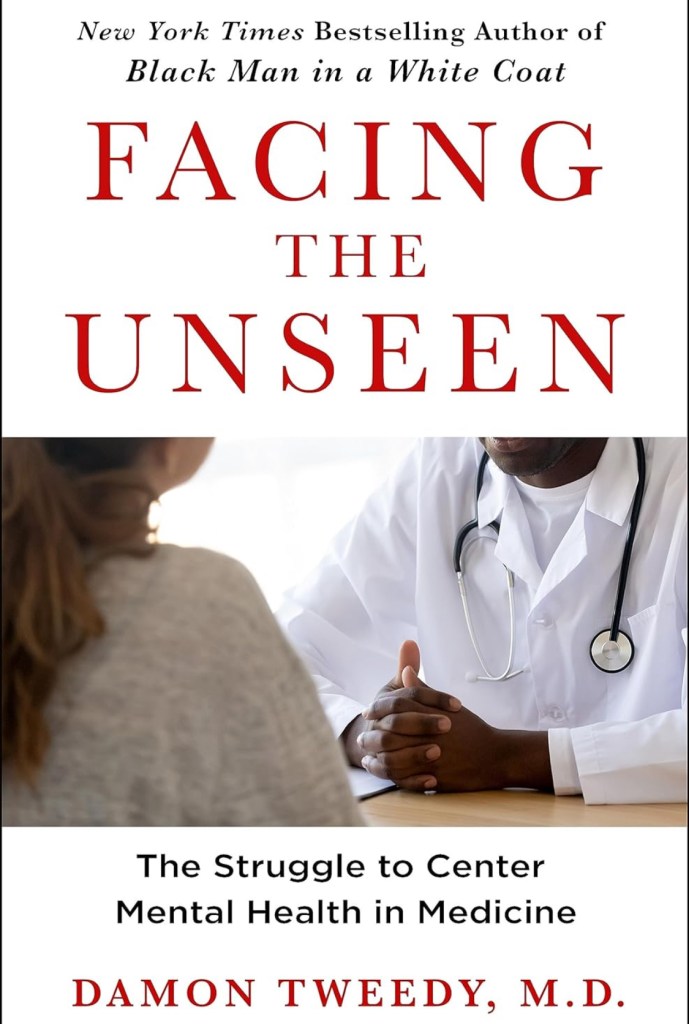
At Quail Ridge Books, The Two Writers Talk About Tweedy’s New Book, Facing The Unseen: The Struggle to Center Mental Health in Medicine

I was thrilled to be Dr. Damon Tweedy’s “conversation partner” at Quail Ridge Books in Raleigh this week. Together we were taking about his new book, Facing the Unseen, which is about the mental health crisis in this country, in our hospitals, and within our families. Tweedy, the bestselling author of Black Man in a White Coat and a professor of psychiatry at the Duke School of Medicine, has written another powerful volume, one that combines expert interviews, personal experience, and policy analysis to examine how the medical system fails people with mental illness. As he writes, “When a system marginalizes mental health … patients pay the price.”

Clearly, Dr. Tweedy was on his home turf at Quail Ridge Books, as he engaged the audience for close to 45 minutes with stories from his world—personal and professional—and then took at least a dozen questions from the audience. By 8 p.m., the program had ended and the good doctor took out his pen, signing his name in the books of a great many individuals who waited in a long line to greet and thank him.

To purchase Dr. Tweedy’s books from Quail Ridge, please click here. Or buy them from your local book store, Bookshop.org, or Amazon.com.

#

Here’s an excerpt from the BookPage review of Dr. Tweedy’s new book:

“Mostly, though, Facing the Unseen is about his patients. Tweedy is an excellent storyteller, making the people whom he treats unforgettably visible in all their complexities. Their stories embody why recognizing the mind-body connection is critical. There’s Natalie (all patients’ names are pseudonyms), an Iraq war veteran with PTSD, who came to the ER desperate for help. But treating her drug withdrawal was not considered a medical priority, and she was left to seek outpatient psychiatric care elsewhere. A passionate advocate for integrated medical and psychiatric care, Tweedy cites statistics that tally addiction and opioid abuse, PTSD, depression and anxiety, and the prevalent use of prescription pills. Throughout, he uses powerful descriptions that yield keen insights, showing us how the health care system sets doctors up to fail their patients, and offering solutions that will help.”

About our laureates

  • Past Laureates

Join Us on Facebook

Join Us on Facebook

Enter your email address to subscribe to this blog and receive notifications of new posts by email.

Join 174 other subscribers

Piedmont Laureate Sponsors

Raleigh Artsuac-logo

Search

Website Powered by WordPress.com.

  • Subscribe Subscribed
    • Piedmont Laureate
    • Join 174 other subscribers
    • Already have a WordPress.com account? Log in now.
    • Piedmont Laureate
    • Subscribe Subscribed
    • Sign up
    • Log in
    • Report this content
    • View site in Reader
    • Manage subscriptions
    • Collapse this bar
 

Loading Comments...