• About
  • Past Laureates
  • Blog
  • Events
  • Resources
  • Contact Us

Piedmont Laureate

~ Promoting awareness and heightened appreciation for excellence in the literary arts throughout the Piedmont Region

Piedmont Laureate

Category Archives: Reading

A Gathering of Laureates

06 Wednesday Dec 2017

Posted by Mimi Herman in Ian Finley, James Maxey, Katy Munger, Mimi Herman, Poetry, Reading, Scott Huler, Writing Advice, Writing Workshops

≈ 3 Comments

23915508_1976582055895529_2258818442474702301_n

Exactly one year ago today, I was initiated into my reign as 2017 North Carolina Piedmont Laureate. This wasn’t my official coronation, complete with tiara, but it had a lot to do with setting the stage for a fabulous year. On this night, Katy Munger, the 2016 Piedmont Laureate in Mystery and Crime Fiction, invited me to drink and dine with the Laureates Emeritus, so they could share with me the secrets to Laureate success.

“Don’t beat yourself up if you don’t write anything all year,” they told me, and although at the time I had grand plans of writing a poem a day (I was, after all, the Piedmont Laureate in Poetry. Who better to set an example as a poet by composing 365 new poems by the end of the year?) I found by the end of January that I’d been unduly ambitious. I will say however, that I’ve written a number of new poems this year, and spent the early autumn creating a new poetry collection.

“Being Piedmont Laureate is great”, the Emeriti told me, “but the really spectacular time will come after your year ended, when you’ll get to be one of us, a Laureate Emeritus. In the meantime, they said revel in the fact that you have been chosen, you have received the literary stamp of approval.”

It felt a little bit like being 11 years old, and hanging out with your big sister and her friends while they tell you what it’s like to be a teenager. Writers are notoriously nerdy, but on that night, I felt pretty cool.

So it seems timely that this Saturday, December 9th, I have the chance to rejoin a number of my compatriots for a Gathering of Laureates at Mordecai Historic Park, where they’ll get to share their writerly brilliance with you once again.

katy_mungerKaty Munger, 2016 Piedmont Laureate
Mystery and Crime Fiction


james-maxeyJames Maxey, 2015 Piedmont Laureate
Speculative Fiction
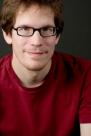


ian_finleyIan Finley, 2012 Piedmont Laureate
Playwriting


scott_hulerScott Huler, 2011 Piedmont Laureate
Nonfiction


The day promises to be splendid, with Mordecai holding its official Holiday Open House, and four Laureates Emeritus and myself teaching bite-sized workshops (20 minutes to an hour) in the historic buildings of the park—the old post office, Andrew Johnson’s birthplace and the Badger-Iredell Law office—and the accessible classroom in the Visitors’ Center, starting at 10:00 am. We’ll follow this up with a reading in beautiful St. Mark’s Chapel at 4 pm. Come to one workshop or try out all five, and stay for the reading.

Five Laureates in one place, free workshops and reading, a chance to tour the stunning Mordecai house, and festive seasonal food and drinks—what more could you desire on a Saturday in December?

Sign up soon at https://raleigharts.wufoo.com/forms/a-gathering-of-laureates/. Spaces are limited.

We look forward to seeing you this Saturday!

Pond and River

08 Wednesday Nov 2017

Posted by Mimi Herman in Mimi Herman, Poetry, Reading, Writing Advice

≈ Leave a comment

River
The bare (brindled) word of it word enough; brim-rhyming as it runs                              alongside reverie-bank (all rindled roots) and order.

                                                                                     by Atsuro Riley

Magnolia and Irises, designed by Louis Comfort Tiffany

This Saturday marks the first Piedmont Laureate/North Carolina Museum of Natural Sciences collaboration, “Find Your Muse on the Millpond.”

Pardon the pun, but it’s a natural connection. Everything about the sciences seems to lend itself to poetry: the wonders you find beneath a microscope lens or at the far end of a telescope; the ways nature constructs, deconstructs and reconstructs itself; the miracles of human bodies and bodies of water.

So on Saturday, we’ll take our human bodies (via kayaks) onto a body of water, a pond that looks less like a flat reflective pan beneath the sky and more like a meandering cypress stream. In the November afternoon sun, bundled up against the cold, we’ll create poems on the pond. We’ll stop periodically to collect names of trees and natural history, to magnify bark and leaf, to listen. And as the words and sounds accumulate, we’ll borrow from the flow of the water to create currents on the page, pausing toward the end to let our words settle onto the page like sediment, before releasing them to float on the waters we’ve paddled.

We aren’t the first to compose poems on the wonders of water, and we won’t be the last. In honor of the poems we’ll be writing, I offer you some that have come before us.

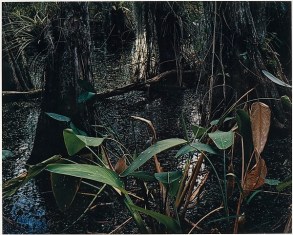
Cypress Swamp, Eliot Porter


The Pond
Cold, wet leaves
Floating on moss-coloured water
And the croaking of frogs—
Cracked bell-notes in the twilight.

by Amy Lowell


2015.300.227a


A Walk in the River
A few companions had been doing too much talking beside the purple water. The troupe, panic-stricken, ran away, and I found I was incapable of following them. I stepped into the water and the depths turned luminous; faraway ferns could just be seen. The reflections of other dark plants stopped them rising to the surface. Red threads took on all sorts of shapes, caught in the invisible and doubtless powerful currents. A plaster-cast woman advancing caused me to make a gesture which was to take me far.

by René Magritte
Translated from the French by Jo Levy

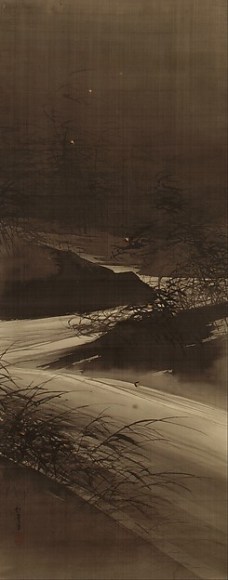
Fireflies Over the Uji River by Moonlight, Suzuki ShonenBlack River – by Joe Hutchison
You believe you must be beginning again.
The river opens to accept your first step,
and you’re into it up to your knees—
the water’s wrestle brotherly, bracing.
You start across, shouldering goods
you believe you’ll need on the far side.
Waist-deep now. Feeling for rooted stones
through sopping boots. Surely this is where
you crossed before; there are no unknown
channels, no abysses, though the current
does seem swifter than you remember,
and darker (of course, it’s only dusk
coming on, staining the air and water;
and the river—you believe—only seems
to be growing wider). Chest-deep now.
Icy water races past your racing heart,
under raised arms that ache to balance
whatever you carry, what you must (you
suddenly understand) be willing to let go.
Chin-deep. Perched on a slippery stone
that shifts with each shivering breath.
No choice but to take the next step—
deeper into the black river, farther
toward the shore of ink-black pines
over which the feverish stars have risen
and the cold comfort of a bone-white moon.

New York Water (Osgood Pond), Roe Ethridge


River Rhyme
The rumpled river
takes its course
lashed by rain

This is that now
that tortures
skeletons of weeds

and muddy waters
eat their
banks the drain

of swamps a bulk
that writhes and fat-
tens as it speeds.

by William Carlos Williams


Elk River Falls, Jasper Nance, flickr

Elk River Falls
is where the Elk River falls
from a rocky and considerable height,
turning pale with trepidation at the lip
(it seemed from where I stood below)
before it is unbuckled from itself
and plummets, shredded, through the air
into the shadows of a frigid pool,
so calm around the edges, a place
for water to recover from the shock
of falling apart and coming back together
before it picks up its song again,
goes sliding around the massive rocks
and past some islands overgrown with weeds
then flattens out and slips around a bend
and continues on its winding course,Clearwater, Michael B
according to this camper’s guide,
then joins the Clearwater at its northern fork,
which must in time find the sea
where this and every other stream
mistakes the monster for itself,
sings its name one final time
then feels the sudden sting of salt.
by Billy Collins

[IDAHO-B-0003] Clearwater River - Ahsahka, photographer unknown

Credits:

Poems
River, by Atsuro Riley
The Pond, by Amy Lowell
A Walk in the River, by René Magritte
Black River, by Joe Hutchison
River Rhyme, by William Carlos Williams
Elk River Falls, by Billy Collins

Art
Magnolias and Irises, designed by Louis Comfort Tiffany, Metropolitan Museum of Art
Cypress Swamp, Florida, by Eliot Porter, Metropolitan Museum of Art
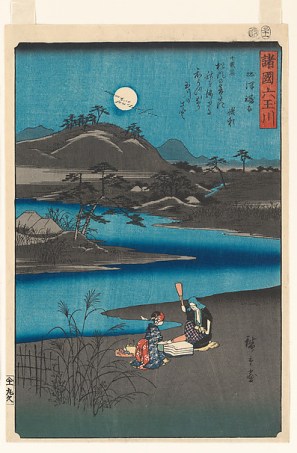
Six Tamagawa Rivers from Various Provinces, by Utagawa Hiroshige, Metropolitan Museum of Art
Fireflies Over the Uji River by Moonlight, by Suzuki Shonen, Metropolitan Museum of Art
New York Water (Osgood Pond), by Roe Ethridge, Metropolitan Museum of Art
Elk River Falls, by Jasper Nance, flickr
Clearwater, by Michael B, flickr
Clearwater River – Ahsahka, by photographer unknown, flickr


Upcoming Laureate Events

25 Wednesday Oct 2017

Posted by Mimi Herman in Ian Finley, Jaki Shelton Green, James Maxey, Katy Munger, Reading, Scott Huler, Writing Advice

≈ 1 Comment

Jerry and Pat Donaho-North Carolina-Blue Ridge Mountains

I’ve always thought of the calendar as a square, with autumn on the right side, sliding down into winter. Now that I’m back from our Writeaways in France and Italy, I’m very aware that we’re sliding toward the end of my wonderful year as Piedmont Laureate. I’ve had ten months of creating the workshops and readings and events of my dreams, with the support of the four marvelous directors of the Piedmont Laureate program: Eleanor Oakley, Belva Parker, Margaret DeMott and Katie Murray.

The good news is that between now and December 31st when I hang up my tiara, we have a glorious fall and early winter bouquet of upcoming Laureate events, which I’ll describe here in the hopes that you’ll join me for some of them.


SertomaExterior
The Geography of Your Life – Sertoma Arts Center
1400 W Millbrook Road, Raleigh, NC 27612

Saturday, November 4, 2017
10:00 am-12:00 pm
Free and Open to the Public (ages 6 and up)

This is a workshop for kids and grownups—and families composed of both kids and grownups. You’ll delve into the important events, people and places from your history through art and poetry by making a map of the journey of your life. Discover your own personal history in a whole new way, by making a map of your life. You’ll find intersections between important people, landmark events, and detours you’ve taken along the way as you use art and poetry to create a three-dimensional map. You’ll explore, create and discover in this journey into what really matters to you. Bring your friends, your family and your memories. 
To register, go to https://reclink.raleighnc.gov/Activities/ActivitiesAdvSearch.asp and enter 219231 in the barcode search.

By the way, I’ve just been invited to teach a weeklong version of this workshop–including writing, visual art, dance, theatre and music–this summer for Family Week at Ghost Ranch, Georgia O’Keefe’s home and inspiration in New Mexico. I hope some of you will be able to join me there!

22310591_1729188354056574_2123370825626705223_n

The Laureate’s Thanksgiving
Orange County Public Library
137 West Margaret Lane, Hillsborough, North Carolina 27278
Wednesday, November 8, 2017
7:00 pm
Free and Open to the Public

We have so much for which to be thankful. Piedmont Poets Laureate Emeritus James Maxey, Katy Munger, Scott Huler and 2017 Piedmont Laureate Mimi Herman invite you to a reading in which we’ll express our gratitude for the things, people and events that have changed our lives.

22496255_1960929147458045_3232997092348498960_o

Educator Trek: Find Your Muse on the Millpond –  NC Museum of Natural Sciences
Robertson’s Millpond
Saturday, November 11, 2017
12:30-5:00 pm
Open to Educators of All Kinds

Join Museum Educators and Piedmont Poet Laureate Mimi Herman in an exploration of the connections between nature and writing. Discover an amazing swamp ecosystem as we paddle on beautiful Robertson Millpond in eastern Wake County, and use the beauty of nature and the wonder of science as a means to express yourself through poetry. This workshop is generously supported by the United Arts Council of Raleigh, the Raleigh Arts Commission, the Durham Arts Council and the Orange County Arts Commission.
To register, go to http://naturalsciences.org/calendar/event/millpond/

unnamed-1Hands-on Poems of Gratitude – Durham Art Walk Holiday Market
Durham Arts Council, 120 Morris Street, Durham, NC 27701

Saturday, November 18, 2017
1:30-3:30 pm
Free and Open to All Ages

In this hands-on poetry-writing workshop, I’ll be carrying on the theme of gratitude from our Laureate’s Thanksgiving at the Orange County Library, as you learn to write poems to share your own various gratitudes. You’ll learn a few simple techniques for writing poetry and then create a poem suitable for sharing at Thanksgiving Dinner.

Chapel3-edited.jpg

A Gathering of Laureates
Workshops and Reading with Piedmont Laureates Past and Present
Mordecai Holiday Open House
1 Mimosa Street, Raleigh, NC 27604

Saturday, December 9, 2017

Scott Huler, 2011 Piedmont Laureate in Nonfiction
Ian Finley, 2012 Piedmont Laureate in Playwriting
James Maxey, 2015 Piedmont Laureate in Speculative Fiction
Katy Munger, 2016 Piedmont Laureate in Mystery and Crime Fiction
Mimi Herman, 2017 Piedmont Laureate in Poetry

Visit the Mordecai Holiday Open House on Saturday, December 9th to experience five Piedmont Laureates in one place. Mimi Herman, the current Piedmont Laureate, will offer a morning workshop in poetry, “This is My Letter to the World: Epistle Poems for the New Year” for ages 8-adult. In the afternoon, visit the historic buildings for 20-minute workshops with the Laureates. Finish out your day with a reading by all the Laureates and a chance to chat with them over seasonal treats.


CHPL-Logo_300Author’s Tea – Friends of the Chapel Hill Public Library
Chapel Hill Public Library, 100 Library Drive, Chapel Hill, NC 27514

Thursday, December 14, 2017
3:30-5:00 pm
Free and Open to the Public

Possibly my final reading of the year as your 2017 Piedmont Laureate. The Friends of the Chapel Hill Public Library invite you to join us for a reading and refreshments. I’ll try to remember to keep my pinky up, and limit my petits fours consumption to three!

dac_logo2

Holiday Card Making – Third Friday Art Walk
Durham Arts Council, 120 Morris St, Durham, NC 27701
Friday, December 15, 2017
5:00-8:00 pm
Free and Open to the Public

Bring your kids, family and friends to create handmade art and poetry cards for the holidays. This is your chance to take the time to remember the people who matter to you, and custom-design cards so they’ll always know how much they mean to you.


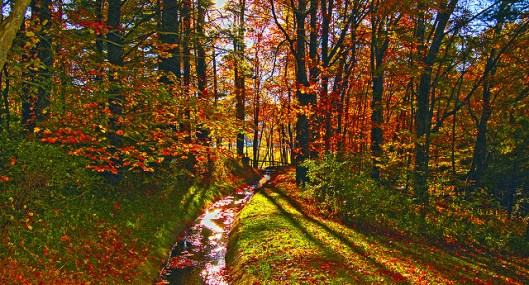
“Autumnal Beauty,” Valerie, flickr, Creative Commons, 2012
“Blue Ridge Parkway,” Jerry and Pat Donoho, flickr, Creative Commons, 2008
“Chapel,” Belva Parker, 2017

From My Shelves to Yours

24 Wednesday May 2017

Posted by Mimi Herman in Mimi Herman, Open Mic, Poetry, Reading, Writing Advice

≈ 1 Comment

My poor books. For the past year and a half – due to the confluence of an invasive raccoon, the life-changing magic of tidying up, an almost pathological inability to choose a paint color, and practically perpetual inertia – they’ve been held captive in cardboard boxes in undisclosed locations all over my house.

But now they’re free, and proudly arranged in bookcases according to organizing principles only I can understand. (I’ll give you a hint. I have several different categories of favorites, each with its own shelf.) I’ve finally sacrificed my passion for visual organization for the traditional alphabetization approach, and arranged all my fiction – hardback and paperback together – rather than separating them out (though I admit my trash reading has its own bookcase). And all those books of poetry by my friends and heroes, they have their shelf – under the watchful eye of the books on how to write poetry, why you need to write poetry, and what it all means, on the shelf above.

I can’t tell you how amazing it is to see all these old friends again, finally released from their captivity. Or how delightful it is to say, “I’d like to look that up,” and be able to go directly to the shelf to find that poem or quote or story.

IMG_4937Now that all my books have come home to roost again, and are happily nesting with their families, I thought I’d share a few of my favorites with you.
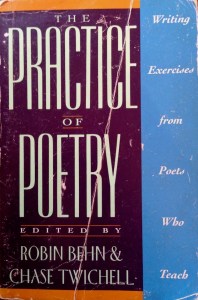
First of all, who can do without The Practice of Poetry, a marvelous collection of exercises edited by Robin Behn and Chase Twichell? This book includes such gems as Rita Dove’s “Your Mother’s Kitchen,” Garret Hongo’s “Not ‘The Oprah Winfrey Show’” and Linnea Johnson’s “Personal Universe Deck.” Whether you’re a beginning writer or a published poet looking to widen your spectrum of subjects and techniques, this one is worth a try.

IMG_4941

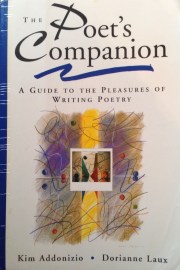
Along the same lines, I love Poet’s Companion, by Kim Addonizion and our own Dorianne Laux, which takes the reader-writer on a guided tour of a gorgeous continent of poetry, with stops in the contiguous countries of subject, craft and the writer’s life, and exercises all along the way.

Because I have such a girl-poet crush on Kim Addonizio, I also have her Ordinary Genius, which, I warn you, may make you dig more deeply into yourself than you’d originally planned.


IMG_4936


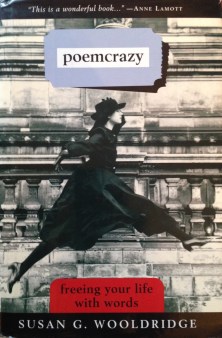
A little-known book you might like is Susan Wooldridge’s poemcrazy, which I bought shortly after meeting her through the California Poets in the Schools program. I thought she was charming, and found her book to be equally charming, with quirky approaches to writing poems, like “collecting words and creating a wordpool” and “skin spinoff.” If you’re just starting out as a poet, or utterly stuck, I recommend her book.


IMG_4942Lest you think I only like the girls, I recommend Ted Kooser’s The Poetry Home Repair Manual. Most of the time when I’m not writing or teaching poetry, I’m building cabinets, replacing toilets, finishing floors or sweating copper. So you can see how a home repair book about poetry might appeal to me.

If you’re like me, and enjoy playing with form, a highly useful and accessible book is Ron Padgett’s Handbook of Poetic Forms, from the terrific Teachers & Writers Collaborative, which gives you dozens of forms in alphabetical order, with easy instructions and examples.

IMG_4934If you write poetry with kids, as a teacher or as a parent, or if you’re a kid yourself, you’ve got to have the classic, Kenneth Koch’s Wishes, Lies and Dreams. Add to that Beyond Words, by my Lesley University colleague Elizabeth McKim and her friend Judith W. Steinbergh. Another book to add to that collection is Michael A. Carey’s Starting from Scratch, which was my guidebook all those years ago when I started out as a writer-in-the schools. It’s out of print, so it’s a little tricky to find, but worth buying if you can uncover a used copy.
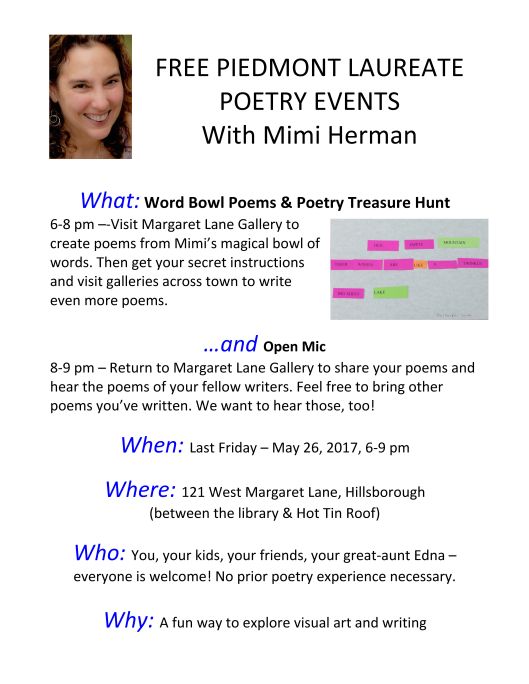
Speaking of writing with kids, I hope you’ll bring yours to Margaret Lane Gallery this Friday night for our Word Bowl and Art & Poetry Treasure Hunt evening. If you don’t have kids, bring a friend, a colleague or just your sense of adventure.

Hillsborough Last Friday Poetry Flyer.jpgStay tuned for more book recommendations in another blog post. I’ve got a whole collection of collections—and really readable prose that talks about the importance of poetry—that I can’t wait to share with you.

Do-it-Yourself Art Poetry Kit

25 Tuesday Apr 2017

Posted by Mimi Herman in Ekphrasis, Mimi Herman, Open Mic, Poetry, Reading, Uncategorized, Writing Advice

≈ Leave a comment

C-My_1_XYAEqOVOArt by Damian Stamer

UPDATE: Check out First Friday at United Arts and enjoy three for the price of one (absolutely free)! Come to United Arts Council at 410 Glenwood Ave., Suite 170, Raleigh on Friday, May 5th from 6:00 to 8:00 pm for an Art and Poetry Treasure Hunt, Word Bowl Poetry and open mic – and see Sheila Hall’s artwork while you’re there!


It’s almost May, and I’m looking forward to seeing those of you who live in the Triangle for our next two Art and Poetry Treasure Hunts at First Friday in Raleigh on May 5th and Last Friday in Hillsborough on May 26th. We had a great time in Carrboro last month, and I’m hoping a bunch of you will come out to write and read great poems about great art.

To make it even easier on you (and so all of you can try it out, even if you can’t make it to one of the art walks), I’m about to reveal the secret instructions for writing ekphrastic poems (poems about art) in this very blog. Are you ready? Here we go…

Art & Poetry Treasure Hunt Secret Instructions
Choose one of the ideas below to write a poem about art.

  • Imagine two works of art get married. Write a love poem from one to the other.*
  • Enter a painting and write about what you see and what’s happening all around you. Or write about what’s happening just off the edge of the canvas.*
  • Eavesdrop on what people are saying in a gallery and weave their conversations into a poem.*
  • Find a painting that’s noisy, smelly, or delicious, and write a poem about it.*
  • Write a poem about a tiny detail in a painting, like it’s a secret only you know.*
  • Think of a piece of art as a city, and write a poem like a tour describing the sites.*
  • Create one line, or one stanza, about each work of art you see, to make one poem.*
  • Imagine that the artwork is an animal. What is its habitat? What does it eat? How does it protect itself? How does it sleep?**
  • Write a dialogue between yourself and the artist. Ask the artist all the questions you’d like to ask, and make up the artist’s answers.**
  • Write a poem from the piece of art to the artist, or the other way around.**
  • Write in the voice of a person or object shown in the work of art.***
  • Imagine what was happening while the artist was creating the piece.***
  • Write a dialogue between characters in a work of art.***
  • Imagine a story behind what you see depicted in the piece.***
  • Choose your own way of writing about a piece of art that interests you.

*Gary Duehr, “Thirteen Ways of Writing Poetry in a Museum”
** Mimi Herman, Piedmont Laureate
***http://www.readwritethink.org

Now that I’ve revealed the secret instructions, it’s your turn.

Grab a pencil, pen or computer, find the nearest piece of art, and write your own ekphrastic poem. You can do this from the comfort of your own home, using that old Escher poster left over from your college days, your great-aunt Edna’s photograph of Venice or your favorite art from your favorite artist—via that modern miracle, the Internet. You pick the art, choose the prompt you want to use from the oh-so-secret instructions above and dash off a quick poem. Invite your kids, your parents, your friends and your great-aunt Edna to write some poems, too. These poems can be serious or goofy—or anywhere in between.

Then share your poems—as many as you like—in one of these four ways:

  1. Come to First Friday reading at the United Arts Council in Raleigh on May 5th or the Last Friday reading at Margaret Lane Gallery in Hillsborough on May 26th (click the links for details) and share your poem with us, using your most fabulous poet’s voice.
  2. Post your poem in a comment in response to this blog entry.
  3. Tweet your poem (if it’s brief enough) here: @PiedLaureate
  4. Post your poem on the Piedmont Laureate Facebook page here: https://www.facebook.com/piedmontlaureate/

Once you’ve experimented with ekphrastic poetry in the privacy of your own home, you may feel emboldened to venture further abroad. If so, you can visit these galleries in Raleigh http://www.godowntownraleigh.com/first-friday-raleigh/map any time between now and 8:00 pm on Friday, May 5th or these galleries in Hillsborough https://www.hillsboroughartscouncil.org/art-walk-last-fridays all month up to 8:00 pm on Friday, May 26th, and use the artwork you find there as inspiration to write more poems. Then scurry over to the reading to share your brilliance with an appreciative audience.

I can’t wait to see and hear what you write!

Art and Poetry Treasure Hunts: Write Your Own Ekphrastic Poems

12 Wednesday Apr 2017

Posted by Mimi Herman in Ekphrasis, Genres, Mimi Herman, Open Mic, Poetry, Reading, Uncategorized, Writing Advice

≈ 3 Comments

Happy National Poetry Month! Here’s wishing you a month of inspiration and a year of writing, reading and listening to poetry.

For a chance to write your own poems and read them at an open mic event, join us on one of the Friday Night Art Walks for an Art & Poetry Treasure Hunt this April or May. We’ll eavesdrop on what other people are saying in galleries, write love letters from one piece of art to another and take journeys inside of paintings and photographs to discover what it’s like to live inside a piece of art.

Here are the details:

Art & Poetry Treasure Hunts

Dates and Locations
Friday, April 14, 2017 — The ArtsCenter, 300 G East Main Street, Carrboro, NC 27510
Friday, May 5, 2017 — United Arts Council, 410 Glenwood Avenue, Suite 170
Raleigh, NC 27603
Friday, May 26 — Margaret Lane Gallery, 121 W. Margaret Lane, Hillsborough, NC 27278

Schedule
6:00 to 7:30 pm — Art & Poetry Treasure Hunt
Drop by the galleries above during this time to pick up your treasure map, notepad and pen, and the secret directions to create your poems.

8:00 to 9:00 pm — Open Mic Reading
Return to the gallery to read some of the poems you’ve created in your gallery wanderings.

*   *   *

Ekphrasis. It sounds like something that calls for a heavy dose of antibiotics, doesn’t it? Actually, it’s just a fancy Greek word for poetry about art, though it may well become contagious this April and May on the Friday night art walks in Chapel Hill/Carrboro, Raleigh and Hillsborough.

As you might imagine, poets have been writing about art for a good long time. It started with Homer painting a word picture of Achilles’ shield in the Iliad. Later, Plato went on to describe the “bedness” of a bed in The Republic, and Socrates had a chat with Phaedrus about writing and painting:

“You know, Phaedrus, that is the strange thing about writing, which makes it truly correspond to painting.
The painter’s products stand before us as though they were alive,
but if you question them, they maintain a most majestic silence.
It is the same with written words; they seem to talk
to you as if they were intelligent, but if you ask them anything
about what they say, from a desire to be instructed,
they go on telling you just the same thing forever.

Plato, Phaedrus 275d

Sosobios_Vase

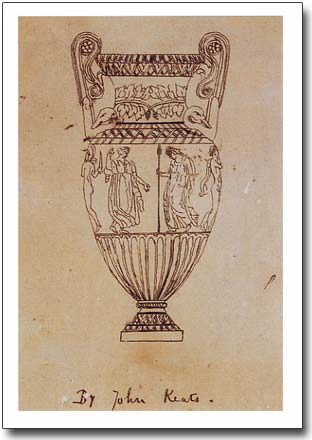
Long before the Internet, before we could even create reproductions of art in books and on posters, ekphrastic poems offered art lovers a virtual museum, where they could “see” art from the comfort of their own armchairs. In the Italian Renaissance, Ekphrasis became popular again, and in 1819, John Keats wrote one of the most famous ekphrastic poems in history, “Ode on a Grecian Urn,” which you can find here, at The Poetry Foundation website.


http://www.keats-shelley-house.org/en/shop/postcards

In more recent times, W. H. Auden described Bruegel’s painting, Landscape with the Fall of Icarus in this ekphrastic poem:

Musee des Beaux Art
W. H. Auden

About suffering they were never wrong,
The old Masters: how well they understood
Its human position: how it takes place
While someone else is eating or opening a window or just walking dully along;
How, when the aged are reverently, passionately waiting
For the miraculous birth, there always must be
Children who did not specially want it to happen, skating
On a pond at the edge of the wood:
They never forgot
That even the dreadful martyrdom must run its course
Anyhow in a corner, some untidy spot
Where the dogs go on with their doggy life and the torturer’s horse
Scratches its innocent behind on a tree.

In Breughel’s Icarus, for instance: how everything turns away
Quite leisurely from the disaster; the ploughman may
Have heard the splash, the forsaken cry,
But for him it was not an important failure; the sun shone
As it had to on the white legs disappearing into the green
Water, and the expensive delicate ship that must have seen
Something amazing, a boy falling out of the sky,
Had somewhere to get to and sailed calmly on.

http://english.emory.edu/classes/paintings&poems/auden.html

icarus

In 1960, William Carlos Williams had his own take on the same painting:

Landscape with the Fall of Icarus

William Carlos Williams

According to Brueghel
when Icarus fell
it was spring

a farmer was ploughing
his field

the whole pageantry

of the year was
awake tingling
with itself

sweating in the sun
that melted
the wings’ wax

unsignificantly
off the coast
there was

a splash quite unnoticed
this was
Icarus drowning

from http://english.emory.edu/classes/paintings&poems/williams.html

You can discover links to more ekphrastic poems here and here.

I hope you’ll join us for one or all of the Art and Poetry Treasure Hunts, where you’ll be inspired by local art to write your own ekphrastic poems. Whether you’ve been writing poems all your life, or your poetry career came to an abrupt halt at “Roses are red,” we’d love to have you. Bring your family. All ages are welcome.

Newer posts →

About our laureates

  • Past Laureates

Join Us on Facebook

Join Us on Facebook

Enter your email address to subscribe to this blog and receive notifications of new posts by email.

Join 174 other subscribers

Piedmont Laureate Sponsors

Raleigh Artsuac-logo

Search

Website Powered by WordPress.com.

  • Subscribe Subscribed
    • Piedmont Laureate
    • Join 174 other subscribers
    • Already have a WordPress.com account? Log in now.
    • Piedmont Laureate
    • Subscribe Subscribed
    • Sign up
    • Log in
    • Report this content
    • View site in Reader
    • Manage subscriptions
    • Collapse this bar
 

Loading Comments...