• About
  • Past Laureates
  • Blog
  • Events
  • Resources
  • Contact Us

Piedmont Laureate

~ Promoting awareness and heightened appreciation for excellence in the literary arts throughout the Piedmont Region

Piedmont Laureate

Category Archives: Poetry

The Faces Behind the Journals & Presses

27 Monday Feb 2017

Posted by Mimi Herman in Mimi Herman, Poetry, Publication, Writing Advice

≈ 2 Comments

Tags

Association of Writers & Writing Programs, AWP Conference, Black Lawrence Press, Colorado Review, Gettysburg Review, Hawaii Review, Main Street Rag, Massachusetts Review, Mizna, Muse/A, Press 53, Solid Objects

img_4563
img_4560
img_4564
img_4559
img_4557
img_4554

If you have the nerve, I recommend attending the AWP Conference, a massive writers’ conference that travels to different cities in the US each year. Imagine spending several days in the company of 12,000 other partially socialized introverts, trying to make the painful choice among far too many simultaneous panel discussions, visiting hundreds of tables at the book fair, and desperately searching for that small dark closet in which you can recover from all this stimulation. Really it’s a lot more fun than I’m making it sound, and you’re always likely to see someone you know. And the swag is excellent.

This year, the conference was held in Washington DC, an interesting place to visit at the moment, considering other things currently occurring in our nation’s capital. Except for an NEA panel and a trek to find some surprisingly good French fries, I spent my entire time in the book fair.

While there, it occurred to me that you might want to see some of the faces behind the journals and presses to which we’re sending our work. If you’re like me, submitting to journals is still intimidating even after all these years. You send your stuff out into the ether (in the old days,  before Submittable, we had to type up those poems and that all-important cover letter, make our copies at Kinko’s, stuff everything into a manila envelope, lick it and stick it in a mailbox, and hope like crazy that we wouldn’t get it all back with a painfully generic rejection letter suitable only for wallpapering our bathrooms), and wait for those faceless editors to respond.

I was delighted to discover that the people behind those journals and presses had actual faces. They were real and quirky and delightful.

So I’m sharing with you a sampling of the people I met. Not a bad one in the bunch. Next time you’re logging in to your Submittable account (I even met the Submittable people, who were charming and fun), extrapolate from these pictures, and know that you’re sending your work to someone who’s probably much like you: a writer who’s passionate about good writing and wants people to have the chance to read the best poetry available.

img_4556
img_4555
img_4558
img_4565


On Becoming a Poet

14 Tuesday Feb 2017

Posted by Mimi Herman in Mimi Herman, Poetry

≈ 3 Comments

grandpop-and-mim-reading

My life as a poet began with a love of words. A year before I took my first step, I was already speaking in full sentences, though only in the company of my own family. I was a shy kid who felt safest alone or in the company of one other person.

For the first several years of elementary school, I did my best to remain invisible. Then, in fourth grade, someone outside my family finally saw me: my Language Arts teacher, Miss Stephens. In Miss Stephen’s eyes, I became a person. In her class I became a poet. I started to let my cloak of invisibility slip to the classroom floor.

I’m sure Miss Stephens taught us many things about parts of speech and punctuation, but it’s the poetry I remember. She showed us how write haiku, where every syllable counts. Because of her, I think about the sounds and meanings of words every time I write or speak.

mim-with-fur-coat-and-dictionary

The young poet, contemplating her next meal

In sixth grade, I was mortified by a note passed around my class asking people to sign if they believed that “Mimi eats encyclopedias for breakfast.” Everyone in class signed that note.

As you can imagine, a child who eats encyclopedias for breakfast might find school a little boring. So Mrs. Williams, my highly perceptive teacher, invited me to create a project of my choice, which turned out to be a book of animal poems.

Like so many poets, I spent the next decade writing the tortured (and often cryptic) poems of adolescence. What I lacked in joie de vivre, I appear to have gained in courage, since I summoned the guts to enter a poetry contest run by the Chapel Hill branch of the American Association of University Women. In sixth grade I won second place with “Thoughts of a Child in a Concentration Camp.” In seventh grade, I earned first prize with my poem “Southern Belle.”

I wrote throughout high school and college, sometimes for school, but more often as a way to figure out how the world worked. Mostly I kept my volumes of journals (which now fill several bookshelves) separate from my poems. My journals were bowls to catch the overflow of adolescent emotions. I wrote the poems to craft something that might be useful to my future self and maybe, if I were lucky and diligent, to others.

I’ve always liked William Wordsworth’s definition, “Poetry is the spontaneous overflow of powerful feelings: it takes its origin from emotion recollected in tranquility.” As I grew older, I started to understand the “tranquility,” a state of mind not usually available to adolescents.

When I was accepted to the Warren Wilson MFA Program in Creative Writing, my father gave me three gifts. First he asked if it would be okay for him to pay my tuition, a gift I’d never expected.I accepted with astonishment, and, I hope, a certain amount of grace. Next, he gave me Eudora Welty’s book, One Writer’s Beginnings. And finally, he told me, “I know writers often write about the people in their families. I want you to know that you can write anything you want about me. Just tell me what to read and what not to read.”

In the 26 years since Warren Wilson, I’ve made my way as a writer and as a teacher of writing. I’ve struck a balance between Wordsworth’s “powerful feelings” and his “tranquility.” I’ve helped over 25,000 students and teachers—many of whom would rather scrub a bathtub than write a poem—discover the poets within themselves. And I’ve kept exploring the world through poetry.

This week, I’m teaching poetry to fourth graders at my old school, E.C. Brooks Elementary. It’s another gift in a series of gifts, the chance to share with kids what Miss Stephens helped me discover when I was in fourth grade: that you can be seen and heard, and that paying attention to the sounds and meanings of words is one way to become visible in the world.

Have Tiara, Will Travel

31 Tuesday Jan 2017

Posted by Mimi Herman in Katy Munger, Mimi Herman, Poetry

≈ 9 Comments

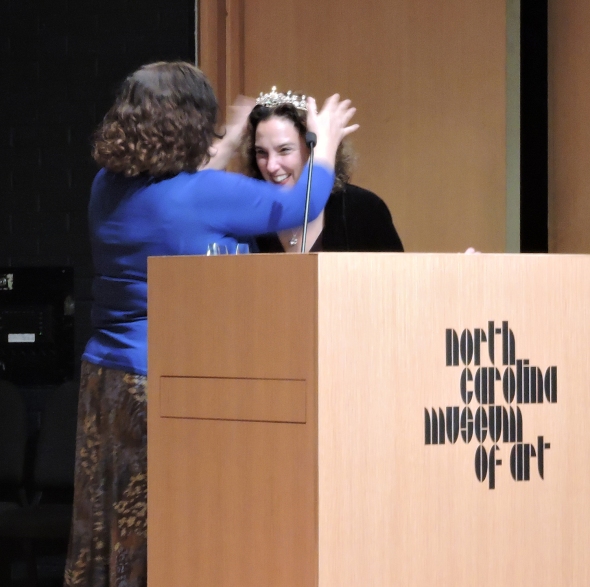
munger-herman-coronation-cropped

I’m delighted to launch into my year as the 2017 North Carolina Piedmont Laureate. The year began for me on New Year’s Eve, with this great article by David Menconi in The News & Observer.

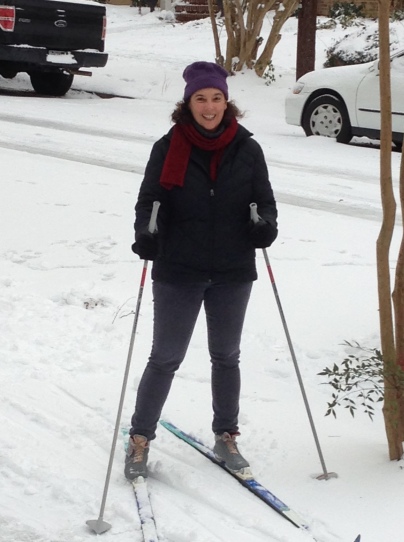
A week later, we were graced here in the Piedmont with a snowfall, so I took advantage of the snow days to write some poetry and do a little skiing around my neighborhood—always an inspiration.

mimi-on-skis-3-january-7-2017

On Tuesday, January 10th, with snow still on the ground, Katy Munger, the 2016 Piedmont Laureate in Mystery Writing officially crowned me the 2017 Piedmont Laureate at the North Carolina Museum of Art.

I know a few of you weren’t able to slog through the snow, so I thought I’d share with you some of the remarks I composed for the occasion, so you can get a sense of me and what I’m planning for the year.

I appreciate the great work done by the City of Raleigh Arts Commission, the Durham Arts Council, the Orange County Arts Commission and the United Arts Council in creating and sustaining the Piedmont Laureateship.

I was born in Orange County—Orange County California, that is. But my family moved to Raleigh when I was eight months old, then later to Chapel Hill, and for the last 28 years I’ve lived in Durham. My father was born and raised in Winston-Salem, and was a pediatrician in Raleigh for many years. I went to Carolina with Michael Jordan, earned my degree in creative writing from there, and got my Masters in Fine Arts from Warren Wilson. I have called the Piedmont home for all of my talking, walking and poetry-writing life. This is the landscape I know. These are the people I cherish.

“How can I know what I mean until I see what I say?” E. M. Forster once said. I believe we can do this best by writing poetry. Write a draft. See what you’re trying to say to yourself. Play with the sound and language of it. Say it better, so it’s not just you talking to yourself, but you sharing what’s in your head and heart with other people in a way that inspires them to say, “That’s exactly what I felt. I just hadn’t figured out how to say it.

In the animated film, Ratatouille, the great chef Auguste Gusteau says, “Anyone can cook.” I believe anyone can write. My goal this year as Piedmont Laureate is to create opportunities for people to do that: for experienced poets to hone and share their craft, and for new writers to discover their voices. I plan to provide occasions for older people to share the stories of their lives and for younger people to imagine theirs—all through poetry. And for those of us in the middle (and my father used to say, “Middle age is ten years older than whatever you happen to be right now,” so I think I can safely say that most of us are in the middle!), maybe we can use poetry to help us understand our own lives a little better.

In the interest of time [and to leave you with something to look forward to in future blog posts], I won’t tell you about all I have planned for the year, but I did want to mention one of my favorites: poetry nap workshops in stressful workplaces.

Each of us has a distinctive voice. This year, I invite you to discover yours.

I’ll be offering all sorts of poetry events throughout Wake, Durham and Orange Counties, from workshops to readings to surprises I’ll reveal as the year progresses. I hope you’ll join me at one—or many—of these great events.

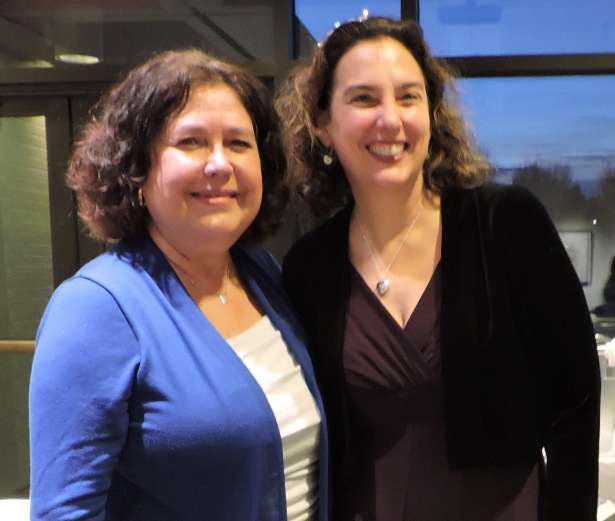
munger-herman-cropped

Newer posts →

About our laureates

  • Past Laureates

Join Us on Facebook

Join Us on Facebook

Enter your email address to subscribe to this blog and receive notifications of new posts by email.

Join 174 other subscribers

Piedmont Laureate Sponsors

Raleigh Artsuac-logo

Search

Website Powered by WordPress.com.

  • Subscribe Subscribed
    • Piedmont Laureate
    • Join 174 other subscribers
    • Already have a WordPress.com account? Log in now.
    • Piedmont Laureate
    • Subscribe Subscribed
    • Sign up
    • Log in
    • Report this content
    • View site in Reader
    • Manage subscriptions
    • Collapse this bar
 

Loading Comments...