
Last week in “Playing with Sound in Poetry, Part 1,” we experimented with rhyme, alliteration and other word play. This week we’re expanding into meter and rhythm. But never fear, we’ll take it one step at a time.
Like most of us, formal poems have feet. Unlike us, their feet don’t have toes attached at the end. A poetic foot is the basic unit of a line, a small segment of rhythm. It is often repeated throughout a poem to create a consistent rhythm.
Look below to find some different types of feet, with the name, pronunciation, rhythm (light on Te, heavy on TUM), and a word or phrase to demonstrate each foot.

TYPES OF FEET
- Iamb (EYE-am): Te TUM (“again”)
- Trochee (TRO-key): TUM te (“wander”)
- Anapest (AN-a-pest): te te TUM (“understand”)
- Dactyl (DAK-til): TUM te te (“happily”)
- Spondee (SPON-dee): TUM TUM (“show me”)
- Pyrric (PIR-ik): te te (“of the”)
The most common foot – found in sonnets, Shakespeare’s plays and many other types of formal poetry – is the iamb. Place your hand on your heart or the inside of your wrist and you’ll see why some people believe we’re drawn to iambs: we have a steady pulse of iambic heartbeats keeping rhythm for us throughout our lives.
Each of the feet above can be made into meter by adding a little “ic.”
- Iamb=Iambic Meter
- Trochee=Trochaic Meter
- Anapest=Anapestic Meter
- Dactyl=Dactylic Meter
- Spondee=Spondaic Meter
- Pyrric=(oddly enough) Pyrric Meter
METER
When you put a bunch of the same kind of feet together, you get meter. We use the Latin prefixes to count the number of feet in a line, and that tells us the meter of that line (and generally the poem). The most common meters are below:
- Monometer: one foot per line
- Dimeter: two feet per line
- Trimeter: three feet per line
- Tetrameter: four feet per line
- Pentameter: five feet per line
- Hexameter: six feet per line
- Heptameter: seven feet per line
We generally use three to five feet per line, in other words, something between trimeter and pentameter. When you put the type of foot together with the number of feet in a line, you get the name of the meter, such as “iambic pentameter.” Perhaps you’ve heard of this one?
Here’s an example of how the same poem can be written in the meters above, using iambs. Try reading these out loud, pausing at each line break. How do they sound different from each other? It’s pretty warm outside, so I thought you might want to cool down by playing with a winter theme.
MONOMETER
We could
not meet
for class
this week
because
the snow
had fall-
en thick
upon
the streets
and ev-
ery tree.
It made
me sick
at heart
to see
our chance
to meet
had dis-
appeared:
a dir-
ty trick.
The wea-
ther jeered:
a fit
of pique.
DIMETER
We could not meet
for class this week
because the snow
had fallen thick
upon the streets
and every tree.
It made me sick
at heart to see
our chance to meet
had disappeared:
a dirty trick.
The weather jeered:
a fit of pique.
TRIMETER
We could not meet for class
this week because the snow
had fallen thick upon
the streets and every tree.
It made me sick at heart
to see our chance to meet
had disappeared:
a dirty trick.The wea-
ther jeered: a fit of pique.
TETRAMETER
We could not meet for class this week
because the snow had fallen thick
upon the streets and every tree.
It made me sick at heart to see
our chance to meet had disappeared:
a dirty trick.The weather jeered:
a fit of pique—-
PENTAMETER
We could not meet for class this week because
the snow had fallen thick upon the streets
and every tree. It made me sick at heart
to see our chance to meet had disappeared:
a dirty trick.The weather jeered: a fit
of pique – – – – – – –
HEXAMETER
We could not meet for class this week because the snow
had fallen thick upon the streets and every tree.
It made me sick at heart to see our chance to meet
had disappeared: a dirty trick.The weather jeered:
a fit of pique – – – – – – – –
HEPTAMETER
We could not meet for class this week because the snow had fall-
en thick upon the streets and every tree. It made me sick
at heart to see our chance to meet had disappeared: a dir-
ty trick. The weather jeered: a fit of pique – – – –
As you may have noticed, by the time you get to hexameter or heptameter, it’s a bit hard to say a whole line in one breath. These longer lines tend to be a bit unwieldy and breathless, so they’re rarely used.
Try this on your own, figure out which meter you like best, , and let me know what you come up with. And tune in next week when we put this all together to play with formal poetry.



 Over the years, our teachers have learned to make their own shadow puppets to bring fables, myths and fairy tales to life. They’ve danced the water cycle, the rock cycle, pressure systems and punctuation. They’ve acted out civil rights, become immigrants to America in 1901, and written letters overseas from the home front in World War II. They’ve ventured on treasure hunts into the world of Multiple Intelligences and made colorful three-dimensional maps of their brains. They’ve built bugs from plastic bottles, created Claymation ecosystems, and extracted poetry from scientific concepts. They’ve written their own blues and released the composers trapped inside themselves—even those who didn’t believe they could carry a tune in a bucket. They’ve explored Cuba, Ghana and Zimbabwe through music, and Appalachia through photography and poetry. They’ve written and performed a 1920s musical in the North Carolina Museum of History in a mere three hours and used their X-ray vision to conjure poetry and paintings from satellite maps of their favorite places.
 And everything they’ve done, they’ve brought back to their classrooms to make magic of the curriculum, to get their students excited about learning, and to remind themselves of why they became teachers in the first place.
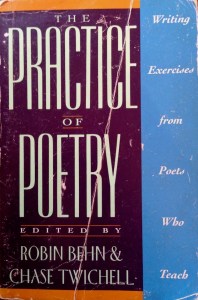 Now that all my books have come home to roost again, and are happily nesting with their families, I thought I’d share a few of my favorites with you.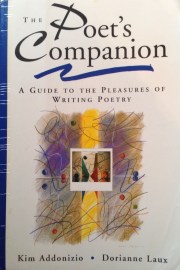
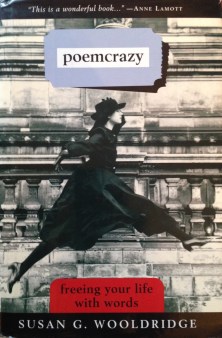
 Lest you think I only like the girls, I recommend Ted Kooser’s The Poetry Home Repair Manual. Most of the time when I’m not writing or teaching poetry, I’m building cabinets, replacing toilets, finishing floors or sweating copper. So you can see how a home repair book about poetry might appeal to me.
 If you write poetry with kids, as a teacher or as a parent, or if you’re a kid yourself, you’ve got to have the classic, Kenneth Koch’s Wishes, Lies and Dreams. Add to that Beyond Words, by my Lesley University colleague Elizabeth McKim and her friend Judith W. Steinbergh. Another book to add to that collection is Michael A. Carey’s Starting from Scratch, which was my guidebook all those years ago when I started out as a writer-in-the schools. It’s out of print, so it’s a little tricky to find, but worth buying if you can uncover a used copy.
 Stay tuned for more book recommendations in another blog post. I’ve got a whole collection of collections—and really readable prose that talks about the importance of poetry—that I can’t wait to share with you.
 Art by Damian Stamer
 Piedmont Laureate