• About
  • Past Laureates
  • Blog
  • Events
  • Resources
  • Contact Us

Piedmont Laureate

~ Promoting awareness and heightened appreciation for excellence in the literary arts throughout the Piedmont Region

Piedmont Laureate

Category Archives: Ekphrasis

Arts Integration in Action

23 Friday Jun 2017

Posted by Mimi Herman in Ekphrasis, Mimi Herman, Poetry

≈ 1 Comment

Tags

Arts Integration, teachers, United Arts Council

IMG_5200
School’s out, and the United Arts Council Arts Integration Institute (Now that’s a mouthful!) is in full swing. This is one of my favorite weeks of the year, when elementary school teachers from all over Wake County, North Carolina converge to draw, print, paint, dance, write, sing, play and act out the curriculum in a week of hands-on workshops and lesson planning. We created the Arts Integration Institute way back in the dark ages of 2006 – when we used to write our poems on stone tablets with chisels – and it’s been going strong ever since.

IMG_0667Over the years, our teachers have learned to make their own shadow puppets to bring fables, myths and fairy tales to life. They’ve danced the water cycle, the rock cycle, pressure systems and punctuation. They’ve acted out civil rights, become immigrants to America in 1901, and written letters overseas from the home front in World War II. They’ve ventured on treasure hunts into the world of Multiple Intelligences and made colorful three-dimensional maps of their brains. They’ve built bugs from plastic bottles, created Claymation ecosystems, and extracted poetry from scientific concepts. They’ve written their own blues and released the composers trapped inside themselves—even those who didn’t believe they could carry a tune in a bucket. They’ve explored Cuba, Ghana and Zimbabwe through music, and Appalachia through photography and poetry. They’ve written and performed a 1920s musical in the North Carolina Museum of History in a mere three hours and used their X-ray vision to conjure poetry and paintings from satellite maps of their favorite places.

525798_10151215435082388_2003705076_nAnd everything they’ve done, they’ve brought back to their classrooms to make magic of the curriculum, to get their students excited about learning, and to remind themselves of why they became teachers in the first place.

Can you tell I love this week?

This is the week when I get to extend my love for poetry into all the arts, to be both Piedmont Laureate and Pied Piper.

It’s a treat for me to make sure these teachers are well-fed (okay, we make sure they’re spectacularly well-fed, with a steady stream of tasty treats from mid-morning snacks to a feast at lunch to mid-afternoon snacks) in body and – as you can see from the types of adventures I’ve listed above – in their minds and spirits. And it’s a treat for all of us who create this institute each year to make sure that all these teachers are treated as the professionals, the artists, the musicians, the dancers, the actors, the writers and the all-around creative geniuses they are.

This year, teachers researched nocturnal animals and recreated them in drawings and prints, delved into Westward Expansion by creating characters and scripts (and performing them) using photographs from the time, became literate in art through sketching and poetry, danced about weather and rocks, found rhythm in their hands and feet and melody in the voices and the oh so delightfully named boomwhackers, and wrote lesson plans that will – when these teachers return to school this fall – entice their students into a delightful land of learning they’ll want to inhabit for the rest of their lives.

Do-it-Yourself Art Poetry Kit

25 Tuesday Apr 2017

Posted by Mimi Herman in Ekphrasis, Mimi Herman, Open Mic, Poetry, Reading, Uncategorized, Writing Advice

≈ Leave a comment

C-My_1_XYAEqOVOArt by Damian Stamer

UPDATE: Check out First Friday at United Arts and enjoy three for the price of one (absolutely free)! Come to United Arts Council at 410 Glenwood Ave., Suite 170, Raleigh on Friday, May 5th from 6:00 to 8:00 pm for an Art and Poetry Treasure Hunt, Word Bowl Poetry and open mic – and see Sheila Hall’s artwork while you’re there!


It’s almost May, and I’m looking forward to seeing those of you who live in the Triangle for our next two Art and Poetry Treasure Hunts at First Friday in Raleigh on May 5th and Last Friday in Hillsborough on May 26th. We had a great time in Carrboro last month, and I’m hoping a bunch of you will come out to write and read great poems about great art.

To make it even easier on you (and so all of you can try it out, even if you can’t make it to one of the art walks), I’m about to reveal the secret instructions for writing ekphrastic poems (poems about art) in this very blog. Are you ready? Here we go…

Art & Poetry Treasure Hunt Secret Instructions
Choose one of the ideas below to write a poem about art.

  • Imagine two works of art get married. Write a love poem from one to the other.*
  • Enter a painting and write about what you see and what’s happening all around you. Or write about what’s happening just off the edge of the canvas.*
  • Eavesdrop on what people are saying in a gallery and weave their conversations into a poem.*
  • Find a painting that’s noisy, smelly, or delicious, and write a poem about it.*
  • Write a poem about a tiny detail in a painting, like it’s a secret only you know.*
  • Think of a piece of art as a city, and write a poem like a tour describing the sites.*
  • Create one line, or one stanza, about each work of art you see, to make one poem.*
  • Imagine that the artwork is an animal. What is its habitat? What does it eat? How does it protect itself? How does it sleep?**
  • Write a dialogue between yourself and the artist. Ask the artist all the questions you’d like to ask, and make up the artist’s answers.**
  • Write a poem from the piece of art to the artist, or the other way around.**
  • Write in the voice of a person or object shown in the work of art.***
  • Imagine what was happening while the artist was creating the piece.***
  • Write a dialogue between characters in a work of art.***
  • Imagine a story behind what you see depicted in the piece.***
  • Choose your own way of writing about a piece of art that interests you.

*Gary Duehr, “Thirteen Ways of Writing Poetry in a Museum”
** Mimi Herman, Piedmont Laureate
***http://www.readwritethink.org

Now that I’ve revealed the secret instructions, it’s your turn.

Grab a pencil, pen or computer, find the nearest piece of art, and write your own ekphrastic poem. You can do this from the comfort of your own home, using that old Escher poster left over from your college days, your great-aunt Edna’s photograph of Venice or your favorite art from your favorite artist—via that modern miracle, the Internet. You pick the art, choose the prompt you want to use from the oh-so-secret instructions above and dash off a quick poem. Invite your kids, your parents, your friends and your great-aunt Edna to write some poems, too. These poems can be serious or goofy—or anywhere in between.

Then share your poems—as many as you like—in one of these four ways:

  1. Come to First Friday reading at the United Arts Council in Raleigh on May 5th or the Last Friday reading at Margaret Lane Gallery in Hillsborough on May 26th (click the links for details) and share your poem with us, using your most fabulous poet’s voice.
  2. Post your poem in a comment in response to this blog entry.
  3. Tweet your poem (if it’s brief enough) here: @PiedLaureate
  4. Post your poem on the Piedmont Laureate Facebook page here: https://www.facebook.com/piedmontlaureate/

Once you’ve experimented with ekphrastic poetry in the privacy of your own home, you may feel emboldened to venture further abroad. If so, you can visit these galleries in Raleigh http://www.godowntownraleigh.com/first-friday-raleigh/map any time between now and 8:00 pm on Friday, May 5th or these galleries in Hillsborough https://www.hillsboroughartscouncil.org/art-walk-last-fridays all month up to 8:00 pm on Friday, May 26th, and use the artwork you find there as inspiration to write more poems. Then scurry over to the reading to share your brilliance with an appreciative audience.

I can’t wait to see and hear what you write!

Art and Poetry Treasure Hunts: Write Your Own Ekphrastic Poems

12 Wednesday Apr 2017

Posted by Mimi Herman in Ekphrasis, Genres, Mimi Herman, Open Mic, Poetry, Reading, Uncategorized, Writing Advice

≈ 3 Comments

Happy National Poetry Month! Here’s wishing you a month of inspiration and a year of writing, reading and listening to poetry.

For a chance to write your own poems and read them at an open mic event, join us on one of the Friday Night Art Walks for an Art & Poetry Treasure Hunt this April or May. We’ll eavesdrop on what other people are saying in galleries, write love letters from one piece of art to another and take journeys inside of paintings and photographs to discover what it’s like to live inside a piece of art.

Here are the details:

Art & Poetry Treasure Hunts

Dates and Locations
Friday, April 14, 2017 — The ArtsCenter, 300 G East Main Street, Carrboro, NC 27510
Friday, May 5, 2017 — United Arts Council, 410 Glenwood Avenue, Suite 170
Raleigh, NC 27603
Friday, May 26 — Margaret Lane Gallery, 121 W. Margaret Lane, Hillsborough, NC 27278

Schedule
6:00 to 7:30 pm — Art & Poetry Treasure Hunt
Drop by the galleries above during this time to pick up your treasure map, notepad and pen, and the secret directions to create your poems.

8:00 to 9:00 pm — Open Mic Reading
Return to the gallery to read some of the poems you’ve created in your gallery wanderings.

*   *   *

Ekphrasis. It sounds like something that calls for a heavy dose of antibiotics, doesn’t it? Actually, it’s just a fancy Greek word for poetry about art, though it may well become contagious this April and May on the Friday night art walks in Chapel Hill/Carrboro, Raleigh and Hillsborough.

As you might imagine, poets have been writing about art for a good long time. It started with Homer painting a word picture of Achilles’ shield in the Iliad. Later, Plato went on to describe the “bedness” of a bed in The Republic, and Socrates had a chat with Phaedrus about writing and painting:

“You know, Phaedrus, that is the strange thing about writing, which makes it truly correspond to painting.
The painter’s products stand before us as though they were alive,
but if you question them, they maintain a most majestic silence.
It is the same with written words; they seem to talk
to you as if they were intelligent, but if you ask them anything
about what they say, from a desire to be instructed,
they go on telling you just the same thing forever.

Plato, Phaedrus 275d

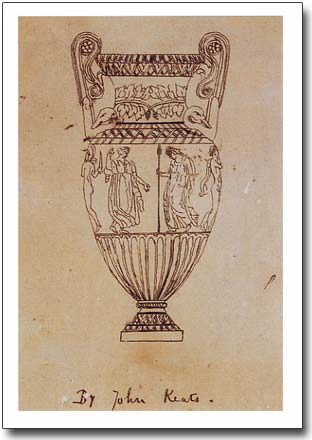
Sosobios_Vase

Long before the Internet, before we could even create reproductions of art in books and on posters, ekphrastic poems offered art lovers a virtual museum, where they could “see” art from the comfort of their own armchairs. In the Italian Renaissance, Ekphrasis became popular again, and in 1819, John Keats wrote one of the most famous ekphrastic poems in history, “Ode on a Grecian Urn,” which you can find here, at The Poetry Foundation website.


http://www.keats-shelley-house.org/en/shop/postcards

In more recent times, W. H. Auden described Bruegel’s painting, Landscape with the Fall of Icarus in this ekphrastic poem:

Musee des Beaux Art
W. H. Auden

About suffering they were never wrong,
The old Masters: how well they understood
Its human position: how it takes place
While someone else is eating or opening a window or just walking dully along;
How, when the aged are reverently, passionately waiting
For the miraculous birth, there always must be
Children who did not specially want it to happen, skating
On a pond at the edge of the wood:
They never forgot
That even the dreadful martyrdom must run its course
Anyhow in a corner, some untidy spot
Where the dogs go on with their doggy life and the torturer’s horse
Scratches its innocent behind on a tree.

In Breughel’s Icarus, for instance: how everything turns away
Quite leisurely from the disaster; the ploughman may
Have heard the splash, the forsaken cry,
But for him it was not an important failure; the sun shone
As it had to on the white legs disappearing into the green
Water, and the expensive delicate ship that must have seen
Something amazing, a boy falling out of the sky,
Had somewhere to get to and sailed calmly on.

http://english.emory.edu/classes/paintings&poems/auden.html

icarus

In 1960, William Carlos Williams had his own take on the same painting:

Landscape with the Fall of Icarus

William Carlos Williams

According to Brueghel
when Icarus fell
it was spring

a farmer was ploughing
his field

the whole pageantry

of the year was
awake tingling
with itself

sweating in the sun
that melted
the wings’ wax

unsignificantly
off the coast
there was

a splash quite unnoticed
this was
Icarus drowning

from http://english.emory.edu/classes/paintings&poems/williams.html

You can discover links to more ekphrastic poems here and here.

I hope you’ll join us for one or all of the Art and Poetry Treasure Hunts, where you’ll be inspired by local art to write your own ekphrastic poems. Whether you’ve been writing poems all your life, or your poetry career came to an abrupt halt at “Roses are red,” we’d love to have you. Bring your family. All ages are welcome.

About our laureates

  • Past Laureates

Join Us on Facebook

Join Us on Facebook

Enter your email address to subscribe to this blog and receive notifications of new posts by email.

Join 174 other subscribers

Piedmont Laureate Sponsors

Raleigh Artsuac-logo

Search

Website Powered by WordPress.com.

  • Subscribe Subscribed
    • Piedmont Laureate
    • Join 174 other subscribers
    • Already have a WordPress.com account? Log in now.
    • Piedmont Laureate
    • Subscribe Subscribed
    • Sign up
    • Log in
    • Report this content
    • View site in Reader
    • Manage subscriptions
    • Collapse this bar
 

Loading Comments...