

All right, fearless readers and writers. We’ve now explored sound and meter in poetry, so we’re ready to put them together to start creating formal poems. If you create something you really like, please share it with the rest of us. We’d love to see what you’re writing.
With every kind of formal poetry, you can follow the rules precisely and create strictly formal poems, or you can relax a little, put on those jeans with the holes in the knees, and create a looser version. Either way, it’s not about proving how good a rule-follower you are. It’s about using these forms and techniques to write the poems that matter to you and your readers.
Let’s start with that classic: sonnets. If it’s good enough for Shakespeare, it’s good enough for us. And besides, it’s only fourteen lines long.
There are two types of sonnets, each with two names, the Elizabethan/Shakespearean sonnet and the Italian/Petrarchan sonnet. English is, unfortunately, a very rhyme-impoverished language, particularly as opposed to Italian, so the Italian sonnet has a lot more words that rhyme with each other. We’re going to go for the Elizabethan version, since if you’re reading this, I’m guessing your command of English is fairly strong.
All sonnets are written in iambic pentameter: ten syllables that alternate light and heavy stresses like this: ta-TUM-ta-TUM-ta-TUM-ta-TUM-ta-TUM. If you want to know what this feels like, try limping around the room, coming down heavily every second step.
An Elizabethan/Shakespearean sonnet has three quatrains (four-line stanzas) often without a break in between, with alternating rhyme, followed by a rhyming couplet (two-line stanza). So the rhyme scheme for this sonnet looks like this:
a
b
a
b
c
d
c
d
e
f
e
f
g
g
To learn more about rhyme, go to Playing with Sound in Poetry, Part 1. To learn more about rhythm, go to Playing with Sound in Poetry, Part 2.
Here’s one of my favorite Elizabethan/Shakespearean sonnets:
If I Should Learn
by Edna St. Vincent Millay
If I should learn, in some quite casual way,
That you were gone, not to return again –
Read from the back-page of a paper, say,
Held by a neighbor in a subway train,
How at the corner of this avenue
And such a street (so are the papers filled)
A hurrying man, who happened to be you,
At noon today had happened to be killed –
I should not cry aloud – I could not cry
Aloud, or wring my hands in such a place –
I should but watch the station lights rush by
With a more careful interest on my face;
Or raise my eyes and read with greater care
Where to store furs and how to treat the hair.
Try reading it while you limp around the room.* Maybe do it several times to get the rhythm in your body. Now try writing one, just as an experiment. About anything. I wrote one about yeast once and another about apnea, so you can see the world of sonnet subjects is vast.
Remember, you can follow the rules strictly, or play with the form. If you’re just starting out, I recommend aiming for about 10 syllables per line (allowing yourself to have 9 or 11, as needed), in 14 lines, rhyming ababcdcdefefgg as above, and giving yourself the freedom to use as many slant rhymes as you want. The form is not nearly as important as taking the chance to play with different techniques, so you’ll have new ways to write the poems you want to write.
*If you want a real treat, go here to hear a Youtube version of Edna reading another of her famous poems, “Recuerdo.” I can’t get enough of her voice!



 Over the years, our teachers have learned to make their own shadow puppets to bring fables, myths and fairy tales to life. They’ve danced the water cycle, the rock cycle, pressure systems and punctuation. They’ve acted out civil rights, become immigrants to America in 1901, and written letters overseas from the home front in World War II. They’ve ventured on treasure hunts into the world of Multiple Intelligences and made colorful three-dimensional maps of their brains. They’ve built bugs from plastic bottles, created Claymation ecosystems, and extracted poetry from scientific concepts. They’ve written their own blues and released the composers trapped inside themselves—even those who didn’t believe they could carry a tune in a bucket. They’ve explored Cuba, Ghana and Zimbabwe through music, and Appalachia through photography and poetry. They’ve written and performed a 1920s musical in the North Carolina Museum of History in a mere three hours and used their X-ray vision to conjure poetry and paintings from satellite maps of their favorite places.
 And everything they’ve done, they’ve brought back to their classrooms to make magic of the curriculum, to get their students excited about learning, and to remind themselves of why they became teachers in the first place.
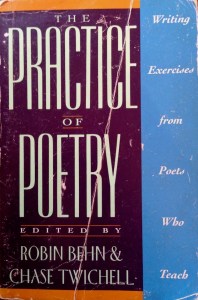 Now that all my books have come home to roost again, and are happily nesting with their families, I thought I’d share a few of my favorites with you.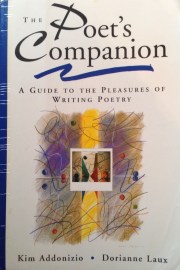
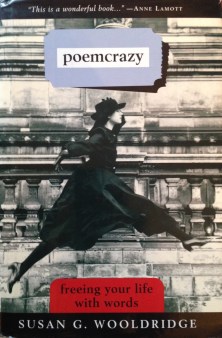
 Lest you think I only like the girls, I recommend Ted Kooser’s The Poetry Home Repair Manual. Most of the time when I’m not writing or teaching poetry, I’m building cabinets, replacing toilets, finishing floors or sweating copper. So you can see how a home repair book about poetry might appeal to me.
 If you write poetry with kids, as a teacher or as a parent, or if you’re a kid yourself, you’ve got to have the classic, Kenneth Koch’s Wishes, Lies and Dreams. Add to that Beyond Words, by my Lesley University colleague Elizabeth McKim and her friend Judith W. Steinbergh. Another book to add to that collection is Michael A. Carey’s Starting from Scratch, which was my guidebook all those years ago when I started out as a writer-in-the schools. It’s out of print, so it’s a little tricky to find, but worth buying if you can uncover a used copy.
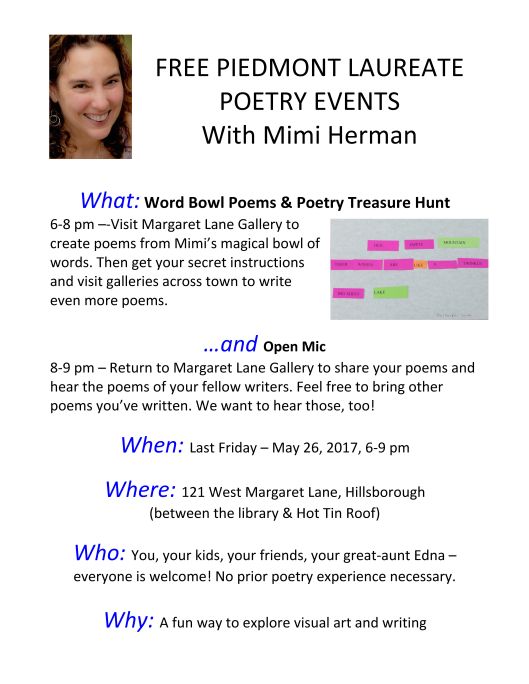 Stay tuned for more book recommendations in another blog post. I’ve got a whole collection of collections—and really readable prose that talks about the importance of poetry—that I can’t wait to share with you.
 Piedmont Laureate