Piedmont Laureate Talks: Petrow Spoke At Flyleaf Books About The Joy You Make During Publication Week

Tags

, , , , ,

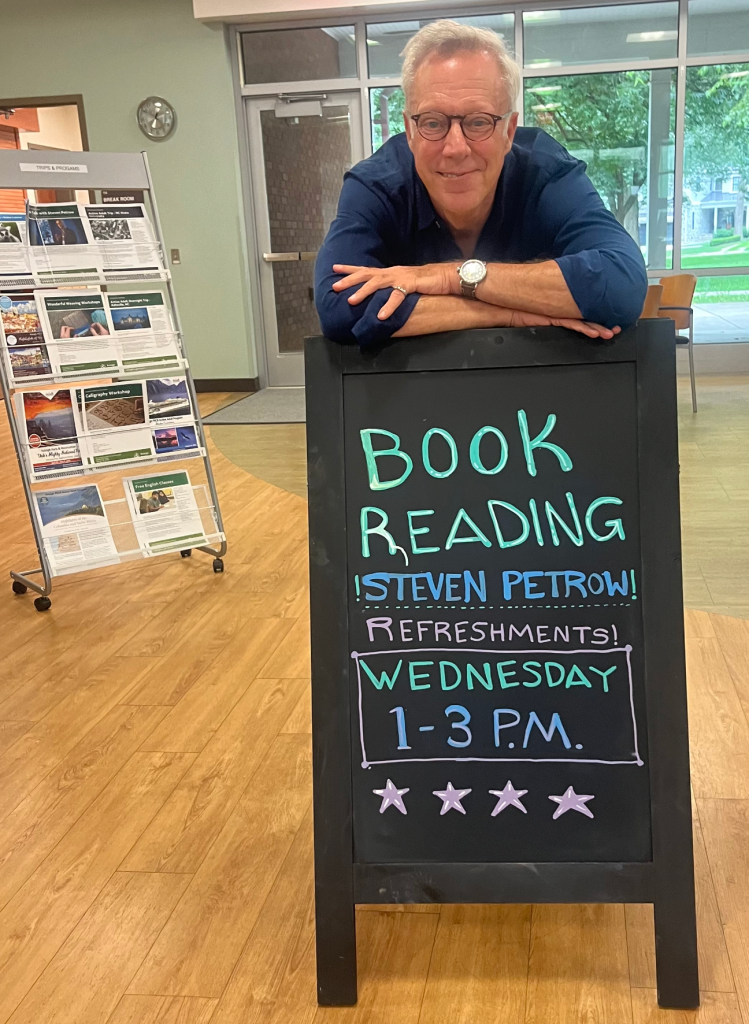
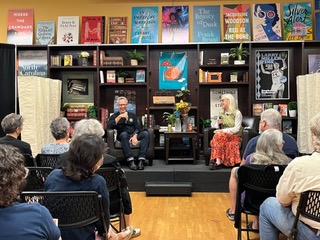
Two days after the book’s publication date last week, I had the official kick-off for The Joy You Make, at Flyleaf Books in Chapel Hill. This is now my third launch at Flyleaf—and it’s always so fun to be with the hometown crowd, as well as to support another independent bookstore. 

Bridget Booker, a neighbor, a writer, and a long-time friend, was my conversation partner and we really got into the ways that all of us can cultivate more joy in our lives. As I said to the standing room only audience, this book is a roadmap to finding more joy in your life—in nature, our memories, by re-creating recipes we cherish, by being in the presence of others, by doing nothing, and by taking up a game or two again (not to win, but to be with others). 

I also like that on my media tour I get to talk about what it means to be Piedmont Laureate. For now, I’ll just say this: It is so gratifying!

Click here to buy The Joy You Make.

Piedmont Laureate Banned Books Week Panel Coming on Sept. 24. At So & So Books in Raleigh

Tags

, , ,

The last week of every September is officially Banned Books Week throughout the U.S., thanks to the American Library Association. In this panel discussion to be held at So and So Books, 2024 N.C. Piedmont Laureate Steven Petrow will lead a discussion about the threat books bans pose to freedom and democracy and more granularly to young people, LGBTQ+ individuals, librarians, and other marginalized people. Our focus is on the right to choose and the right to read.

Where: So and So Books ,719 N. Person Street, Raleigh, N.C.

When:   September 24, 2024 at 6:30 pm

Participants:

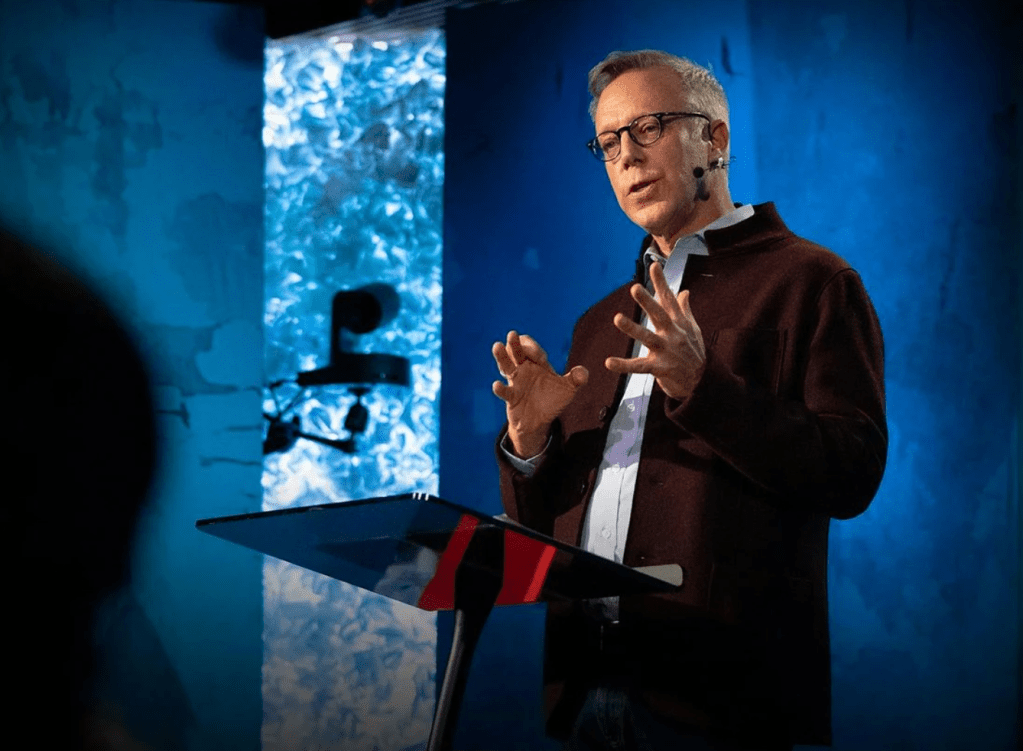
Steven Petrow (moderator) is the 2024 N.C. Piedmont Laureate, a columnist for The Washington Post, and the author of the just published book, The Joy You Make. His TED Talk, “3 Ways to Practice Civility,” has been viewed nearly 2 million times.

Belle Boggs is the author of The Gulf: A NovelThe Art of Waiting; and Mattaponi Queen: StoriesThe Art of Waiting. She is an associate professor of English at North Carolina State University, where she also directs the MFA program in creative writing.

Jaki Shelton Green, ninth Poet Laureate of North Carolina is the first African American and third woman to be appointed as the North Carolina Poet Laureate.

Ed Southern has been the executive director of the North Carolina Writers’ Network, one of the largest writers’ organizations of its kind in the country, since 2008 In 2015 he won the Fortner Award for service to the literary arts in North Carolina.

Scott Summers is a librarian and educator serving as the Assistant Director of the Media and Education Technology Resource Center in the College of Education at NC State University. He was recognized as one of the “people shaping the future of libraries” as a 2024 Library Journal Mover and Shaker.

Worth Parker is a retired United States Marine turned writer. He lives in Wilmington, NC with his wife and daughter. He Has written for The New York Times, Garden and Gun Magazine, The Bitter Southerner, among other publications.

The Piedmont Laureate program is co-sponsored by the City of Raleigh Arts Commission, Durham Arts Council, Orange County Arts Commission, and United Arts Council of Raleigh & Wake County. Its primary goal is to promote awareness and heighten appreciation for excellence in the literary arts in the Piedmont region of North Carolina. The program is dedicated to building a literary bridge for residents to come together and celebrate the art of writing, enriching the lives of all our citizens.

The Piedmont Laureate Talks: With Frances Mayes About Her New Novel, A Marriage Secret, And Why You Must Not Wear White After Labor Day

Tags

, , , ,

If you know the novel, Under the Tuscan Sun, you likely know of its author, the inimitable Frances Mayes. The Georgia native, who now divides her time between a home in Italy and another in Durham, has also written other international bestseller, including Bella Tuscany and A Year in the World, not to mention three beautiful illustrated cookbooks. Having dined at her table, I can attest that her creativity with language extends to her artistry in the kitchen. From her kitchen table in Bramasole, where Mayes spent most of the summer with her husband Ed Mayes, she answered a handful of questions about her life as a writer, her new novel, A Great Marriage, and what inspires her. 

Q; Your most recent book, just published, is titled A Great Marriage (and it’s received outstanding reviews). What was the genesis of this novel? 

A: The opening line of the novel, “The wine spilled” came to me on its own volition and fortunately it carried me throughout the novel. I consider this my version of inspiration—when, unbidden, an image or a face or a line lands in your mind like the spore in the petri dish. These gifts are what writers live for, no?

Q: What would you say are the elements of a great marriage? I ask that knowing that both you and I have been divorced and that from every angle it appears you’re now in one great marriage to Ed Mayes. Do people ask you if there’s an autobiographical aspect to this novel (which is, of course, fiction)?

A: Fragments and collages of autobiography make up a lot of this novel. There’s my marriage secret, hard earned, in the plot of the novel, but I will say my idea of a great marriage is not based on compromise, as many therapists insist. There’s a sublime way, if you’re aware enough.

Q: Do you think you have another side career in you (in addition to Bramasole olive oil), perhaps as a wedding planner or etiquette advisor?

A: No, but yes to garden design, setting beautiful tables, renovating old houses, planning travel tours. Being from the deep South, you can be sure I have my ideas on etiquette. My mother’s phrases still ring in my ears: no white shoes after September, tattoos are tacky, let your date win the tennis match… I confess, I don’t really like to go to weddings!

Q: I think  your last book was A Place in The World: Finding the Meaning of Home. I know you split your time between Italy and North Carolina, rather different places. Where do you feel at home these days?

A: This year I traveled around the world and found so many new places to love, places I could live. But my long-loved home in Italy feels like home. And it’s odd to feel at home in a country that is not your own. 

Q: What’s next on your desk? Do you have a roadmap of next works already laid out?
A: I wish. I have no idea—just waiting for that furtive little phrase to float by my window. I admire those who are super organized in their writing process. Mine is erratic and uncharted. But over the years you learn to trust your rhythms. I do get a lot done.
A Piedmont Laureate Event: A recap of my book talk at Five Points Center for Active Adults

Tags

, , , , , ,

I had such a good time last week at Five Points Center for Active Adults. Not only did we have a great turnout—see the photo below—but I loved this queer audience of seniors who had great questions and dilemmas coming from their own life experiences (especially this one: “I’m 82, do I really have to tell people my age?”)

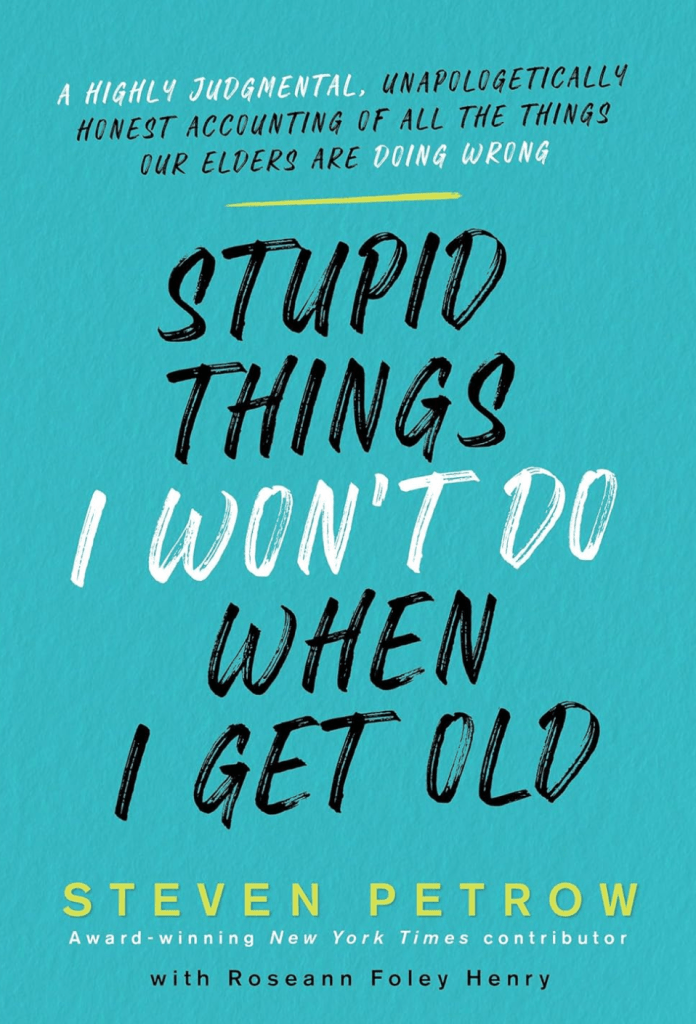
I’d been invited to talk about my most recent book, Stupid Things I Won’t Do When I Get Old, and to be honest it had been a minute. I felt like I visited an old friend (the book) and made new friends (those who came out the day before Tropical Storm Debby dumped a record amount of rain on The Triangle).

This event was co-sponsored by Five Points Active Adult Center, Raleigh Arts, and the Carolina Aging Alliance.

A Piedmont Laureate Event: Steven Petrow will be speaking about his bestselling book, “Stupid Things I Won’t Do When I Get Old,” in Raleigh on Weds., August 7

Tags

, , , ,

Join Steven Petrow, author and Washington Post columnist, when he discusses his book, Stupid Things I Won’t Do When I Get Old. Petrow began assembling a list of “things I won’t do when I get old” that formed the basis of his engaging collection of do\’s and don’ts. The book is equally humorous, honest, and practical and was chosen as a New York Times favorite. This event is co-sponsored by Five Points Active Adult Center, Raleigh Arts, and the Carolina Aging Alliance.

Event details:

Where: Five Points Center for Active Adults

2000 Noble Rd., Raleigh

When: Weds., August 7, 1-3 pm

Price: Free and open to all

Register for tickets on Eventbrite.

The Piedmont Laureate Is Reading: “The Fine Art of Literary Fist-Fighting,” by Lee Gutkind

Tags

, , , , ,

[This review by Lucas Mann is excerpted from The Washington Post. It especially caught my eye as I consider myself a “creative nonfiction writer,” not to mention that I’m the 2024 N.C. Piedmont in Creative Nonfiction. Read on!]

Joan Didion stands in San Francisco’s Golden Gate Park in April 1967 with a group of hippies, during her reporting for her article “Slouching Towards Bethlehem.” (Ted Streshinsky/Corbis/Getty Images)

In the first paragraph of “The Fine Art of Literary Fist-Fighting,” Lee Gutkind, the “Godfather” of the creative-nonfiction genre (a title used once to describe him in Vanity Fair in 1997 and since taken up repeatedly over the years, mostly by Gutkind himself, including in the bio on this book jacket), begins with a question he often receives: “‘What is creative nonfiction?’ Or, in some cases, ‘What the hell is creative nonfiction?’”

It’s a fitting sentiment for the genre, and for its longtime champion. This term, which others forgo in favor of “literary nonfiction” or “narrative nonfiction,” or simply “the essay,” as Gutkind writes, is a blanket that seeks to cover works from Joan Didion’s stylized journalistic chronicles of the ’60s to Mary Karr and the memoir boom of the ’90s to Annie Dillard’s nature writing, and everything in between that isn’t made up but also probably wouldn’t run in the newspaper. To practice or teach creative nonfiction (or whatever else you might want to call it) has been to operate from a defensive position. As Gutkind shows, this is a genre whose inception and growth were met with uncertainty, skepticism and in many cases disdain.

In trying to name, categorize, legitimize creative nonfiction, it’s hard not to feel that you’re being defined by what you are failing to do — it’s not creative in the eyes of fiction writers, or rigorously factual in the eyes of journalists, or properly literary in the eyes of academics. Here, Gutkind attempts to narrate the history of the genre, and that story is inevitably one of contestation and conflict — about what “creative nonfiction” even is, above all else, and just how “creative” writers can be before they’re no longer writing nonfiction. Those are familiar debates for some of us, and they haven’t stopped. I was in graduate school more than a decade ago, at one of the creative-nonfiction programs that Gutkind describes, and I was constantly getting into “Literary Fist-Fights,” though I imagine most of the people around me wanted to punch me for real.

To read more of this review, please click here.