
Tags
I like to think of poetry as a balance between sound and meaning, though not necessarily in exact measure. Think of a seesaw on a playground. A child and an adult can balance on a seesaw, even though they’re different sizes. So too, sound and meaning can wiggle around to find the best positions to balance each other in a poem.
You probably have a pretty good idea of the meaning in your poems: the things you want to say, which you hope your reader will understand. But since formal poetry has become somewhat unfashionable, we don’t talk about sound as much as we used to. Poems are often ideas or feelings spilled out on the page and chopped into line breaks at the places where we would naturally pause for breath. These can be wonderful poems, but you may also want to play with using the sound of language to amplify meaning in your poetry or cause tension between meaning and the sound.
This brief series will give you some tools you may want to use in your poetry. In this post, we’ll listen to the sounds of words. My next post will delve into line breaks, meter and rhythm.
So find a pack of Q-tips, clean the wax out of your ears, and let’s begin.
Rhyme: words with the same ending sound.
We all know about rhyme, of course: cat/hat/bat/rat. When I’m teaching beginning poetry to kids – or even to adults – I often tell them they’re not allowed to rhyme. After the moans and groans (How can it possibly be poetry if it doesn’t rhyme?), I ask if they’ve ever written a poem where had to force the meaning to fit the rhyme. Most of us have. But rhyme can be useful, whether you’re writing formal verse, free verse or something in between. We’re generally think of rhyme as one thing, but it actually comes in a variety of flavors.
True Rhyme: words with exact same ending sounds
(Also known as Full Rhyme, Exact Rhyme or Perfect Rhyme)
Examples: cat/hat/bat/rat, pillow/willow, quotation/rotation/flotation
I tend to go through the alphabet, trying out various beginning letters until I find a rhyme I like, but a rhyming dictionary can also be helpful: http://www.rhymezone.com/
Identical Rime or Rime Riche: a word that rhymes with itself.
Examples: pale/pale, will/will
Slant Rhyme: words with similar ending sounds
(Also known as Near Rhyme, Half Rhyme or Off Rhyme)
Examples: odd/bad, pillow/follow, quotation/Canadian
Try this fun tool: http://www.rhymedesk.com/. Insert a word, and it will offer you perfect rhymes, near rhymes, synonyms, antonyms, definitions, a thesaurus and syllable count (which will prove useful later, when we play with meter and rhythm).
End Rhyme: rhyme that comes at the ends of lines in a poem.
Now that so many poets write in free verse, there’s a tendency to think of end rhyme as old-fashioned and sing-songy. Still, I recommend trying it out, and working your way through a variety of rhymes until you find the ones that best express your meaning.
Internal Rhyme: rhyme that appears within a line.
More subtle than end rhyme, this can be a wonderful echoing note to weave into free verse.
Alliteration: same starting sounds.
Examples: wake/would/wiggle, cable/could/Kant
This doesn’t necessarily mean the same starting letters. Cat and children are not alliterative, though cat and kangaroo are. Alliteration can provide a powerful sense of purpose, or a pop of playfulness.
Consonance: the same consonant sounds, which may appear anywhere in the word
Examples: deck/kid/ache, wasp/slither/ask
Consonance is a subtle way of connecting words with one another. You can use consonance in consecutive words, or sprinkle it throughout the poem. It gives a poem a certain sense of coherence, though it can sometimes feel forced or overdone.
Assonance: the same vowel sounds (though not necessarily the same vowel), which may appear anywhere in a word
Examples: wonder/undo/comfortable, bake/able/okay
Assonance (a lovely, slightly naughty-sounding word to say aloud) is an even more subtle way of connecting words within a line or throughout a poem.
Onomatopoeia: words with sounds that are identical to their meaning
Examples: bang, pow, sizzle, slither
Very popular with the elementary school set, this tool can also be useful for adult poets and anyone who writes graphic novels.
Letter sounds: the sounds that individual letters make
We often talk about word choice. You can also experiment with going more granular, by paying attention to letter choice, to evoke different emotions.
If you hear a poem with a lot of “t,” “k,” and “p” sounds it’s unlikely to be a love poem, unless you’re writing about friction in love, or want to create a contrast between the sound and the meaning.
If you hear a poem with a high frequency of “l,” “m,” “w,” “n,” and “sh” sounds, it’s probably not going to concern itself with conflict, though it may have a certain passive aggressive tone. Again, you can play with reinforcing the meaning, or contrasting with it.
So now you have a “starter kit” for using sound in poetry. Try out these tools, play with them, revise old poems by paying attention to sound, or experiment in the next ones you write. And tune in two weeks from now – same blog time, same blog station – to explore line breaks, meter and rhythm in poetry.
Photograph from the New York Library Digital Collections
https://digitalcollections.nypl.org/items/8e928682-532a-9806-e040-e00a1806465d

 Over the years, our teachers have learned to make their own shadow puppets to bring fables, myths and fairy tales to life. They’ve danced the water cycle, the rock cycle, pressure systems and punctuation. They’ve acted out civil rights, become immigrants to America in 1901, and written letters overseas from the home front in World War II. They’ve ventured on treasure hunts into the world of Multiple Intelligences and made colorful three-dimensional maps of their brains. They’ve built bugs from plastic bottles, created Claymation ecosystems, and extracted poetry from scientific concepts. They’ve written their own blues and released the composers trapped inside themselves—even those who didn’t believe they could carry a tune in a bucket. They’ve explored Cuba, Ghana and Zimbabwe through music, and Appalachia through photography and poetry. They’ve written and performed a 1920s musical in the North Carolina Museum of History in a mere three hours and used their X-ray vision to conjure poetry and paintings from satellite maps of their favorite places.
 And everything they’ve done, they’ve brought back to their classrooms to make magic of the curriculum, to get their students excited about learning, and to remind themselves of why they became teachers in the first place.
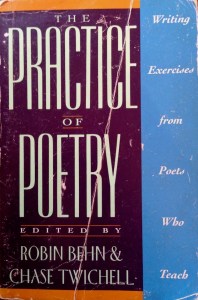 Now that all my books have come home to roost again, and are happily nesting with their families, I thought I’d share a few of my favorites with you.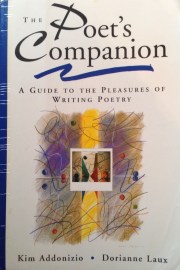
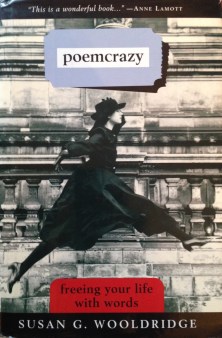
 Lest you think I only like the girls, I recommend Ted Kooser’s The Poetry Home Repair Manual. Most of the time when I’m not writing or teaching poetry, I’m building cabinets, replacing toilets, finishing floors or sweating copper. So you can see how a home repair book about poetry might appeal to me.
 If you write poetry with kids, as a teacher or as a parent, or if you’re a kid yourself, you’ve got to have the classic, Kenneth Koch’s Wishes, Lies and Dreams. Add to that Beyond Words, by my Lesley University colleague Elizabeth McKim and her friend Judith W. Steinbergh. Another book to add to that collection is Michael A. Carey’s Starting from Scratch, which was my guidebook all those years ago when I started out as a writer-in-the schools. It’s out of print, so it’s a little tricky to find, but worth buying if you can uncover a used copy.
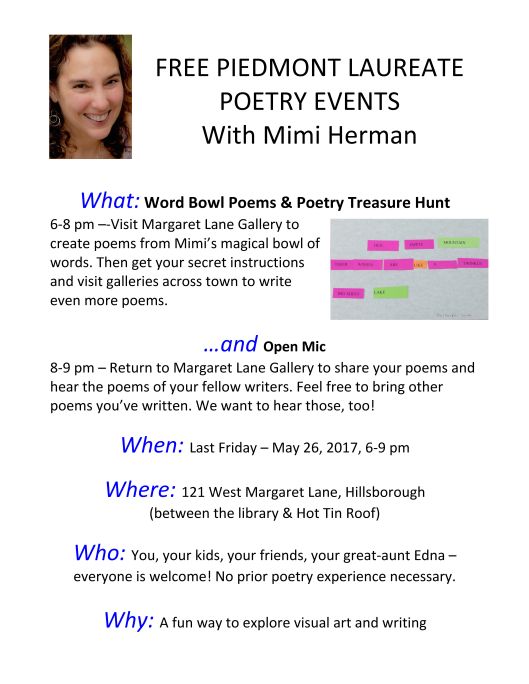 Stay tuned for more book recommendations in another blog post. I’ve got a whole collection of collections—and really readable prose that talks about the importance of poetry—that I can’t wait to share with you.

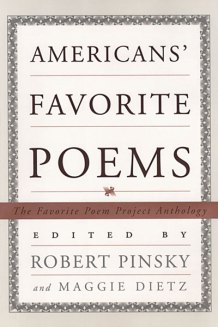 In 1997, Robert Pinsky, the 39th Poet Laureate of the United States, created the Favorite Poem Project, in which he asked Americans to share the poems they loved most, and to give a brief explanation of why they’d chosen their poems.
 Art by Damian Stamer
 Piedmont Laureate